We Did It!

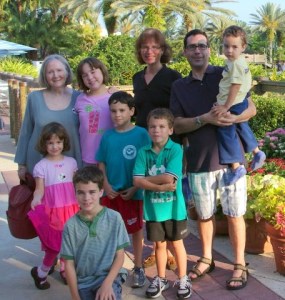
Cue the fireworks and strike up the band! As of this Wednesday, I reached my goal for the 2012 Jacksonville Walk for Autism Speaks. Or perhaps I should say that we reached our goal for the walk. Each and every one of you who donated helped get me closer to the $1500.00 mark—and closer to blue hair. Thank you all so very much!

I can’t tell you how moving it was each time I received notification that another one of you made a donation on our family’s behalf. When I began this thing back in March, I imagined I would see the numbers rack up over time with a dispassionate acknowledgement of my friends’ generosity.

Sure, I’d be grateful and all that. But I wasn’t expecting to be as affected as I turned out being. Each time another name was added to the list, I would think of that person and all that he or she has meant to me or Katie over the years. It would feel as if that person were right there with me, assuring me that we weren’t alone in this. And that has made a very big difference. Now, when I walk on September 29, I’ll be taking each of these people with me in my heart, thanking them for their concern and praying that God will shower them with his blessings.

A Few Moving Surprises.

Something else that surprised me was the great variety of people who donated. One pledge came in from a priest in Noblesville, Indiana whom I haven’t seen in decades. We knew each other when I was in College at Mount St. Mary’s and he was a seminarian there, but haven’t seen each other since our days at the Mount in the late 1970s and early 1980s. Another came from a co-worker at The Word Among Us whom I have met only once or twice, but who has never met Katie or my kids. Still, she wanted to help. And a third came from a cousin up in Pennsylvania whom I don’t think I’ve seen since I was in my twenties.

Of course, the people you would expect to give showed up—the family members and close friends who see you regularly. But to hear from people like those I mentioned above—that’s just amazing.

So now I’m off to get some blue dye and a puzzle-piece template. But I’m not done yet. There are still four weeks to go until the walk. There’s still time to give, if you’ve been putting it off. Don’t let the fact that I’ve reached my goal stop you. In fact, I’m thinking (not sure yet) of upping the ante and promising to dye my whole head blue if I get to $2,000.00. Now wouldn’t that be a hoot?

One Small Step.

It’s a great feeling to know I’ve reached my goal. But that’s just small potatoes. The medical and scientific community is still a long way off from reaching its goal. We still know so little about the causes of autism spectrum disorders. We still know so little about how to help those afflicted with ASD. And we surely have a verrrrry long way to go in raising awareness about this little-known but rapidly-growing disorder.

Too many kids are being bullied and written off in schools all around the country. Too many adults are unemployed or underemployed because people can’t see all they have to offer. Too many pediatricians don’t know ASD when it’s staring them right in the face. Too many parents are told there’s no hope . . . when there is tons of it.

So I reached my goal. So I’m going to walk. But that’s just one small step. The whole ASD community has a very long road to walk. I am so grateful to each of you who have made this one step possible. Still, I can’t help but keep appealing to everyone else to help us get a little bit farther. Just click on this link, and help us out. Thanks to all of you!
Why I Walk

As most of you know, my family and I will be participating in the 2012 Jacksonville Walk for Autism Speaks. Well, this week, I was contacted by the folks organizing the walk. They wanted to recognize me, I guess, because I had raised a certain amount of money. Anyway, as I was talking with the coordinator, she invited me to write a short piece for their online newsletter. The theme was “Why I Walk,” and I was to keep it to 350 words or less—quite a challenge for a wordy person like myself! But I did it, and here it is, with a few links added in:

Hi, there. My name is Leo Zanchettin, and I’ve got plenty of reasons to walk for autism. Actually, I’ve got four main reasons: our kids who are on the autism spectrum. I’ve also got two other reasons: our kids who are not on the spectrum.

That’s right. My wife (Katie) and I have six kids, and four of them are on the autism spectrum. We like to say that we put the fun in high-functioning! We have so much fun that I’ve set an ambitious goal for this year’s walk—and a wacky incentive to go along with it. I’ve promised my donors that if I can raise $1,500.00 or more, I will dye a huge, blue puzzle piece in my hair for the walk. Yes, I will “go blue” for autism research!

So why do I walk? First, because I don’t want any family to go through the heartbreak we went through when our oldest child was diagnosed at 11 years of age—or the heartbreak that he went through for so long before he was diagnosed. I walk because I want every pediatrician to become expert in early detection. I want every child on the spectrum to benefit from early intervention—the way my older ones did not but my younger ones have.

Second, I walk because I dream of a world where educators recognize and welcome students on the spectrum. Too many times have we heard teachers telling us that there’s nothing wrong with one or another of our kids—at least nothing that a little extra discipline won’t solve. I walk to help raise awareness. I want kids on the spectrum to receive every opportunity to grow to their fullest potential.

Finally, I walk because I want every family touched by ASD to have access to scientifically validated, clinically effective treatments that really will help them. We are just beginning to understand the causes of ASD. We are just beginning to figure out what works and what doesn’t. I walk because I want trusted experts to protect families against hope-stealing, wallet-draining “miracle cures.”

So that’s why I walk. My kids are my heroes, and I want to give them everything I can.

Yep, that’s what I’m walking. And that’s what you are helping to accomplish with your donations. I’m very close to my goal, too. Just $120.00 more, and I’ll go blue. So here’s your chance to push me over the edge. Go ahead and make a pledge. Come on. You know you want to!

Am I Out of Your Mind?

We were at Mass a couple of weeks ago when my six-year-old had one of his more dramatic melt downs. In a previous post, I dissected a melt down that my oldest daughter had at a local sub shop. There, I talked about how sensitive ASD folks can be to ordinary visual and auditory “noise.” It can cause such an assault on their senses that they lose control.

Well, church is another place where this can happen. You are surrounded by a ton of people intoning unfamiliar words. Choirs, often mediocre in quality, sing with great gusto in the belief that high volume equals deep sincerity. Women are more intensely perfumed than when they go to the grocery store . You also have statues, stained glass windows, and spot lights to contend with—not to mention the occasional use of incense. When you look at it from an ASD point of view, church can be a disaster waiting to happen.

From Pillar to Post.

I’ve been working with my boy the past few months, taking him to the more subdued Saturday vigil Mass—and only with his next-older brother, who has recently mastered the art of respectful silence. He was doing so well that I thought it was time for the whole family to try to go to the better attended, more formal Sunday morning Mass. Katie took three kids to one side of the church, and I took the other three to the opposite side. (Baby steps. We’re not ready to be all together yet.)

It wasn’t long before I discovered that we’ve still got some work to do. The kid could barely keep himself together. He kept trying to play raucously with his younger brother, and whenever I separated them, he would break into prolonged sobs and full-voiced promises to do better. After a bit of this, and seeing that I would not grant him access to his brother, he began climbing over me to get to the little guy—which prompted more hushed remonstrations by me, which prompted louder protestations from him. And on it went through the readings and homily.

By the time we got to the Creed, my half of the family was heading for the nearest exit—with the boy bewailing his fate the whole way. His older brother found the other half, and I sat outside the church with the other two, listening to the rest of the liturgy through the outdoor speakers. At least I knew when it was time to go back in for communion.

Mind Blindness.

Now much of this could be attributed to normal six-year-old rambunctiousness. But the most telling ASD sign was his lack of regard for the people around him. He had no concept that his antics or his complaints were disturbing anyone. He was unaware of the nonverbal cues given by the folks in the pew in front of us—cues that included one gentleman turning around and looking right at him with a bemused scowl on his face. Even when I pointed out to my boy that he was keeping other people from praying, it didn’t register. It was only when we got home, away from all the noise and distractions, that I was able to help him see where he had gone off the rails. And I know that this won’t be the only time he loses it. We’ve got a way to go—slow and steady—until he learns how to read a situation and act appropriately in it.

So how is this related to ASD? Because folks on the spectrum tend to have a deficit in what is known as “theory of mind.” It’s also called “mind blindness.” That’s psych-speak for the ability to recognize other people’s perspectives, beliefs, needs, and desires. People with ASD need extra help in understanding that other individuals have their own personality, think their own thoughts, and have their own preferences. What’s more, they don’t get that they themselves have a limited, subjective perspective. To a greater or lesser degree, the sum total of reality is limited to what they perceive or what they are aware of. This is especially the case when they are under stress or in a new, frightening environment. As their neurotypical peers would do in similar situations, they collapse in on themselves—only more dramatically. That’s where the term autism comes from: auto is the Greek root for “self.”

This mind blindness regularly gets a good portrayal in the television show Parenthood. One of the characters is a boy named Max, who has Asperger syndrome. In this clip, Max has a hard time navigating an ordinary history lesson. He doesn’t get that he has to show some deference to the girl in the desk next to him, and he isn’t clear on the respect due to his teacher. But as the clip shows, Max is not really being disrespectful. He’s being “a-respectful.” And that can be very maddening for the uninitiated.

The “Data Myth.”

Now all this makes a lot of sense, and it’s very helpful as I work with my kids. Very often, they’re not being bad, they’re just being aspie. And that gives me something to work with.

But a word of caution is needed here as well.

There are those who would equate mind blindness with a lack of empathy. Because ASD folks have a hard time reading other people’s faces, vocal tones, or body language, they must be incapable of making contact with them or having meaningful relationships. They’re like the android Data on Star Trek: The Next Generation. But mind blindness is not the same thing as lack of empathy. In fact, folks on the spectrum can be very loving and kind. They just don’t know how to show it. Or they show it in inappropriate ways. And that can lead to a kind of isolation in which the ASD person has few friends, if any. He wants to reach out, but he doesn’t know how. And he can have a hard time seeing when someone else is making a friendly overture to him, or he misinterprets it as something else. Then the social faux-pas happens, and he ends up alone again.

We’ve been through this with our older kids, and it can be heartbreaking. We try to help them understand what a potential friend was trying to say or do—but it’s usually wisdom given after the fact. And then it doesn’t help all that much, because ASD folks also have a hard time generalizing from a specific situation to a number of similar ones. It’s a horrible Catch-22 for them, but that’s where they are.

So we keep working with them. We especially keep working to make sure they know that they are loved and welcomed and accepted as the wonderful people they are. In this way, we are blessed to have a large family. Our kids have no choice but to figure out how to relate to other people. It’s the only way we’ll get anything done as a family! They’re getting some vital socialization right under their own roof, and we know that’s going to help them once they enter the world and try to make a way for themselves. In the mean time, they’ve got us. And they’ve got each other. And that’s just fine for now.

If It Ain’t Broke. . .

Recently, a co-worker made a comment that continues to reverberate in my brain.

We were talking about a passage from the Acts of the Apostles that described some of the miraculous healings that St. Paul performed during his ministry. As you might expect, our conversation included on the age-old question of why we don’t see so many of these healings today. Mind you, we have seen real healings in our lifetimes, but they just don’t seem as prevalent as what is described in the Book of Acts. It was in this context that this fellow said: “Just think: if St. Paul were here today, so many people would be healed. Who knows? Maybe even your kids would be normal.”

I had an internal hiccup, but instead of addressing it I gently shifted the conversation.

Normal—It’s such a loaded word. It implies that my kids are abnormal, that they’re defective or not good enough. Now I doubt that’s what this fellow really thinks about my children. He has a history of choosing the wrong word at the wrong time. But still, the comment made me think.

Healing? No, Thanks.

First, there’s the question of healing. I said in an earlier post that I don’t pray for their healing half as much as I pray for their success in the world. Frankly, I don’t know what healing would mean for them. Autism, Aspergers, PDD-NOS—they’re all so pervasive in their effects on a person that it’s hard to disentangle the ASD from the person. Some would even say it’s impossible. It’s who they are, to the core of their personalities.

I have a very hard time imagining any of my kids without autism. I can’t fathom what they would look like. It’s not the same as if a deaf person were suddenly able to hear, or if someone were suddenly cured of cancer or diabetes. I suspect that if my kids were somehow “healed,” they would end up being different people.

Different, Not Less.

That’s the thing about ASD. It carries with it some heart-rending social challenges. It frequently causes cognitive and learning glitches as well. The brain of an ASD individual is wired differently, and that’s going to cause some deviations from a neurotypical brain. But along with the challenges and deviations come strengths and bonuses: Amazing attention to detail; very strong memory; hyper-focus; even the occasional savant expertise in an area. Not for nothing are figures like Thomas Jefferson, Wolfgang Mozart, and even Bill Gates identified as being on the autism spectrum. Heck, even Dan Aykroyd has said that he has Asperger syndrome!

Mind you, I wouldn’t complain if my six-year-old suddenly lost his tendency to melt down at the first sign of a change in plans. And it would give me great joy to see my eleven-year-old freed from her perseverations. But autism isn’t melt downs and perseveration. It isn’t anxiety and narrow focus of interest. Those are all symptoms of a broader condition: a brain that processes sensory input in atypical ways. The melt downs, anxieties, and perseverations are all the results of the core otherness of an ASD brain.

They are the results, too, of feeling the pressure to conform to other people’s expectations. It’s bad enough that so much in the world seems stacked against them. Just imagine how stressful it is to be made acutely aware of how different you are by people who misjudge you. Now add that to the already strong social anxiety that is typical for someone with ASD. And add all that to the virtual assault on the senses that many ASD folks feel when they are in an environment that they can’t control.

What Do I Want?

Asking for my kids to be “healed” of their autism would be like asking God to unmake their entire brain structure and forge a new personality. Is that really what I want for my children? Isn’t that a way of rejecting who they are and wishing they were someone else?

No, a far better approach would be to teach my kids how to make their way in a neurotypical world. I don’t want to change who they are. I want what every other parent wants: for my kids to learn how to deal with their challenges so that their natural strengths and gifts can shine.

Do you know what else I want? I want a world in which my kids, and everyone on the autism spectrum, are welcomed, respected, and appreciated for who they are and for the gifts that they bring. I want a world that understands these folks and treats them with the dignity they deserve. I want a world where they get a fair chance to show what they’re made of and to make a difference for other people.

They’re not broken. So don’t try to fix them.

Practically Perfect in Every Way

Here’s a story about an autism-friendly staging of Broadway’s Mary Poppins. Anyone who knows me knows that I’m a huge fan of all things Disney (with the possible exception of their ‘tween stuff. Miley Cyrus? Really?). So it came as no surprise that the Disney company would cooperate so fully with the folks at the Theatre Development Fund. When they learned that TDF had bought out the house for the Sunday matinee, they were more than happy to make adaptations to the show so that audience members with autism would have as positive an experience as possible: No strobe lights? Check. Quiet down the sound of the tap-dancing? You got it. Give ample warning before loud noises or big surprises? No problem. The entire cast and crew added extra hours of rehearsal so they could get this one showing just right. I can’t tell you how good this makes me feel, even though we live 965 miles from the New Amsterdam Theatre.

Reading this piece reminded me of the “fun” we had when our oldest was a baby. The pastor of our church would often tell a joke or have a dry, witty remark at the opening of Mass–something to engage the congregation and loosen them up a bit. The problem was, our son was very sensitive to sudden noises, especially outbursts of laughter or applause. (He still is.) So every time the congregation would laugh or clap, he would let out a blood-curdling scream and  begin to cry as if in pain. Katie or I would have to take him out into the lobby until he calmed down. Then we’d bring him back in, just in time for the homily–which often involved audience participation. And then there were the announcements at the end, with the occasional shout-out to some super-involved parishioner or committee–followed by applause. So if all three events happened at the same Mass, our son ended up spending most of the time in the lobby, with Katie and me alternating as his chaperone.

All that was back when we had no clue that he was on the autism spectrum. Heck, we didn’t even know there was a spectrum! We thought he was just sensitive. (He was.) We thought he was just high strung. (He was.) We thought he’d grow out of it eventually. (He hasn’t–at least not completely.) We never thought it was because his brain was wired differently. We never saw it as a warning sign of other challenges and developmental delays down the road. It took many more years before we put the pieces together.

But now we know. Now we get why he reacted that way at Mass. We also get why it took him five days of a six-day beach vacation to muster the courage to crawl off the beach towel and onto the gritty sand. We get why he spent a whole spring and summer afraid to walk on the pointy grass blades of our front lawn. We get why the geckoes that loved to dash around our front porch in St. Augustine filled him with terror and kept him from going outside unless one of us carried him. All these sensory assaults were just too much.

So now we know. And that knowledge, while unsettling in some ways, is comforting in other ways. We have a label. We have an explanation. And that means we can learn how to help him. It means, also, that he doesn’t have to go through life afraid of all the things that used to startle him so deeply. Because he can name his challenges, he has a greater degree of control over them. He can learn how to adapt.

Now twelve years old, our son knows who he is, and that knowledge has a good side and a not-so-good side. On the not-so-good side, he is having to deal with a sense of otherness about himself. He knows that he’s got more challenges than most of his peers, and it can get him down. This is not uncommon for folks on the spectrum–the incidence of depression is much higher among them than in the general population.

But on the good side, he has developed a real compassion for other kids on the spectrum, especially those who are more profoundly affected than he is. He actively seeks them out at school and tries to befriend them. He is even looking into the possibility of volunteering as an after-school aid to work with these kids. He can also be very tender-hearted toward his brothers, who are more autistic than he is.

I’m proud of the way my boy has accepted his diagnosis. We’ve still got some work to do in the self-worth department, and there are still social and academic challenges he must overcome. But I love the way he’s looking outside of himself and trying to help other kids. Who knows? He may end up as a counselor or mentor. He may end up  bringing masterpieces like Mary Poppins to kids who aren’t fortunate enough to live in New York City. He may even end up developing entirely new autism-friendly experiences for the next generation–something that’s practically perfect in every way.