Sobering Stats and an Appeal

It’s been a while, so I thought I’d update everyone on the fundraising for my walk for autism research next month. First, I want to thank those of you who have generously pledged to support me and my family on this walk. It’s really touching to see how many of you have decided to help us reach our goal. It can be very easy for Katie and me, as we dive into the day-to-day challenges of helping our kids navigate their special challenges, to lose sight of all the wonderful people around us. But donations like yours remind us that we’re not alone in this. So again, thank you for your help!

I also wanted to let you all know that there’s still time to pledge for our family at the walk, which takes place on September 29. We are more than halfway toward our goal, but we still have a ways to go. Even if you give just a little, you’ll be getting us that much closer to our goal—and that much closer to forcing me to dye a puzzle piece in my hair!

Of course, the blue hair is just a gimmick. It’s just a fun way to throw down the gauntlet. The real issue is funding to support research into autism spectrum disorders—and the need for this research is great.

Did you know that autism is one of the least funded of childhood disorders, even though it is the fastest-growing? As an example, muscular dystrophy research receives about $162 million a year in private funding, while autism research receives only $79 million a year. But autism touches approximately 1 in 88 people, while muscular dystrophy touches only 1 in 100,000 people.

Similarly, pediatric AIDS, which receives approximately $395 million a year in private funding, affects 1 in 300 people.

What’s more, despite its growing prevalence and the huge burden it places on society (about $137 billion a year), autism research receives only 0.6% of the NIH annual budget.

Mind you, I don’t begrudge the muscular dystrophy or pediatric AIDS people a dime of the money they need. I’d like to see them receive more. But these statistics show how far we have to go in helping researchers understand this complex, mysterious thing called autism.

So if you want to help—or if you just want to make me look a little silly—click on this link and make a pledge.

Thanks, everyone! I really do appreciate your friendship and your support.

Scarborough Responds


Well, MSNBC has issued a statement from Joe Scarborough concerning his remarks yesterday linking the Aurora, Colorado, shooter to autism. Here’s what he said:

During a debate regarding the recent Colorado shootings, I suggested that the Aurora tragedy should make Americans focus more on mental health in this country. I also stated that my own experiences raising a son with Aspergers made me keenly aware of how important strong support systems are to those who might otherwise be isolated.

The growing Autism epidemic is a tremendous burden for children, parents and loved ones to endure. My call for increased funding and awareness for Autism and other mental health conditions was meant to support the efforts of those who work every day to improve the lives of Americans impacted. Those suggesting that I was linking all violent behavior to Autism missed my larger point and overlooked the fact that I have a wonderful, loving son with Aspergers. Perhaps I could have made my point more eloquently.

I look forward to continuing my work with wonderful organizations like Autism Speaks to provide badly needed support to millions of Americans who struggle with Autism every day.

Not the most convincing. And not really what the clip has him on record as having said. He does, however, concede a little bit of ground, admitting that “perhaps” he could have made his point more “eloquently.” Judging from the disconnect between the clip and his explanation of what he was trying to say, I don’t think eloquence is the problem. It’s more like he was lacking in clarity. I’m a fairly intelligent guy; I don’t think I’m so obtuse as to have missed his larger point. He just did a poor job of making it—if that is what he was trying to do.

Actually, if Scarborough had said what he claims to have meant, it would have been a pretty good thing. But I’m just having a hard time seeing it in that clip.

Others, in responding to the MSNBC/Scarborough statement, have latched on to words like “burden” and “epidemic,” but I don’t want to go there. Perhaps these are places where he could have been more eloquent or at least sensitive to families struggling with autism. But let’s face it. Autism is no picnic, and 1 in 88 sure sounds like an epidemic to me. Of course, I would never consider my children a burden, and the word “epidemic” makes ASD sound like the plague, but that’s a matter of semantics more than anything else.

I know that many organizations are still not satisfied, and some are continuing their call for a real apology. Me? I’m not holding my breath. Whatever damage has been done has already been done, and whatever reconciliation was going to occur has occurred. Instead of dwelling on this, I think I’ll just roll up my sleeves, get back to work, and keep enjoying my kids.

When Bloviators Bloviate

And I was having such a good day. I had learned that Ernie Els won the British Open, which prompted me to look more closely into his links with the autism community and to be really encouraged and inspired by his generosity. Plus, my little girl came home from a long weekend with her grandfather and seemed to have a very good time—just a couple of ASD flare-ups needing to be addressed. Plus, I was making good progress on a set od articles at work. Yes, things were going well.

But then I just had to do it. I just had to check in with Facebook one more time. And what did I find? Links to a video clip from MSNBC commentator Joe Scarborough this morning. He was discussing Friday night’s shooting in an Aurora, Colorado, movie theater, trying to find sense in the horrendous events. Then in the course of the conversation, Scarborough offers these words of deep wisdom and insight:

As soon as I heard about this shooting, I knew who it was. I knew it was a young, white male, probably from an affluent neighborhood, disconnected from society. It happens time and time again. Most of it has to do with mental health; you have these people that are somewhere, I believe, on the autism scale. I don’t know if that’s the case here, but it happens more often than not. People that can walk around in society, they can function on college campuses—they can even excel on college campuses—but are socially disconnected.

Then, as if to pour salt in the wound, Scarborough tells us that he has a son with Asperger syndrome. So I guess that means he’s qualified to make a long-distance provisional diagnosis of the shooter. And that he’s qualified to suggest that being on the autism spectrum makes you more likely to become a homicidal maniac.

What Was He Thinking?

Now it’s possible that Scarborough’s own journey with autism has been particularly challenging, and he is projecting his experience onto the whole autism community. I know of kids on the spectrum who seem to fit the kind of picture Scarborough painted—kids who stick to themselves, are socially awkward, and may be prone to violent melt downs.

But these people are far from the norm. And even those who tend to be more aggressive take out their aggression on themselves and their caregivers, not on perfect strangers. Not to mention that a melt down is pretty spontaneous. It’s not usually something four months in the making, involving elaborate booby traps and multiple purchases of ammunition on the Internet.

My real problem is that Scarborough stigmatized an entire population that is already suffering from a lot of misunderstanding and prejudice. As the father of a child on the autism spectrum, he should know better. As a professional journalist, he should know better. But he couldn’t resist the temptation to shoot off his mouth. By his unfettered logorrhea not only did he end up espousing an indefensible theory; he gave people another baseless reason to be afraid of people on the spectrum and to treat them as a separate class, “others” who are just weird enough to shoot up a whole movie theater.

No, They’re Not.

No, people on the autism spectrum are not more prone to violent crimes than the general population.

No, people on the autism spectrum are not sociopaths. There is no correlation between ASD and mass murder.

No, people on the autism spectrum are not retarded—even if some of them do suffer from mental retardation.

No, people on the autism spectrum are not automatons devoid of personal emotions and incapable of empathy—even if some struggle in expressing what is going on inside of them.

No, people on the autism spectrum are not just spoiled brats who need more parental discipline.

Send a Message.

So if this makes you uncomfortable in any way, follow this link. It will take you to an online petition asking that Scarborough retract his speculation and offer an apology to the autism community. He really does need to set the record straight, if only for the sake of his son.

Congrats, Ernie!

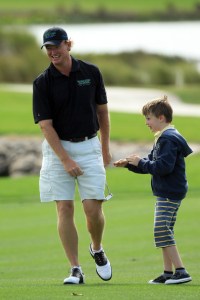
While the golfing world is filled with news of Ernie Els winning the British Open this weekend, I thought I’d repost a video he produced for Autism Speaks. In 2005, Els’ son, Ben, was diagnosed as being on the autism spectrum, and after he and his wife went through the shock and grief of the diagnosis–which he himself speaks of–he realized he was in a unique position to help. And so began the plans for the Els Center of Excellence in South Florida. “Autism hits families hard,” Els wrote, “and I’ll be fighting for the rest of my life to try and help others in the same situation.”

I find it comforting to know that people like Ernie Els are giving so much to the cause of autism research and therapy. Of course, he’s got skin in the game! But he doesn’t have to go to such lengths to found a $30-million state-of-the-art facility. He could just as easily write a huge check to Autism Speaks every year, and get on with his golf. And neither is he trying to use this project as a way to burnish his image or market himself, as others have done. He’s just trying to make a difference for people like Ben.

So join me in congratulating Ernie Els on winning the British Open–something he wasn’t expected to do. But let’s congratulate him also for his generosity and dedication to something bigger than his life, his career, and his image. And if you have a mind to help out, remember that my family is going to be walking for autism research in September. We’d really appreciate any donations you could make to help us hit our goal. We can’t give $6 million, like Ernie and Liezl Els did, but we can do something that still makes a difference!

Sad News for Researchers

Sorry it’s taken me so long to get around to this. It seems that about a month ago, a freezer at the Harvard Brain Tissue Research Center failed, resulting in the thawing of close to 150 brains that had been donated for research. Of those affected, more than 50 were dedicated to autism research. The Boston Globe has up the story, which you can read right here.

This is a significant setback for autism research, as the brains in this freezer made up a full one-third of the total brains in Autism Speaks’ Autism Tissue Program. Scientists estimate that it could take up to ten years to obtain that many brains from generous organ donors.

Harry Kimball, at Brainstorm, a blog hosted by the Child Mind Institute, found a silver lining in this tragic event:

“Now, this loss may turn out to be a real blow to the current state of autism research—but it also illustrates just how far we have come. Foul play or malfunctioning freezer units aside, this incident gives us insight into a coordinated research effort that teams a leading advocacy organization with a top-tier research university and federal funding. We see families affected by autism and other psychiatric and neurological disorders eager to turn their own personal tragedies into opportunities for others. It is sad that something went terribly wrong, but at least it happened in the context of things being done so right.”

I found another silver lining. This loss highlights the need to support autism research. Programs like the Autism Tissue Program, AGRE, and the Interactive Autism Network rely largely on private donations. NIH gives some money, but it doesn’t come close to covering the ambitious projects that these organizations are undertaking. I know I’ve got the Make Me Go Blue challenge on this blog, and it’s got a fun side to it. I’d get a real kick out of dyeing my hair blue, and I’m sure a lot of folks would get a good laugh out of the pictures. But this is serious stuff. Autism diagnoses are ballooning, and scientists are only chipping around the edges of what’s causing the epidemic. So please consider making a donation. It’s a long road toward understanding this vexing, pervasive disorder. But every step along the way gets us that much closer. Thanks.