Tag Archives: autism awareness
Shaken, Not Deterred

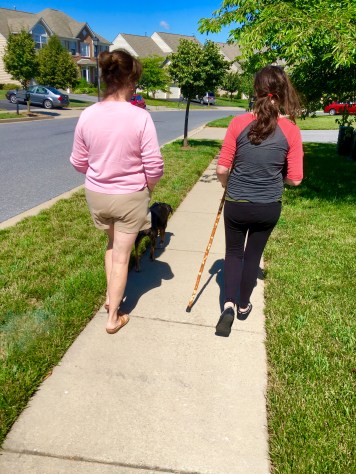
See that picture? That’s my wife and my daughter (15) taking a walk. Oh, and our dog, Roxie. Do you know why I’m posting this picture? Not because I love these two (which, of course, I do), but because of how proud I am of my little girl. The fact that she is out on a walk shows how courageous she is.
You see, about four weeks ago, my daughter had a seizure. It was her first. Not a little tremor—a grand mal. You know, the kind where you’ve fallen to the floor convulsing, with your eyes wide open but seeing nothing. The kind where you can’t remember anything about it. The kind where you wake up as the paramedics are gently placing you on a stretcher and wheeling you into an ambulance. Terrifying stuff.
Then, ten days later, she had another one. The first one was in our house, but this one was out in public, at a food court. Again, it was a grand mal, and it lasted longer than the first one. Fortunately, I was there with her, so I knew to roll her onto her side, cradle her head, and wait it out. Again, she woke up, disoriented, to emergency personnel hovering around her.
So what does this have to do with the picture up there? Everything.
Overcoming “What If.”
Events like these would be traumatic for any adolescent girl; they can be positively paralyzing for a girl with ASD and anxiety disorder. The randomness of the seizures, the lack of memory, the waking up surrounded by strangers—it’s all so upsetting. The largest question that looms in her mind now is “What if?” What if I have another one? What if Mom and Dad aren’t around? What if it happens in front of my friends?
She’s on anticonvulsants now, and she hasn’t had a seizure in two weeks, but that doesn’t matter. The anxiety is so big, and the autistic tendency to perseverate is so strong, that the mere possibility of another event has kept her pretty much homebound ever since. She even missed an appointment with her counselor, whom she really likes.
Now do you see why this picture is so precious to me? Katie and I have convinced her that she needs to start getting out. We’re starting slowly, having her join us as we walk the dog in the mornings. And she’s doing it! She’s walking, she’s talking about everyday stuff, and she’s not perseverating over the seizures.
(The walking stick? That’s because she has mild scoliosis, and it helps her posture.)
Different Drums.
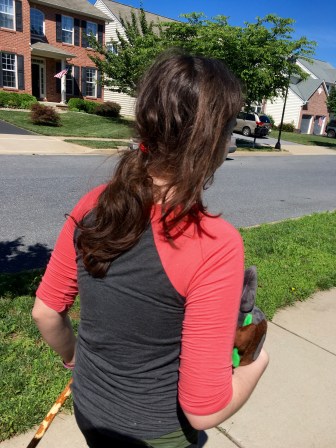
Now take a look at this picture.
Do you see that plush doll in the crook of her right arm? That’s Phantump, one of her favorite Pokémon characters. She is rarely separated from this creature, and when she is, she’s holding another one of the more than 100 she has collected over the years. They are her security blanket. They bring her comfort. They help her bridge the gap between the fantasy world she so enjoys and the real world, which is fraught with challenges and dangers.
So there’s my daughter, out in public with a walking stick and a plush Pokémon. While most girls her age are swooning over boys, preparing for their learner’s permit, and paying close attention to their appearance, here is my girl, walking to the beat of her own drum. She’s fighting her fears. She’s facing down her anxieties. She’s pushing through some things no fifteen-year-old should have to face. And she’s still standing.
There was a time when I’d object to the plush doll. “You’re a young woman now. For God’s sake, leave that thing behind!” There was a time when I’d try to force her to push through her fears more quickly than she was ready to do—usually to disastrous results. There was a time when I knew pretty much what I wanted her (and all my kids) to be, without paying too close attention to her unique personality. But if walking this autism path with my kids has taught me anything, it’s to throw away all of my expectations and to not care about how other people look at them. Those concerns were more about me than the kids, anyway.
So march on, girl! I don’t care if you need to take five Pokémon with you. I don’t care if you choose one of the most ornate, obvious, obnoxious walking sticks possible. Do whatever you need to do. Just keep moving forward. Today, it’s a walk with Mom, Dad, and Roxie. Next Sunday, it may be joining the whole family at Mass. Or maybe just part of Mass. Or maybe not yet. It doesn’t matter. Take it one step at a time, and we’ll be right there with you.
* These pictures, and this story, have been posted with the kind permission of my daughter (and, of course, my beautiful wife, Katie).
The Last Bottle
“Do you mind checking the dosage on this one? I think I put too many in the boy’s cup this morning, so I told him to take only one. I think we need to put the extra one back in the bottle”
So said my wife when I came down for breakfast, as she handed me a medicine cup.

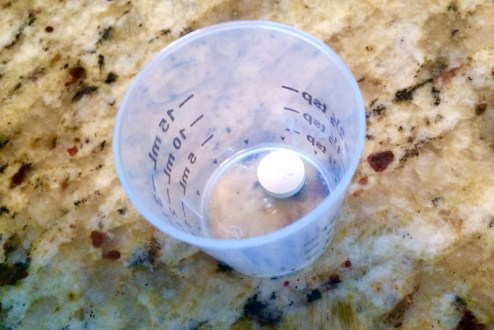
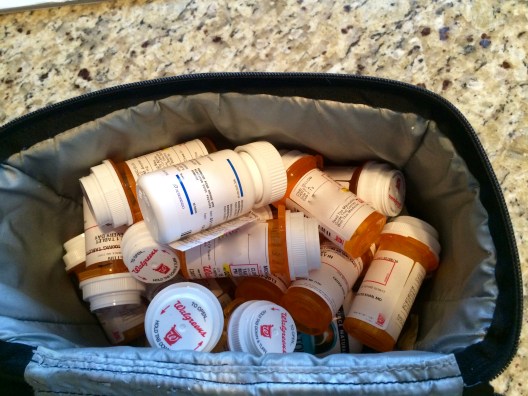
This is how we dole out the kids’ medication. Each kid gets his or her own cup with the proper medicines at the proper dosages. Normally, this is my job every morning and evening—a job that involves taking every pill bottle out of our “apothecary box,” reading each bottle to verify who gets what and how many of each, and placing the appropriate medicines in each kid’s cup. It also involves getting out the Gatorade for the one kid who can’t handle the taste of his medicine with water, and getting out the milk for the other kid who can’t handle Gatorade or water. In the morning it also involves bringing two of the boys their medicine in bed so that it can begin working in them before they join the rest of us. Depending on how awake I am, this can take between five and ten minutes.

Well, this morning I was late coming downstairs, so Katie took over the job. Only our doctor had just changed the dosage on one of the prescriptions, and she couldn’t remember what it had changed to. Hence the extra pill.
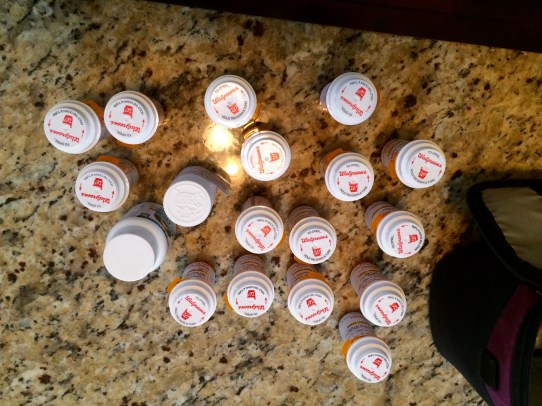
So I sat down at the table and began my usual ritual of sorting through the apothecary box to find the right bottle so I could put the extra pill away. A few minutes later, this is what the kitchen table looked like. (For those of you not patient enough—or not anal enough—to count, that’s eighteen bottles there.)

Why eighteen? Because, in keeping with the laws of the universe, it was the last bottle in the box. It’s always the last bottle in the box. Just once, I’d like it to be the first bottle. Or the fifth. Or the eleventh. Hell, I’d be happy if it was the seventeenth. But no, it’s always the eighteenth. <sigh>
The Story That Never Was

This is a story about a story that never became a story. Got that? A story. About a story. That never became a story.
A couple of weeks ago, I wrote a blog post about an incident that happened in our house over the holidays. But because it was a story about a couple of the older kids, I didn’t hit the Publish button right away. My older kids are on Facebook now. They have virtual friends. They’re connected to some of their cousins. And the story I was telling could be interpreted in more than one way. I saw it as an illustration of some of the challenges that teenagers on the spectrum face—along with a hopeful, encouraging conclusion about how my kids are working through these challenges. But other people might focus only on the challenges and the difficulties, and they might get the wrong impression about my kids.
See, I know a thing or two about ASD. I get it in ways that many other people don’t. Sure, my story might help people understand autism a little better, but at what cost? The way my kids’ friends perceive them? The way my kids perceive themselves? Was I putting them out there in the wrong way? It didn’t seem so to me, but I wasn’t sure.
So I did something I had been thinking of doing for a few months. I told them that I occasionally post stories about being an ASD dad on social media. Then I e-mailed my story to them and asked if they’d be okay with my posting it.
They were and they weren’t.
One of them had an easygoing response. “Whatever raises awareness, Dad, I’m okay with. I know you’d never make me look bad. I don’t even have to read your story. Go ahead and publish it if you think it will help.”
The other one was not okay. “I don’t want people to think I’m a nervous, insecure, insane, freak!” That’s all I needed.
And so the story never became a story.
Careful . . .
It seems we’ve entered a new era. When I started this blog back in 2012, it was easy to tell stories because the kids were young and unconnected. Now I have to be more selective. But that’s okay. I’m sure there will be plenty of stories to tell that don’t run the risk of putting them in a bad light. Stories like this one about my boy’s success at singing in the chorus. Or this one about my daughter correcting one of her teachers. Or this one about the Catholic psychologist who wrote some really messed-up stuff about ASD and who I convinced to issue an apology.
Part of me will miss telling some of the harder stories—not because I want to embarrass my kids, of course. I’ll miss it because there’s this perception about ASD out there that it mostly affects little kids, and that’s just not true. There are plenty of stories about young children, who are so damned cute and whose parents are just beginning to come to grips with a new diagnosis.
But there’s another whole population of ASD folks out there. They’re older, and it’s not so cute when they do some of the quirky things that autistic kids do. When someone is five, he’s precocious; when he’s 15, he’s rude. She’s given much more leeway when she’s three because she’s expected to “outgrow” her autism; when she’s doing the same thing at 13, she’s stubborn, willful, or disturbed. Of course, none of this is accurate, but it’s how they are perceived.
So I’ll be more careful. I’ll look for the stories that emphasize how awesome my kids are. Or how far the autism community has come in gaining acceptance—and how much further it has to go. Or how much Katie and I are learning and growing as we raise our kids. Or God knows what else. Because our kids are still autistic. They will be even when they become adults. And the world needs to see that this very broad autism spectrum runs not just from low- to high-functioning, but from infancy to old age as well.
Now, would you believe me if I told you that my story-not-a-story was the best thing I had ever written? No? Well, you’ll never know, will you?
Lots of Snowflakes

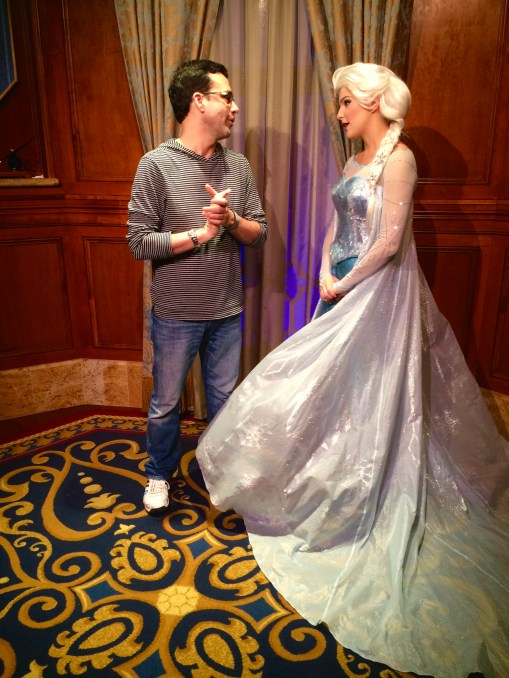
My next stop was the enchanting kingdom of Arendelle, where I visited Queen Elsa. Like the other people I spoke with, she was very happy to record a message to kids on the autism spectrum. She got it right away when I explained why I was asking her to do this. You see, Elsa has special, unique abilities that most people didn’t understand, and this made her feel like an outcast. She was even denounced as a “monster” by the Duke of Weselton. She hid away for years, staying in the shadows, because she was afraid of her powers, which she couldn’t control. She also stayed in hiding because of how guilty she felt for having accidentally hurt her sister, Anna.
As you can see, Elsa was living under a dark cloud of oppression—much of it undeserved. I told her that many kids on the autism spectrum can feel that way as well. They can stand out from the crowd. They can feel as if they are too different from the people around them. Even worse, those things that make them different can overwhelm them and make them say or do hurtful things. Like Elsa, they can be bound up in guilt and fear. Some even build a colorful, imaginative world of their own, a refuge from the world where they are free to be themselves. But like Elsa’s ice castle, this refuge can turn into a prison as they remain isolated from the people who love them.
Elsa thought that her castle would protect her. She thought that it would be the one place where she express everything unique and awesome about herself. But then the outside world came crashing in. She became a prisoner of people who didn’t understand, people who didn’t love, and that made her more miserable than before.
It took an act of true love to finally set Elsa free—her sister Anna’s complete acceptance of her and her willingness to sacrifice her own life to protect her. That was the key. Knowing how much she was loved helped her lose all the negative thoughts she had had about herself—all the fear and guilt and isolation that was swirling around inside of her.
The best part about Elsa’s story is that her freedom didn’t mean that she became “normal” like everyone else. She was still the same shy young woman with a unique talent. But because she was surrounded by love, she learned how to harness that talent and use it for good. She let go of the bad stuff and embraced the good. And because of that, she was no longer subject to her powers; now they were subject to her. In the end, Elsa was free to be the one-of-a-kind person she always was. And that’s what she wanted to share with everyone.