A Fortunate Slip of the Lip

Fourth Doctor Gobsmacked

Note: This post originally appeared as a guest post on the awesome “Confessions of an Asperger’s Mom page. Many thanks to Karen for inviting me to share my story with her readers. You should definitely check out her blog, as well as her Facebook page. She has a lot of wisdom to share.

I could have sworn he was downstairs. Really. I wouldn’t have said what I did if I knew he was in his bedroom—well within earshot. As Katie and I were going up the stairs this afternoon, I was recounting how this kid (#4, nine years old) had taken such good care of his younger brother (#6, six years old) at the neighborhood pool. If I had known he was in his bedroom, at the top of the stairs, changing out of his bathing suit, I would not have said, out loud:

“And [this kid], our autistic son, did really well today. So much for the old myth about empathy!”

“Dad? What does ‘autistic’ mean?”

My heart sank. It was probably the first time he ever heard himself described as autistic.

It’s not that I was hiding it from him. I had been wanting to tell him for some time now. I just didn’t know how to do it. And I didn’t want to manufacture some Hallmark moment where there would be this big reveal and a whole new understanding. I wanted it to be natural and, well, right. (Plus, I was also a little chicken.)

No Good Opportunity.

You see, he’s one of six, and they’re all autistic. His two older brothers and older sister already know about their diagnoses—and they found out more or less by accident as well. At least, it didn’t happen on my terms and in a way that I wanted it to. (Insert chicken squawks here.)

So autism is pretty much the lay of the land in our family, and that means he doesn’t really stick out at home enough to wonder why he’s different. All the kids present a pretty consistent profile of being on the higher-functioning end of the autism spectrum, so he’s got a built-in tribe of autistics to relate to.

He also manages to blend in pretty well with his peers at school—at least so far. He’s only in fourth grade, too which means that his classmates are too busy running around on the play ground to pay much attention to his quirks or language glitches. Plus, he works hard to try to fit in. It’s not perfect, and it can lead him to come home tired, moody, and explosive. But it works.

So there didn’t seem to be any need to explain autism to him. (Squawk!!)

Stumbling into The Talk.

Anyway, there I was, completely unprepared for the talk. But there was no getting around it; I had to answer his question.

I brought him into our room along with Katie, and asked him, “What did you hear me say?”

“You said I was autistic and I have empathy.”

“That’s right. Do you know what empathy means?” (I was stalling for time.)

“No.”

“It means that you care about how other people feel. It means that you can feel their feelings, and you want to help people who feel bad. That’s a really good thing, and I’m so glad you are like that.”

“Okay. What about autistic?”

I hesitated, not sure exactly what to say. Then Katie stepped in and saved me. “It means you think outside of the box.”

O merciful intervention! I knew that this kid thinks too literally to grasp metaphors like that. But that was a good thing; it gave me something concrete to react to. I didn’t have to come up with a complete explanation out of nowhere. The talk was happening all by itself.

Autism Is. . .

So I told him that “outside of the box” means that God made his brain a little different than most other kids’ brains. I talked about the cool gifts this brain gives him, like his laser focus on math and cooking and singing. He’s got some real talents there. Then I talked about challenges like how he can have a hard time putting words together or how he sometimes struggles understanding when someone’s talking to him. I hit on a couple of others, like emotional regulation and his need to jump around and get giddy sometimes. Then came the Big Finish.

“So there’s something a little different about you. That doesn’t make you weird. Just different. Autism isn’t a disease or a sickness. It just makes you special. Got it?”

“Yeah.”

“Any questions?”

“No. Can I go type on the computer now?”

“Sure thing. Knock yourself out.”

No Drama.

And that was that. No fuss. No drama. No nothing. None of the baggage that the world gives to the word autism. None of the baggage that I can give it, either. Just another word to help him describe himself.

In a way, I’m glad that it happened like this. I didn’t have time to worry about developing the perfect speech. I didn’t have the luxury of turning it into a thing, which might risk emphasizing the difference more than I wanted. I didn’t have enough of a chance to screw it up, either.

I also liked the way it became just another thing that happened today. Mind you, I’m not sure how much of it he really grasped. But I didn’t want to push. It doesn’t really matter anyway. We began a conversation today that will unfold and deepen over time.

No Big Deal.

So there you have it. My son found out that he is autistic, and he’s doing just fine. An inopportune-but-opportune moment presented itself, and we did our best with it.

It may not sound like the best approach, but there’s something really appealing and “normal” about things like this happening within the natural flow of everyday life. It helps the kids see that it’s not a big deal. It’s one facet of who they are, and it has no bearing on how much we love them or how much dignity or value they have—in our eyes or in God’s eyes.

That’s four down, two to go. I think I’m getting the hang of this thing. So bring it on!

No Rules, New Rules, One Rule

IMGP4810

So last night, the Fourth of July, held a minor victory as our oldest kid did pretty well facing his fear of fireworks. All the kids did pretty well, in fact, with each one showing a little more improvement in the sensory processing realm. Plus, they got to stay up later than usual. Mind you, we didn’t go anywhere for fireworks. We’re just talking about the small-time crackers and roman candles that some folks in the neighborhood set off. Still, progress is progress.

Anyway, this morning we ended up paying for the late night and the extra stimulation. As we were trying to get everyone ready for Mass, we were presented with two very strong tantrum-melt downs from two different kids, one stubbornly tired kid who could barely keep his eyes open, and another one exceedingly anxious about the her siblings’ potentially bad behavior in church.

We tried to roll with it. We really did. But after a while we realized that Mass just wasn’t going to work. It was too risky. So we played hooky. Sort of. Rather than go to our local church, which is only a half-mile away, we loaded everyone in the van and drove twenty miles to Mount St. Mary’s University–my alma mater of a Catholic college.

A Mini Pilgrimage.

The van is a safe zone. Each of them can enter their own world, whether by staring out the windows or by putting on their head phones and listening to music or by taking a quick nap. It’s one way to help them press the reset button, and that’s pretty much what happened. By the time we arrived, they were doing better. Not great, but better.

We spent about an hour there, walking the nearly empty campus and visiting the Grotto, which is a replica of the shrine to the Virgin Mary at Lourdes, France. We ended with a visit to the grotto chapel, where I had the kids sit as quietly as possible for as long as possible (5 minutes) and told them to try to pray. Then we read the Gospel reading they would have heard if they had gone to Mass, I said a few words about it, and we left. Nothing big. Nothing dramatic. And no other people around.

The kids did pretty well overall. We did have to deal with some sensory issues and low-level anxiety. And our toe-walker started to complain about pain in his legs from all the uphill walking. But I was glad that they got the message that Sunday is more than just another day. It’s still the Sabbath. It’s still the day that we honor God as a family. They saw that the alternative to missing Mass isn’t a free pass to video games.

A New Rule Book.

I don’t like skipping Mass. I really enjoy the closeness to God that I feel there. And for the most part, I can see how it helps the kids. But as far as I could see, there really wasn’t an alternative.

This is one thing that I’ve learned again and again as an autism parent: you have to learn to live by a different set of rules. It seems that everything we do—from church services to school, to recreation to family gatherings—we do differently. And there are times that we have to throw out even our modified rule book. But that’s okay. Because the only rule that really matters is this: Love and accept your kids where they’re at, and they’ll be more likely to follow where you want to lead them.

How I Learned to Love the Drugs

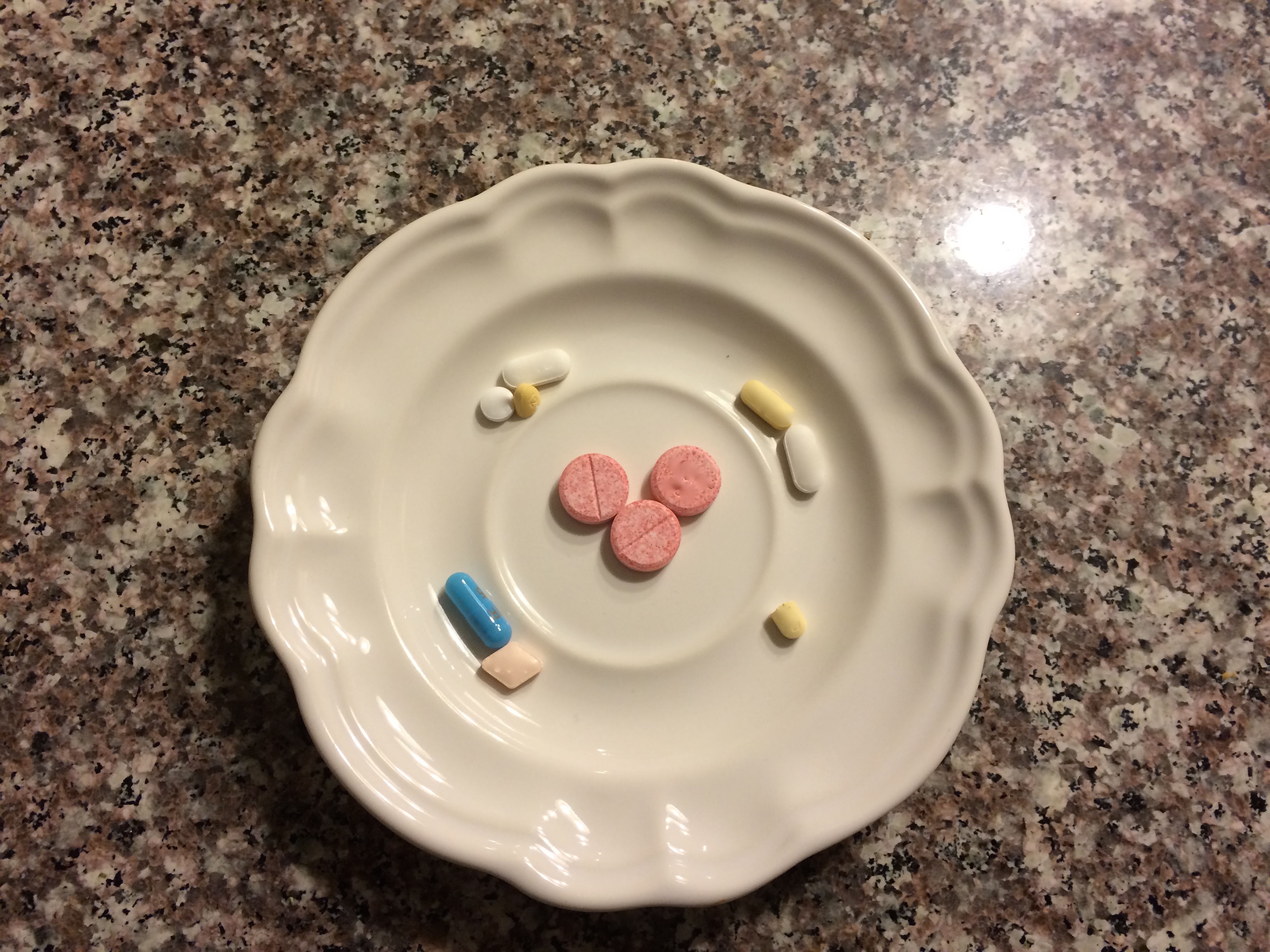
Kids' Meds

Here’s a snippet of a conversation I had yesterday evening with my little girl.

Her: Daddy, why does F take medicine?

Me: It helps him not feel so sad all the time.

Her: Okay, so why does L take medicine?

Me: It helps her focus in school and not be too worried.

Her: Well, what about C? What does his medicine do?

Me: It helps him keep calm in school and at home.

Her: And what about B? He takes medicine too.

Me: His medicine helps him not get too angry.

Her: So when will I start taking medicine?

With an internal sigh, I brushed off her last question and changed the subject. I didn’t have the heart to tell her that we were going to start her on a drug trial in a couple of weeks—to help her deal with her anxiety. I figured she’d have plenty of time to think about it when the trial actually began. Nor did I tell her that her little brother was going to start his own trial around the same time. Again, the less said, the better.

So there it is. By the middle of May, all six of our children will be on some kind of psychotropic medication.

Surprised by Sympathy.

It’s interesting. I shared this little dialogue with a couple of autism parenting support groups I belong to on Facebook, and I was kind of surprised by some of the comments. Many posted the symbol for a virtual hug: (((you))), and a few said something like “It’s hard” or “So sad.” But my wife, Katie, had the best response: she laughed. It was, after all, a cute exchange, and it showed how innocent our girl is.

It never dawned on me that this conversation would elicit words of sympathy, but now that I see it through these commenters’ eyes, I think I get it. See, I’ve grown so used to our routine that it seems, well, routine to me. I don’t think of it as unusual, hard, or sad at all. In fact, it’s the thought of not medicating my children that fills me with fear and trembling—for my sake as much as for theirs!

An Evolution of Sorts.

It wasn’t always this way. Back in 2007, when our pediatrician first prescribed a medicated patch to help one of our girls with ADHD-like symptoms, I resisted mightily. I hated the idea of introducing mind-altering chemicals into her sweet little brain. It didn’t help that the doctor told us we’d likely need a prescription steroid to help control the skin irritation that often accompanied the patch. Great! A medicine to counteract the side effects of the original medicine. What could be better? Eventually, however, I gave in.

When the patch didn’t work, we began a three-year odyssey of various other trials (under the direction of two different pediatricians and two different psychiatrists) to help her not only with ADHD but her growing anxiety. One made her giddy and made her gain a lot of weight. Another gave her terrifying nightmares. A third got her so agitated that she ended up biting me on the shoulder in the middle of Mass one Sunday. There were other failures as well, but I can’t recall them now.

It wasn’t until we began working with our third psychiatrist that we found the right combination. Her anxiety diminished considerably. She lost the extra weight. Her grades began to soar. And her demeanor at home, while still needing some help, became much more manageable. The tide was turning, and I was happy—happy enough to let three of our other kids begin their own medicine trials. Thanks be to God, there was a lot less initial drama with them and generally positive results.

Six for Six.

So now our two youngest ones are on the verge of getting prescriptions. Their therapist tells us that she can do only so much with them as they are right now. The little guy is too hyperactive and the little girl is too nervous for any talk therapy to have a lasting effect. “If we can just take the edge off,” she told us, “we might be able to make some headway. But as it is, the cascade of emotions is too strong for them to work through.”

It was a bitter pill to swallow at first, this thought that all our kids need psychiatric medicines. Not only does it get expensive, but it emphasizes their otherness and the challenges they face. Still, it didn’t take me long to adjust. I’ve been down this road a few times already! Plus, the sheer everyday nature of the routine helps a lot. Maybe that’s why my little girl can be so nonchalant about it. She has seen her siblings take medicine twice a day for as long as she can remember. It’s just a part of who we are and how we live.

Embrace the Mess.

That’s probably the way it should be. For everyone. You work and work and work until you find what works for you. You let go of the “picture perfect” life you had envisioned for yourself and your family, and you embrace the beautiful, horrible, glorious, maddening, sanctifying mess that God has given you. And as you do, you find that he’s embracing you as well.

He’s probably laughing, too.

A Wibbly-Wobbly Ball of . . . Stuff

Wibbly-Wobbly Ball

Before we start, take a look at this very short clip from Doctor Who, in which The Doctor explains the true nature of time. Trust me, it does relate.

That was pretty good, wasn’t it? Now for the explanation.

In a recent blog post, ASD guru and Aspergers role model John Elder Robison tackled the use of terms high-functioning and low-functioning when it comes to describing people with autism. Here’s what he said:

Much has been written about calling people high functioning or low functioning. With all respect to you and your situation, I don’t do it anymore and I suggest you don’t either.

It’s not accurate, and it’s degrading. . . . Suggesting that “you’re a real high functioning autistic” feels to me a lot like “you talk pretty good for a retard.” People say the former to me all the time today, and they said the latter to me quite a bit 50 years ago. I didn’t like it then and I don’t like it now.

Robison then goes on to talk about how dividing people up based on their “functioning” status misses the point of how autism works:

We now know that our functional level changes with time and other factors. As bright and capable as someone like me can seem, I can have meltdowns during which I become essentially nonfunctional and have no more usable intellectual capability that someone with an IQ of 70. It’s true that is not a lasting condition for me, but it happens, and when it does I would just as soon not be stigmatized for it.

As I said in my last post, my kids are showing me that autism can shift and swirl over time. Not for nothing is it called a developmental difference. It’s a matter of how and when a person develops social, cognitive, and communication skills. Some people develop more slowly or more unevenly than others. Some have persistent, nagging glitches in their development that affect them throughout their lives, while others overcome some challenges as they mature—only to find new challenges crop up. For many, it’s a mixture of both permanent and emerging attributes. So it’s awfully simplistic to reduce such a complex thing as autism to a question of high or low functional skills.

Forget the Spectrum.

But I want to go one step further. I want to suggest that along with abandoning the high- versus low-functioning distinction, we should scrap the image of a spectrum altogether. When we use this term, we evoke a kind of linear gradation, with some people lower down, or farther back, on the scale than others. But one problem with this approach is that people are assigned their place on that spectrum according to different criteria. Is it IQ? Is it verbal communication? Is it eye contact? Social skills?

Someone with limited verbal skills may well have an off-the-chart IQ. Or someone who can appear gregarious and outgoing in public may be masking significant social struggles, only to melt down in private. Where would you place each of these people on the spectrum? How would you decide? And most important, what purpose does it serve?

The Autism Ball.

Rather than talking about a spectrum, I’d like to suggest we talk about a sphere—a big ball of wibbly-wobbly, autism . . . stuff. There’s no low or high end. There’s no up or down or forwards or backwards. You just happen to be somewhere on that sphere, and your fellow autistics are somewhere else on it. No one is farther along than anyone else. No one is of greater value than another because he or she is “higher functioning.”

This is why I like the Doctor Who clip. It paints the picture of time, or in this case autism, as something that isn’t static but full of life and energy. And that makes it unpredictable: wild and mysterious, wonderful and dangerous.

So let’s imagine a ball that contains all the possible symptoms and manifestations of autism, all wibbling-wobbling around. Things like hand flapping, mind blindness, rigid thinking, sensitivity to loud noises, toe-walking, perseveration, narrow focus of interest. Imagine that ball also containing the comorbid conditions connected to autism: OCD, depression, ADHD, ODD, etc. Finally, imagine that this ball contains the positive traits of autism: laser focus, attention to detail, unflinching objectivity, a quirky imagination, a strong sense of justice, and an innate innocence.

Now, imagine your own ASD profile as a line running through the ball in one end and out the other end. As that line travels through the ball, it intersects with the various ways your autism manifests itself—not all of the traits, just the ones particular to you. No two lines are in exactly the same place, and no line is in a better position than another. They’re just there, marking out their own individual quirks and challenges, strengths and gifts.

High? Or Low?

All of this theorizing has a point. In an earlier post, I described how misleading the term “mild autism” can be. I gave some examples from my own kids of how difficult things can be for them, even though they would be considered high-functioning. As Robison said, people with high-functioning autism still have autism, and it still affects them profoundly.

We recently went through a rough patch with one of our kids, in which we saw just how much he keeps things hidden inside of himself, especially his awareness of how different he is and how hard it is for him to feel like he fits in. But on the outside, he presents as a clever, quick-witted, amiable boy. So while he seems very high-functioning, a lot of “low-functioning” stuff is going on underneath the surface: depression that can keep him in bed for two days straight, lack of empathy, misunderstanding of other people’s emotions, learning glitches, and an inordinate need for physical stimulation. He can navigate the outside world, but only for a time. Then he shells up when he’s home or alone. Where would you place him on the spectrum? Is he low-functioning or high-functioning?

Then there’s another one of my boys. You need only five minutes with him to “see” the autism: his odd gait, his lack of eye contact, his unusual speech patterns, his stimming, and his tendency to disappear within himself for a time. But hidden behind all of these quirks and tics is a very intelligent, sensitive child with keen insights into his own behavior and the people around him. Where does he fit on the spectrum? In the higher-functioning part of the line? Or the lower? Why?

Get on the Ball!

Mind you, most of this is irrelevant to me. I just look at them as my kids, with all of their strengths and weaknesses, their beauty and awesomeness, and work with each of them based on who they are. But it does make a difference in the universe outside of our home. It makes a difference when I attend IEP meetings or when I have to explain some unusual behavior to a friend or neighbor. It also makes a huge difference in the way society treats people with autism. If you’re a Bill Gates kind of autistic, you are given as many opportunities as you want. But if you’re nonverbal or if you’ve got some other trait that people might call low-functioning, you’ve got fewer chances to show just how awesome you are and what you can accomplish. And that’s sad, because you risk accepting a bleaker narrative about yourself and your potential than if you were given the opportunity to shine.

If we can get away from defining people based on their so-called levels of functionality, we can get closer to seeing each person as a precious individual with his or her own unique set of talents. We will stop assigning each person a value based on what he or she “contributes” to society. Each person is a gift, and you don’t assign a value to a gift based on its usefulness. You treasure it for what it is: a token of love from the One who gave it to you.

So get off the line and get on the wibbly-wobbly ball!

Aspie on the Verge

So here I am, sitting in our local Music and Arts store, typing away on my iPad while my son spends the next thirty minutes in heaven. He knows we’re not going to buy him an electric guitar until he gets a lot better at his acoustic, but he still likes to come here to try out the electrics and to dream.

The thing is, by most calculations, he shouldn’t be here at all. He was rude to his mother. He was verbally abusive to his little brother and sister. And he hung up the phone on me this afternoon when I told him I didn’t want him playing a particularly violent online computer game. He didn’t come up from the basement for dinner, and he gave us some serious lip when we told him that he had to clear the table after he finally did eat.

So why am I giving in to his request? Why am I not withholding this highly desired activity as a consequence for his negative behavior?

Because the rudeness isn’t the whole story. In addition to being obstreperous, he was also jittery, depressed, and anxious. Even the dog, whom he always loves, gave him the heebie-jeebies. Just one whine from her, and he clenched his fists, hunched his shoulders, and covered his ears. “Roxie!” he barked back, “Stop it!” When his little sister turned on the TV just a little too loud, he jerked his head back, winced, and yelled at her. His eyes were red-rimmed and darted back and forth. His breathing was shallow. He paced back and forth around the kitchen, his muscles betraying the tension of a hunted animal waiting for the arrow to pierce him through. I knew that if I didn’t get him out of the house, he’d explode. And that’s never pretty.

I sometimes wonder if I’m just enabling his bad behavior when I do this. After all, it’s possible that he’s manipulating Katie and me. But this isn’t a nightly pattern. There are many evenings when he’s generally okay, evenings when he participates in dinner, does his chores without complaining, and shows at least a little bit of tolerance for his younger siblings. There are also plenty of times when he doesn’t get his way, whether he likes it or not. But still, every time this happens, I wonder if I’m being a bad parent.

I don’t know if I’ll ever get used to this. When your kid is on the autism spectrum, you have to be ready all the time for God only knows what. You never know what’s going to set him off. Maybe he had a tough day at school. Maybe one class was a little too rowdy, and it set him on edge. Maybe a classmate said something mean, and he kept it in, letting it fester, or maybe it was an innocent, joking comment that he misinterpreted. Maybe he was overly tired from staying up too late (which he does on occasion but rarely admits to). Maybe it was nothing special at all. Maybe the ordinary challenges of living in the world have finally gotten to him. Of course, we know some of the things that definitely will set him off, but there are so many unpredictables in everyday life that just about anything could trigger a melt down.

Fast Reset, Slow Reset.

By the time we were ready to go to the store, I was pretty much done. I had been home for a little more than an hour, but that was enough, after a long workday, to wear me thin. This kid’s aspie-on-the-verge shtick had drained me of what little reserves I had left. It was all I could do not to unload on him when he asked me to take him to the store. “Keep it together,” I told myself. “He didn’t mean half of what he said. Just give him this time to reset himself, and it’ll be okay.”

Sure enough, the reset began as soon as we got in the car. Away from the noise and triggers of the house, his mood shifted, and he became the chatty, relatively chipper kid he often is. I, on the other hand, was still rattled from trying to keep the peace at home. I never stop marveling at how quickly our kids can shed their symptoms, oblivious to the effects they had on the people around them. It’s just another example of the social challenges they face–not really “getting” the feelings of other people. So there he was, chatting up a storm, while I was trying mightily to cool down!

So now I’ve got a half-hour to regroup. That’s how much time I’ve given him at the store. I hope it’s enough. For both of us.