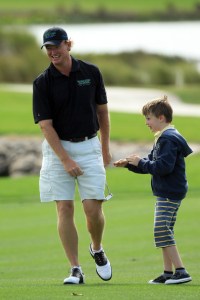
Congrats, Ernie!

While the golfing world is filled with news of Ernie Els winning the British Open this weekend, I thought I’d repost a video he produced for Autism Speaks. In 2005, Els’ son, Ben, was diagnosed as being on the autism spectrum, and after he and his wife went through the shock and grief of the diagnosis–which he himself speaks of–he realized he was in a unique position to help. And so began the plans for the Els Center of Excellence in South Florida. “Autism hits families hard,” Els wrote, “and I’ll be fighting for the rest of my life to try and help others in the same situation.”

I find it comforting to know that people like Ernie Els are giving so much to the cause of autism research and therapy. Of course, he’s got skin in the game! But he doesn’t have to go to such lengths to found a $30-million state-of-the-art facility. He could just as easily write a huge check to Autism Speaks every year, and get on with his golf. And neither is he trying to use this project as a way to burnish his image or market himself, as others have done. He’s just trying to make a difference for people like Ben.

So join me in congratulating Ernie Els on winning the British Open–something he wasn’t expected to do. But let’s congratulate him also for his generosity and dedication to something bigger than his life, his career, and his image. And if you have a mind to help out, remember that my family is going to be walking for autism research in September. We’d really appreciate any donations you could make to help us hit our goal. We can’t give $6 million, like Ernie and Liezl Els did, but we can do something that still makes a difference!

Sad News for Researchers

Sorry it’s taken me so long to get around to this. It seems that about a month ago, a freezer at the Harvard Brain Tissue Research Center failed, resulting in the thawing of close to 150 brains that had been donated for research. Of those affected, more than 50 were dedicated to autism research. The Boston Globe has up the story, which you can read right here.

This is a significant setback for autism research, as the brains in this freezer made up a full one-third of the total brains in Autism Speaks’ Autism Tissue Program. Scientists estimate that it could take up to ten years to obtain that many brains from generous organ donors.

Harry Kimball, at Brainstorm, a blog hosted by the Child Mind Institute, found a silver lining in this tragic event:

“Now, this loss may turn out to be a real blow to the current state of autism research—but it also illustrates just how far we have come. Foul play or malfunctioning freezer units aside, this incident gives us insight into a coordinated research effort that teams a leading advocacy organization with a top-tier research university and federal funding. We see families affected by autism and other psychiatric and neurological disorders eager to turn their own personal tragedies into opportunities for others. It is sad that something went terribly wrong, but at least it happened in the context of things being done so right.”

I found another silver lining. This loss highlights the need to support autism research. Programs like the Autism Tissue Program, AGRE, and the Interactive Autism Network rely largely on private donations. NIH gives some money, but it doesn’t come close to covering the ambitious projects that these organizations are undertaking. I know I’ve got the Make Me Go Blue challenge on this blog, and it’s got a fun side to it. I’d get a real kick out of dyeing my hair blue, and I’m sure a lot of folks would get a good laugh out of the pictures. But this is serious stuff. Autism diagnoses are ballooning, and scientists are only chipping around the edges of what’s causing the epidemic. So please consider making a donation. It’s a long road toward understanding this vexing, pervasive disorder. But every step along the way gets us that much closer. Thanks.

Am I Out of Your Mind?

We were at Mass a couple of weeks ago when my six-year-old had one of his more dramatic melt downs. In a previous post, I dissected a melt down that my oldest daughter had at a local sub shop. There, I talked about how sensitive ASD folks can be to ordinary visual and auditory “noise.” It can cause such an assault on their senses that they lose control.

Well, church is another place where this can happen. You are surrounded by a ton of people intoning unfamiliar words. Choirs, often mediocre in quality, sing with great gusto in the belief that high volume equals deep sincerity. Women are more intensely perfumed than when they go to the grocery store . You also have statues, stained glass windows, and spot lights to contend with—not to mention the occasional use of incense. When you look at it from an ASD point of view, church can be a disaster waiting to happen.

From Pillar to Post.

I’ve been working with my boy the past few months, taking him to the more subdued Saturday vigil Mass—and only with his next-older brother, who has recently mastered the art of respectful silence. He was doing so well that I thought it was time for the whole family to try to go to the better attended, more formal Sunday morning Mass. Katie took three kids to one side of the church, and I took the other three to the opposite side. (Baby steps. We’re not ready to be all together yet.)

It wasn’t long before I discovered that we’ve still got some work to do. The kid could barely keep himself together. He kept trying to play raucously with his younger brother, and whenever I separated them, he would break into prolonged sobs and full-voiced promises to do better. After a bit of this, and seeing that I would not grant him access to his brother, he began climbing over me to get to the little guy—which prompted more hushed remonstrations by me, which prompted louder protestations from him. And on it went through the readings and homily.

By the time we got to the Creed, my half of the family was heading for the nearest exit—with the boy bewailing his fate the whole way. His older brother found the other half, and I sat outside the church with the other two, listening to the rest of the liturgy through the outdoor speakers. At least I knew when it was time to go back in for communion.

Mind Blindness.

Now much of this could be attributed to normal six-year-old rambunctiousness. But the most telling ASD sign was his lack of regard for the people around him. He had no concept that his antics or his complaints were disturbing anyone. He was unaware of the nonverbal cues given by the folks in the pew in front of us—cues that included one gentleman turning around and looking right at him with a bemused scowl on his face. Even when I pointed out to my boy that he was keeping other people from praying, it didn’t register. It was only when we got home, away from all the noise and distractions, that I was able to help him see where he had gone off the rails. And I know that this won’t be the only time he loses it. We’ve got a way to go—slow and steady—until he learns how to read a situation and act appropriately in it.

So how is this related to ASD? Because folks on the spectrum tend to have a deficit in what is known as “theory of mind.” It’s also called “mind blindness.” That’s psych-speak for the ability to recognize other people’s perspectives, beliefs, needs, and desires. People with ASD need extra help in understanding that other individuals have their own personality, think their own thoughts, and have their own preferences. What’s more, they don’t get that they themselves have a limited, subjective perspective. To a greater or lesser degree, the sum total of reality is limited to what they perceive or what they are aware of. This is especially the case when they are under stress or in a new, frightening environment. As their neurotypical peers would do in similar situations, they collapse in on themselves—only more dramatically. That’s where the term autism comes from: auto is the Greek root for “self.”

This mind blindness regularly gets a good portrayal in the television show Parenthood. One of the characters is a boy named Max, who has Asperger syndrome. In this clip, Max has a hard time navigating an ordinary history lesson. He doesn’t get that he has to show some deference to the girl in the desk next to him, and he isn’t clear on the respect due to his teacher. But as the clip shows, Max is not really being disrespectful. He’s being “a-respectful.” And that can be very maddening for the uninitiated.

The “Data Myth.”

Now all this makes a lot of sense, and it’s very helpful as I work with my kids. Very often, they’re not being bad, they’re just being aspie. And that gives me something to work with.

But a word of caution is needed here as well.

There are those who would equate mind blindness with a lack of empathy. Because ASD folks have a hard time reading other people’s faces, vocal tones, or body language, they must be incapable of making contact with them or having meaningful relationships. They’re like the android Data on Star Trek: The Next Generation. But mind blindness is not the same thing as lack of empathy. In fact, folks on the spectrum can be very loving and kind. They just don’t know how to show it. Or they show it in inappropriate ways. And that can lead to a kind of isolation in which the ASD person has few friends, if any. He wants to reach out, but he doesn’t know how. And he can have a hard time seeing when someone else is making a friendly overture to him, or he misinterprets it as something else. Then the social faux-pas happens, and he ends up alone again.

We’ve been through this with our older kids, and it can be heartbreaking. We try to help them understand what a potential friend was trying to say or do—but it’s usually wisdom given after the fact. And then it doesn’t help all that much, because ASD folks also have a hard time generalizing from a specific situation to a number of similar ones. It’s a horrible Catch-22 for them, but that’s where they are.

So we keep working with them. We especially keep working to make sure they know that they are loved and welcomed and accepted as the wonderful people they are. In this way, we are blessed to have a large family. Our kids have no choice but to figure out how to relate to other people. It’s the only way we’ll get anything done as a family! They’re getting some vital socialization right under their own roof, and we know that’s going to help them once they enter the world and try to make a way for themselves. In the mean time, they’ve got us. And they’ve got each other. And that’s just fine for now.

If It Ain’t Broke. . .

Recently, a co-worker made a comment that continues to reverberate in my brain.

We were talking about a passage from the Acts of the Apostles that described some of the miraculous healings that St. Paul performed during his ministry. As you might expect, our conversation included on the age-old question of why we don’t see so many of these healings today. Mind you, we have seen real healings in our lifetimes, but they just don’t seem as prevalent as what is described in the Book of Acts. It was in this context that this fellow said: “Just think: if St. Paul were here today, so many people would be healed. Who knows? Maybe even your kids would be normal.”

I had an internal hiccup, but instead of addressing it I gently shifted the conversation.

Normal—It’s such a loaded word. It implies that my kids are abnormal, that they’re defective or not good enough. Now I doubt that’s what this fellow really thinks about my children. He has a history of choosing the wrong word at the wrong time. But still, the comment made me think.

Healing? No, Thanks.

First, there’s the question of healing. I said in an earlier post that I don’t pray for their healing half as much as I pray for their success in the world. Frankly, I don’t know what healing would mean for them. Autism, Aspergers, PDD-NOS—they’re all so pervasive in their effects on a person that it’s hard to disentangle the ASD from the person. Some would even say it’s impossible. It’s who they are, to the core of their personalities.

I have a very hard time imagining any of my kids without autism. I can’t fathom what they would look like. It’s not the same as if a deaf person were suddenly able to hear, or if someone were suddenly cured of cancer or diabetes. I suspect that if my kids were somehow “healed,” they would end up being different people.

Different, Not Less.

That’s the thing about ASD. It carries with it some heart-rending social challenges. It frequently causes cognitive and learning glitches as well. The brain of an ASD individual is wired differently, and that’s going to cause some deviations from a neurotypical brain. But along with the challenges and deviations come strengths and bonuses: Amazing attention to detail; very strong memory; hyper-focus; even the occasional savant expertise in an area. Not for nothing are figures like Thomas Jefferson, Wolfgang Mozart, and even Bill Gates identified as being on the autism spectrum. Heck, even Dan Aykroyd has said that he has Asperger syndrome!

Mind you, I wouldn’t complain if my six-year-old suddenly lost his tendency to melt down at the first sign of a change in plans. And it would give me great joy to see my eleven-year-old freed from her perseverations. But autism isn’t melt downs and perseveration. It isn’t anxiety and narrow focus of interest. Those are all symptoms of a broader condition: a brain that processes sensory input in atypical ways. The melt downs, anxieties, and perseverations are all the results of the core otherness of an ASD brain.

They are the results, too, of feeling the pressure to conform to other people’s expectations. It’s bad enough that so much in the world seems stacked against them. Just imagine how stressful it is to be made acutely aware of how different you are by people who misjudge you. Now add that to the already strong social anxiety that is typical for someone with ASD. And add all that to the virtual assault on the senses that many ASD folks feel when they are in an environment that they can’t control.

What Do I Want?

Asking for my kids to be “healed” of their autism would be like asking God to unmake their entire brain structure and forge a new personality. Is that really what I want for my children? Isn’t that a way of rejecting who they are and wishing they were someone else?

No, a far better approach would be to teach my kids how to make their way in a neurotypical world. I don’t want to change who they are. I want what every other parent wants: for my kids to learn how to deal with their challenges so that their natural strengths and gifts can shine.

Do you know what else I want? I want a world in which my kids, and everyone on the autism spectrum, are welcomed, respected, and appreciated for who they are and for the gifts that they bring. I want a world that understands these folks and treats them with the dignity they deserve. I want a world where they get a fair chance to show what they’re made of and to make a difference for other people.

They’re not broken. So don’t try to fix them.

Anatomy of a Melt Down

So we went out to dinner last night. Nothing fancy, just a local sub shop. And by “we,” I mean me and five of the six kids—Katie had taken our oldest to soccer practice. We’ve been doing this since soccer season started a few weeks ago. I figured the weekly outings would give everyone good practice for those more rare times when we all go out to a “real” place for dinner.

Generally, the kids have been doing pretty well in these outings. They’ve become more aware of their environment and are learning a greater degree of empathy for each other—something ASD folks are not too good at. But today was another story. We tried a different place than usual, and that change of routine in itself could be enough to put kids on edge. But there was more. The place had two TVs on the same channel—very loud. So there was the added sensory stimulation. Even worse, the TVs were showing some kind of wrestling competition—only for some reason, it was a match between a man and a woman. And one final ingredient: our twelve-year-old daughter was having an anxiety-filled day due to an upcoming exam.

So what happens when you put an anxious aspie girl in a new, loud environment filled with images that she finds objectionable? A combination of broad comedy and high drama. Here’s what happened.

The Attack of the Legal Beagle.

My girl is on a never-ending quest to control her environment, especially when it’s unfamiliar to her. She figures that if she can shape it, she won’t have to deal with the sensory assaults that come from the unpredictable. So, assailed by the new place and the sound of the TVs, she began to feel threatened and overwhelmed. She couldn’t control the TV, so she decided to control her brothers, both of whom were fascinated by a socially-sanctioned, live-action version of one of their favorite video games.

“Daaad! Tell these sons of yours to stop watching the TV! They know you don’t approve!” Then, scowling and pointing an accusing finger to the boys, she went on. “Turn your eyes away right now!”

“It’s okay,” I said, as calmly as possible. “The match is over now; all they’re doing is interviewing the wrestlers.” I rubbed her back and tried to keep her eyes fixed on mine. “Don’t worry; I’ve got this one. Just try to eat and don’t let the boys get to you.” So I got her to relax. A bit. And then. . .

“Daaad!” she cried, looking at our seven-year-old. “Why is he eating cheese? You know he’s lactose intolerant. Put that sub down right now!”

“It’s okay. Some cheeses are okay for him, and we made sure he’s got the right stuff.”

Brief pause. Then her gaze fixed on her five-year-old sister.

“Don’t sit like that! You’ll fall out of your chair!” I intervene.

Then she turns to our nine-year-old son.

“Ae you drinking Mountain Dew? Don’t you know it has caffeine in it?”

I jump in again. “It’s okay. It’s Sierra Mist, and that doesn’t have caffeine.”

After dinner, we head out to the van. Seeing our three-year-old toddling along on his own, she shouts out to him, “Get out of the road! You’re gonna get killed!” He was only two feet away from the van, clearly safe.

“I have to sit in the front seat! You know I get car sick!”

The Real Girl.

I should set the record straight: She was having an off day. She is usually a sweet, good-natured girl who enjoys helping her family. The past few Mondays, when we went out for subs, I knew I could rely on her to keep the younger ones peaceful while I got their drinks or took one of the boys to the bathroom. I knew I could ask her to take her sister to the bathroom and expect no incidents. (Granted, I knew she’d fight for the front seat, but that’s SOP by now.)

But last night was just too much. All you had to do was look a little more closely, and you’d see that behind the defiant, vigilant facade was an anxious, almost terrified little girl. Her body was hunched over, her back and shoulders forming a protective shell around her. Her brow was furrowed, with her eyes shifting from left to right. She just couldn’t process all the visual and auditory noise—not with the anxiety about her impending exam and the mental exhaustion that such anxieties brought about. And so she melted down. Loudly and publicly, with next to no awareness of the effect her actions had on everyone around her.

This could have happened to any one of our  ASD kids. Not necessarily the “Legal Beagle.” That’s her schtick more than the others. But each of the kids has his or her own triggers. Each manifests his or her social/environmental anxiety in a different way. It just happened to be her turn today. I’m just grateful no one else decided to blow a gasket!

Adventures in Aspergian Living.

This is a snapshot of what life with Aspergers can be like. Heightened sensitivity to external stimuli, combined with an inability to process this stimuli, can make a person very anxious. But lacking the social intuition that most of us have, aspies don’t know how to communicate their anxiety, let alone defuse it. So they remain trapped in their angst, until the pressure builds, and it finds an outlet.

In these situations, the wisest approach is to calm the person down, assure him that it’s not as bad as it seems, and help him learn that he is not at the mercy of his environment. Alas, the gut reaction is to correct the outburst and to reprimand the rhetoric. But that only heightens the anxiety and worsens the melt down, causing a downward spiral.

It has taken me a couple of years to learn this. Mind you, I don’t claim to have it down to a science, and sometimes I’m really surprised by the trigger that will set someone off. So there are still times when I feed the fire instead of put it out. But whether or not I get it right all the time, I do know what the deal is. And that knowledge is very comforting. If nothing else, it helps me to laugh at situations like these instead of get anxious or upset myself. It’s taught me not to care too much about how other people view us. I know we’re a quirky family, and in a way, I usually thrive on the never-a-dull-moment life we lead.

My Heroes.

Of course, none of this really excuses outbursts like last night’s. My daughter is going to have to learn how to manage her anxieties better. She’s going to have to learn the ins and outs of social interactions. She’s going to have to work harder than most of her peers. It’s part of the package. But at least Katie and I know what’s behind much of it, so we can help her. It is important that she understand the ways in which it isn’t her fault—and the ways in which it is. She’s going to have to learn the difference between an explanation and an excuse.

Yes, she’s got a lot of work ahead of her. So do the others. But they’re learning the ropes. They’re doing the work. They’re getting better at it, and they’re not complaining about it. For that reason alone, these kids are my heroes!