Special Needs, Special Skills

liam-neeson-set-of-skills

You know, when I tell people about our family’s unique make-up, I often get variations on one familiar response. It’s usually a combination of incredulity and well-intentioned pity. “Six kids? And they’re all on the autism spectrum? Wow, that must be so hard!”

Sure it’s hard. And challenging. Even daunting at times. But not to worry. We’ve got this. Why? Because special-needs parents have a very particular set of skills. They are skills we have developed over time as we have learned how to assimilate to our new normal, articulate the facts about our kids’ diagnoses, and advocate for them far and wide.

What are these skills? They are too many to count, actually. But the list below contains some of the more important ones. Take a look at them, and then ask yourself whether incredulity and pity are the best responses.

  1. Legal expertise. We know how to read a Federal law—and how to spot our family in it. It takes a special kind of person to know the ins and outs of Public Law 108-446, 118 Stat. 2647. It’s the kind of person who can point to this law with the kind of pride that many graduates point to their yearbooks. “See that? That’s us they’re talking about.”
  2. Close, personal relationships with members of the medical community. And the counseling community. And the law enforcement community. And all the local pharmacists.
  3. Elite status in our kids’ schools. Lunchroom moms and classroom volunteers? Rank amateurs. We have the principal on speed dial. Hell, some of us are on a first-name basis with school board members.
  4. No-Mess vision. It’s like x-ray vision, only way cooler. Cluttered countertops and overloaded kitchen sinks disappear before our very eyes. Piles of unwashed laundry melt away. Furniture damaged in melt downs or picked to shreds by anxious, OCD fingers blend into the walls and (beat-up) carpet.
  5. Membership in exclusive online communities. Other people call them support groups, but what do they know? We call them by their true names: Tribe. Extended Family. Confidantes. Council Elders. Best Friends.
  6. Premier access to upper-level insurance representatives. We know how to jump over the call-center drones half a world away and get right to the decision makers. We know the secret words that will get us there. We have their access codes in the form of multi-digit extension numbers.
  7. An unwavering commitment to date day. It’s more than just keeping the “romantic spark” in our marriage. It’s a matter flat out survival. But never at night. That’s the witching hour. It’s Saturday lunches for us. Or Sunday afternoon excursions to the grocery store together. It’s also the occasional getaway courtesy of a generous family member. Whatever it takes to keep us sane.
  8. Super intelligence. Words like methylphenidate, comorbidity, and neurodiversity roll off our tongues. We can spot the difference between OCD, ODD, and ADD at a hundred yards. We know what FAPE is and how to get it—and no, it’s not a contagious disease. We know how to take control of IEP meetings and how to explain complex neurological disorders to curious laymen and benighted teachers alike.
  9. Unbreakable strides. We don’t let little things like setbacks, discrimination, added diagnoses, or institutional ignorance slow us down. We know how to keep moving forward despite whatever obstacles or opposition we might face. We started our march with the first diagnosis, and nothing is going to stop us from doing everything we can for our kids.
  10. Wide open eyes. Where others might see stubbornness, we see a kid struggling with sensory overload. Where others see defiance, we see a perseverative loop. We have learned to perceive love in the quirky, the ordinary, and the bizarre. We can see joy in chaos and sadness in violence.
  11. Thick, thick skin. I’m talking rhino-hide thick. Judgmental stares bounce off us. Hurtful words shatter on impact. We laugh at denials of service, and scoff at the word No. How did our skin get so tough, you ask? From the salt of all the tears we shed early in our journey.
  12. Soft, soft hearts. We melt when we see a fellow traveler at the park or in the store—a young man flapping his hands or a small girl tapping on every window she passes. When we spot parents out with their special-needs kids, we smile broadly and have to resist the urge to run over and give them bear hugs. Our eyes mist up when our ten-year-old learns how to ride a bike or our first-grader gives us a hug. We have learned to receive love in unorthodox ways and unexpected circumstances. And we have learned how to give love in ways we never thought were possible. We excuse the inexcusable, embrace the inexplicable, and cherish the (seemingly) trivial.

So there they are: twelve key skills of a special-needs parent. As you can tell, we don’t want pity. We’re doing quite well without it, thank you very much.

However, if you wanted to give us cash, we wouldn’t object.

The Pyx in My Pocket


Pyx

Remember my post a few weeks ago about my daughter’s difficulty with getting out of the house because of her fear and anxiety? Well, something cool happened today.

Sunday mornings can be rough for my girl. She hates going to Mass now, because she’s petrified that she’ll have a seizure—and in such a formal, public place. So I’ve been letting her stay home, along with one of her brothers to keep an eye on her (no argument from the boys, of course). To make up for it, I’ve been bringing Communion to her and her brother every Sunday after Mass. I carry the consecrated Hosts back in a little pyx like the one in the picture, and we sit go sit on the back deck together. We read one of the Scripture passages from Mass, talk about it for a few minutes, pray the Lord’s prayer, and then I give them Communion. Short, sweet, to the point.

“I Don’t Want It.”

Today was different, though. She woke up deeply rattled by two separate nightmares. She had promised me that she would come to Mass today, but the nightmares did her in. There was no way she would leave the house, and there was no way I was going to push her.

So off I went to Mass with everyone else, carrying my trusty pyx in my pocket. In the Communion line, I presented my pyx to Fr. Keith and asked for Hosts for my two errant kids. I’m all too familiar with the drill, and so is he. So far, so good.

But when we got home, I discovered that my girl was too upset even to receive Communion. She was in our bedroom, curled up on the bed, her brow furrowed in fear. Her voice quavered as she begged me not to force her not to come downstairs for our weekly Communion service. “I’m just not stable now,” she said. “I don’t know what’s wrong with me; my nightmares are getting worse, and I don’t want to leave your room.”

“There’s nothing wrong with praying and asking God for his help,” I said. “Who knows? Maybe you’ll feel better afterward.”

“I don’t know why, but I just can’t!”

She was nearly in tears, so I put my arm around her, and offered up a silent prayer. This was worse than I had seen in a long time, and I was at a complete loss. All I could do was hug my girl, with a “loaded” pyx in my pocket.

Ninety Short Seconds.

Then it dawned on me. Maybe the Sunday morning ritual we had established was just too intense for her today. The mere act of going downstairs, getting the Bible, and sitting on the deck was just too much for her to handle. It seemed so easy to me, but not to her. If she just stayed inert in our bedroom, she thought, nothing would change. She wouldn’t have to face her fears. She would stay safe in the little sanctuary she had built for herself.

So rather than coax her out into my world, I tried to enter hers. “I have an idea,” I said. “How about we sit right here on the bed, and I just give you Communion? We don’t have to read the Gospel. We don’t have to do anything special. Just a quick Our Father, and then you receive. Can you do that?”

“I think so,” she said.

It took all of 90 seconds, and we were done. And you know what? It made a huge difference. The anxiety faded. Her smile (a slight one, at least) returned. Her hunched shoulders relaxed, and she breathed a little easier.

The change was so dramatic that I was actually able to convince her to come on a couple of errands with me. Of course, I bribed her with the promise of lunch from McDonald’s, but her willingness to join me was still a marked contrast to how she had been just minutes before.

A Mini-Miracle.

Now, I can interpret this episode in a number of ways. Maybe my persistence paid off. Maybe the memory of her nightmares had faded. Maybe I had chosen just the right words, and delivered them in just the right tone of voice. Maybe the good feeling she got from doing what Dad wanted softened her up.

Or maybe, just maybe, God actually worked in my little girl’s heart and calmed her fears.

This answer makes the most sense from a faith standpoint, but it also makes the most logical sense. The desperate scenario I described above was not going to change. My girl was far too anxious. The only variable that changed in the equation was the impromptu Communion service. She eased up only after she received the Eucharist—which we Catholics believe is the actual presence of Christ.

I know this sounds odd. I know it sounds like I’m trying to justify my faith. But I don’t care. As long as mini-miracles like this keep happening, I’m going to keep believing. As long as I find help and answers in prayer, I’m going to keep giving God the credit. As long as my kids can point to evidence of Jesus’ presence and his work in their lives, I’m going to go with it.

That’s why I’m keeping my pyx in my pocket.

His First Sleepover

So here it is, 10:30 at night, and I’m sitting on the floor of my 10-year-old son’s bedroom. I do this every night when he goes to bed. It’s become our little routine. He comes into my room, tells me that he’s worried about something. He says that he needs me to sit with him “just one more night,” and I happily oblige. I sit on the bed with him, and we talk for a few minutes about his day. I pray over him, kiss him on the cheek, and tell him I love him. Then I sit down on the floor next to his bed (usually with my iPad) and wait for him to go to sleep.
 
But tonight is different. This time, his good friend Joseph is spending the night with him. They have spent the past three hours editing a video they’ve been making, laughing and whooping it up the whole time. They were having such a good time that I assumed all would be well. But when bed time came, my boy came into my room again, as usual, and started talking to me.
 
“Dad, I don’t feel very comfortable,” he said, wringing his hands and giving me a sidelong look.
 
“What’s wrong, Squirt?”
 
“This is my first sleepover, and I’m not used to having someone other than my family in our house. Joseph is my best friend and all, but it feels so weird. I don’t know what to do.” His voice was quivering.
 
I held him for a while, and we talked. I told him that it’s no different than if Joseph were to go home after spending time visiting. My boy would just go to bed as usual, only Joseph would be in a sleeping bag on the floor next to him. Nothing strange or wrong or bad would happen. They’d just go to sleep, and in the morning he’d wake up to find his best friend there, ready for some more fun.
 
But no amount of logic would help him. He needed me to be with him. He needed me to assure him that everything would be all right. He needed the comfort of the routine—especially in this situation, when someone who isn’t normally here is, well, here.
 
So here I am, sitting in my boy’s bedroom while he and his friend try to go to sleep. Joseph seems to be nodding off just fine, but every time I look up at my boy, I see that he is squinting his eyes, staring at the ceiling, or looking at me forlornly. Normally, he’s asleep in five minutes. But not tonight. He just can’t settle down. He keeps tossing and turning. Things aren’t the way they’re supposed to be, and that’s upsetting.
 
This may be a long night.

Shaken, Not Deterred

IMG_0119

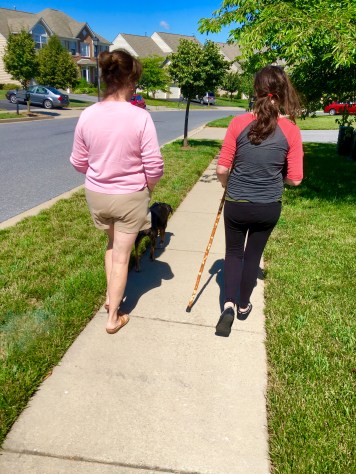
See that picture? That’s my wife and my daughter (15) taking a walk. Oh, and our dog, Roxie. Do you know why I’m posting this picture? Not because I love these two (which, of course, I do), but because of how proud I am of my little girl. The fact that she is out on a walk shows how courageous she is.

You see, about four weeks ago, my daughter had a seizure. It was her first. Not a little tremor—a grand mal. You know, the kind where you’ve fallen to the floor convulsing, with your eyes wide open but seeing nothing. The kind where you can’t remember anything about it. The kind where you wake up as the paramedics are gently placing you on a stretcher and wheeling you into an ambulance. Terrifying stuff.

Then, ten days later, she had another one. The first one was in our house, but this one was out in public, at a food court. Again, it was a grand mal, and it lasted longer than the first one. Fortunately, I was there with her, so I knew to roll her onto her side, cradle her head, and wait it out. Again, she woke up, disoriented, to emergency personnel hovering around her.

So what does this have to do with the picture up there? Everything.

Overcoming “What If.”

Events like these would be traumatic for any adolescent girl; they can be positively paralyzing for a girl with ASD and anxiety disorder. The randomness of the seizures, the lack of memory, the waking up surrounded by strangers—it’s all so upsetting. The largest question that looms in her mind now is “What if?” What if I have another one? What if Mom and Dad aren’t around? What if it happens in front of my friends?

She’s on anticonvulsants now, and she hasn’t had a seizure in two weeks, but that doesn’t matter. The anxiety is so big, and the autistic tendency to perseverate is so strong, that the mere possibility of another event has kept her pretty much homebound ever since. She even missed an appointment with her counselor, whom she really likes.

Now do you see why this picture is so precious to me? Katie and I have convinced her that she needs to start getting out. We’re starting slowly, having her join us as we walk the dog in the mornings. And she’s doing it! She’s walking, she’s talking about everyday stuff, and she’s not perseverating over the seizures.

(The walking stick? That’s because she has mild scoliosis, and it helps her posture.)

Different Drums.

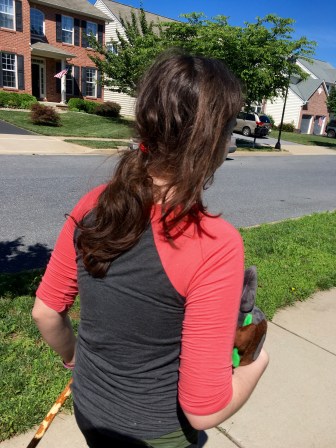
Now take a look at this picture.IMG_0120 Do you see that plush doll in the crook of her right arm? That’s Phantump, one of her favorite Pokémon characters. She is rarely separated from this creature, and when she is, she’s holding another one of the more than 100 she has collected over the years. They are her security blanket. They bring her comfort. They help her bridge the gap between the fantasy world she so enjoys and the real world, which is fraught with challenges and dangers.

So there’s my daughter, out in public with a walking stick and a plush Pokémon. While most girls her age are swooning over boys, preparing for their learner’s permit, and paying close attention to their appearance, here is my girl, walking to the beat of her own drum. She’s fighting her fears. She’s facing down her anxieties. She’s pushing through some things no fifteen-year-old should have to face. And she’s still standing.

There was a time when I’d object to the plush doll. “You’re a young woman now. For God’s sake, leave that thing behind!” There was a time when I’d try to force her to push through her fears more quickly than she was ready to do—usually to disastrous results. There was a time when I knew pretty much what I wanted her (and all my kids) to be, without paying too close attention to her unique personality. But if walking this autism path with my kids has taught me anything, it’s to throw away all of my expectations and to not care about how other people look at them. Those concerns were more about me than the kids, anyway.

So march on, girl! I don’t care if you need to take five Pokémon with you. I don’t care if you choose one of the most ornate, obvious, obnoxious walking sticks possible. Do whatever you need to do. Just keep moving forward. Today, it’s a walk with Mom, Dad, and Roxie. Next Sunday, it may be joining the whole family at Mass. Or maybe just part of Mass. Or maybe not yet. It doesn’t matter. Take it one step at a time, and we’ll be right there with you.

* These pictures, and this story, have been posted with the kind permission of my daughter (and, of course, my beautiful wife, Katie).


A Fortunate Slip of the Lip

Fourth Doctor Gobsmacked

Note: This post originally appeared as a guest post on the awesome “Confessions of an Asperger’s Mom page. Many thanks to Karen for inviting me to share my story with her readers. You should definitely check out her blog, as well as her Facebook page. She has a lot of wisdom to share.

I could have sworn he was downstairs. Really. I wouldn’t have said what I did if I knew he was in his bedroom—well within earshot. As Katie and I were going up the stairs this afternoon, I was recounting how this kid (#4, nine years old) had taken such good care of his younger brother (#6, six years old) at the neighborhood pool. If I had known he was in his bedroom, at the top of the stairs, changing out of his bathing suit, I would not have said, out loud:

“And [this kid], our autistic son, did really well today. So much for the old myth about empathy!”

“Dad? What does ‘autistic’ mean?”

My heart sank. It was probably the first time he ever heard himself described as autistic.

It’s not that I was hiding it from him. I had been wanting to tell him for some time now. I just didn’t know how to do it. And I didn’t want to manufacture some Hallmark moment where there would be this big reveal and a whole new understanding. I wanted it to be natural and, well, right. (Plus, I was also a little chicken.)

No Good Opportunity.

You see, he’s one of six, and they’re all autistic. His two older brothers and older sister already know about their diagnoses—and they found out more or less by accident as well. At least, it didn’t happen on my terms and in a way that I wanted it to. (Insert chicken squawks here.)

So autism is pretty much the lay of the land in our family, and that means he doesn’t really stick out at home enough to wonder why he’s different. All the kids present a pretty consistent profile of being on the higher-functioning end of the autism spectrum, so he’s got a built-in tribe of autistics to relate to.

He also manages to blend in pretty well with his peers at school—at least so far. He’s only in fourth grade, too which means that his classmates are too busy running around on the play ground to pay much attention to his quirks or language glitches. Plus, he works hard to try to fit in. It’s not perfect, and it can lead him to come home tired, moody, and explosive. But it works.

So there didn’t seem to be any need to explain autism to him. (Squawk!!)

Stumbling into The Talk.

Anyway, there I was, completely unprepared for the talk. But there was no getting around it; I had to answer his question.

I brought him into our room along with Katie, and asked him, “What did you hear me say?”

“You said I was autistic and I have empathy.”

“That’s right. Do you know what empathy means?” (I was stalling for time.)

“No.”

“It means that you care about how other people feel. It means that you can feel their feelings, and you want to help people who feel bad. That’s a really good thing, and I’m so glad you are like that.”

“Okay. What about autistic?”

I hesitated, not sure exactly what to say. Then Katie stepped in and saved me. “It means you think outside of the box.”

O merciful intervention! I knew that this kid thinks too literally to grasp metaphors like that. But that was a good thing; it gave me something concrete to react to. I didn’t have to come up with a complete explanation out of nowhere. The talk was happening all by itself.

Autism Is. . .

So I told him that “outside of the box” means that God made his brain a little different than most other kids’ brains. I talked about the cool gifts this brain gives him, like his laser focus on math and cooking and singing. He’s got some real talents there. Then I talked about challenges like how he can have a hard time putting words together or how he sometimes struggles understanding when someone’s talking to him. I hit on a couple of others, like emotional regulation and his need to jump around and get giddy sometimes. Then came the Big Finish.

“So there’s something a little different about you. That doesn’t make you weird. Just different. Autism isn’t a disease or a sickness. It just makes you special. Got it?”

“Yeah.”

“Any questions?”

“No. Can I go type on the computer now?”

“Sure thing. Knock yourself out.”

No Drama.

And that was that. No fuss. No drama. No nothing. None of the baggage that the world gives to the word autism. None of the baggage that I can give it, either. Just another word to help him describe himself.

In a way, I’m glad that it happened like this. I didn’t have time to worry about developing the perfect speech. I didn’t have the luxury of turning it into a thing, which might risk emphasizing the difference more than I wanted. I didn’t have enough of a chance to screw it up, either.

I also liked the way it became just another thing that happened today. Mind you, I’m not sure how much of it he really grasped. But I didn’t want to push. It doesn’t really matter anyway. We began a conversation today that will unfold and deepen over time.

No Big Deal.

So there you have it. My son found out that he is autistic, and he’s doing just fine. An inopportune-but-opportune moment presented itself, and we did our best with it.

It may not sound like the best approach, but there’s something really appealing and “normal” about things like this happening within the natural flow of everyday life. It helps the kids see that it’s not a big deal. It’s one facet of who they are, and it has no bearing on how much we love them or how much dignity or value they have—in our eyes or in God’s eyes.

That’s four down, two to go. I think I’m getting the hang of this thing. So bring it on!