Soooo Tired . . .

Madeline Kahn Tired

How tired am I? Let me count the ways.

Physically, I’m tired from the early morning wake-ups from the youngest and the late-night conversations with my wife about the kids’ various challenges.

Emotionally, I’m tired from managing melt downs, redirecting perseverations, calming anxieties, and comforting socially unaware kids.

Mentally, I’m tired from attending doctor appointments with my kids and trying to keep track of which child uses which medicine, and the various effects and side effects each one experiences.

Organizationally, I’m tired from trying to figure out how to schedule therapy sessions for the kids and still keep on top of my fifty-hour-a-week job, as well as take care of Katie. And myself.

Motivationally, I’m tired from trying to help the kids who tend toward anxiety to keep moving forward and not give in to their frustrations.

Spiritually, I’m tired from battling dealing with my own bouts of fear, frustration, and anxiety.

Yes, I’m tired. And if I’m tired, just imagine how tired my kids must be. But that’s a different subject for a different post.

An Attitude against Platitudes.

I don’t like to complain because I don’t want sympathy or, worse, pity. But the plain truth is that this autism parenting gig is hard work. There are so many twists and turns to ASD that it’s next to impossible to try to plan for the next challenge. Because every person with autism is mind-bogglingly unique, there is no reliable road map to guide you through the terrain. And because most other ASD parents are worn out traveling their own path, it can be hard to connect with fellow travelers—at least anyone  who has the time and energy to listen. (Thank God for Facebook!)

So if I don’t like to complain, why am I . . . complaining? Because every now and then I like to offer a corrective to the platitudes that special-needs parents can hear. Sayings like:

  • I don’t know how you do it.
  • God only gives special kids to special people.
  • You must be really strong to handle all of this.
  • I could never do all that you have to do.

PTSD Parents.

Mind you, these sayings are usually offered in good faith and come from a place of love and respect, so I don’t want to dismiss them—or the people who say them. But idealizing special-needs parents can be similar to the way we lionize the men and women in the military. We call them heroes and warriors and guardians of our freedom. And usually that’s what they are. But such vaunted language can cloak the emotional and psychological trauma that many who have been in combat have experienced. We sanitize the brutality and dehumanizing power of war by putting “Support Our Troops” magnets on our bumpers and applauding soldiers in the airport. But these very soldiers are bearing a burden few of us can imagine—and the Veterans Administration is woefully underfunded..

I don’t mean to compare my experience to that of someone who has been shot at, or worse, who has had to kill a fellow human being. But according to a University of Wisconsin study, parents of special-needs children often exhibit stress levels comparable to combat soldiers. In fact, many of these parents are diagnosed with PTSD or situational depression. And looking back on some of the instances of high drama we’ve experienced over the years, I can easily see how this is the case. As I said above, this is hard stuff.

But back to the not complaining point. The thing is, we don’t think about how hard it is all the time, so we don’t usually complain. It usually happens only when we get really, really tired. Usually  we’re just too  busy trying to keep up and keep awake. It’s not that we’re heroic; it’s just that we love our children. Like any other parent does.

Nothing Special.

So to those who say, “I don’t know how you do it,” the answer is easy: I’m not aware of any alternatives. You don’t count the cost when someone you love needs you. You just do what you need to do.

Anyway, thanks for reading. I didn’t have a major point to make. I just wanted to get this off my chest. Katie and I are not heroes. We’re not special or extra blessed. And I’m sure most of you, if not all of you, would handle our situation just as well as we are doing—and maybe a whole lot better! We’re just everyday people trying to take things one day at a time. And we’re tired.

So. . . . Very. . . . Tired.

P.S. For those who don’t recognize it, the picture at the top is of the incomparable Madeline Kahn, as Lili von Shtupp, singing the song, “I’m Tired” in Mel Brooks’ Blazing Saddles. Here’s a link to the song. And if Mel Brooks isn’t your thing, well that’s a crying shame. Let me offer you a different visual.

Tired-Minion-Coffee-Best-Funny-iPAD-iCloud-WallPaper

A Fortunate Slip of the Lip

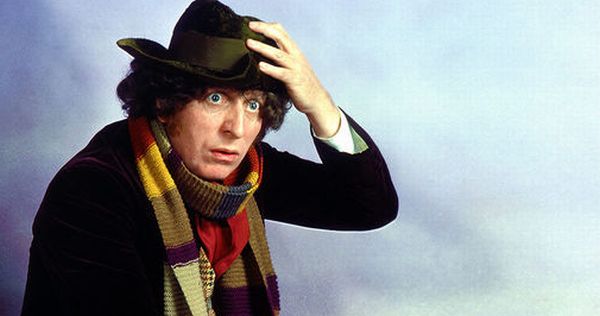
Fourth Doctor Gobsmacked

Note: This post originally appeared as a guest post on the awesome “Confessions of an Asperger’s Mom page. Many thanks to Karen for inviting me to share my story with her readers. You should definitely check out her blog, as well as her Facebook page. She has a lot of wisdom to share.

I could have sworn he was downstairs. Really. I wouldn’t have said what I did if I knew he was in his bedroom—well within earshot. As Katie and I were going up the stairs this afternoon, I was recounting how this kid (#4, nine years old) had taken such good care of his younger brother (#6, six years old) at the neighborhood pool. If I had known he was in his bedroom, at the top of the stairs, changing out of his bathing suit, I would not have said, out loud:

“And [this kid], our autistic son, did really well today. So much for the old myth about empathy!”

“Dad? What does ‘autistic’ mean?”

My heart sank. It was probably the first time he ever heard himself described as autistic.

It’s not that I was hiding it from him. I had been wanting to tell him for some time now. I just didn’t know how to do it. And I didn’t want to manufacture some Hallmark moment where there would be this big reveal and a whole new understanding. I wanted it to be natural and, well, right. (Plus, I was also a little chicken.)

No Good Opportunity.

You see, he’s one of six, and they’re all autistic. His two older brothers and older sister already know about their diagnoses—and they found out more or less by accident as well. At least, it didn’t happen on my terms and in a way that I wanted it to. (Insert chicken squawks here.)

So autism is pretty much the lay of the land in our family, and that means he doesn’t really stick out at home enough to wonder why he’s different. All the kids present a pretty consistent profile of being on the higher-functioning end of the autism spectrum, so he’s got a built-in tribe of autistics to relate to.

He also manages to blend in pretty well with his peers at school—at least so far. He’s only in fourth grade, too which means that his classmates are too busy running around on the play ground to pay much attention to his quirks or language glitches. Plus, he works hard to try to fit in. It’s not perfect, and it can lead him to come home tired, moody, and explosive. But it works.

So there didn’t seem to be any need to explain autism to him. (Squawk!!)

Stumbling into The Talk.

Anyway, there I was, completely unprepared for the talk. But there was no getting around it; I had to answer his question.

I brought him into our room along with Katie, and asked him, “What did you hear me say?”

“You said I was autistic and I have empathy.”

“That’s right. Do you know what empathy means?” (I was stalling for time.)

“No.”

“It means that you care about how other people feel. It means that you can feel their feelings, and you want to help people who feel bad. That’s a really good thing, and I’m so glad you are like that.”

“Okay. What about autistic?”

I hesitated, not sure exactly what to say. Then Katie stepped in and saved me. “It means you think outside of the box.”

O merciful intervention! I knew that this kid thinks too literally to grasp metaphors like that. But that was a good thing; it gave me something concrete to react to. I didn’t have to come up with a complete explanation out of nowhere. The talk was happening all by itself.

Autism Is. . .

So I told him that “outside of the box” means that God made his brain a little different than most other kids’ brains. I talked about the cool gifts this brain gives him, like his laser focus on math and cooking and singing. He’s got some real talents there. Then I talked about challenges like how he can have a hard time putting words together or how he sometimes struggles understanding when someone’s talking to him. I hit on a couple of others, like emotional regulation and his need to jump around and get giddy sometimes. Then came the Big Finish.

“So there’s something a little different about you. That doesn’t make you weird. Just different. Autism isn’t a disease or a sickness. It just makes you special. Got it?”

“Yeah.”

“Any questions?”

“No. Can I go type on the computer now?”

“Sure thing. Knock yourself out.”

No Drama.

And that was that. No fuss. No drama. No nothing. None of the baggage that the world gives to the word autism. None of the baggage that I can give it, either. Just another word to help him describe himself.

In a way, I’m glad that it happened like this. I didn’t have time to worry about developing the perfect speech. I didn’t have the luxury of turning it into a thing, which might risk emphasizing the difference more than I wanted. I didn’t have enough of a chance to screw it up, either.

I also liked the way it became just another thing that happened today. Mind you, I’m not sure how much of it he really grasped. But I didn’t want to push. It doesn’t really matter anyway. We began a conversation today that will unfold and deepen over time.

No Big Deal.

So there you have it. My son found out that he is autistic, and he’s doing just fine. An inopportune-but-opportune moment presented itself, and we did our best with it.

It may not sound like the best approach, but there’s something really appealing and “normal” about things like this happening within the natural flow of everyday life. It helps the kids see that it’s not a big deal. It’s one facet of who they are, and it has no bearing on how much we love them or how much dignity or value they have—in our eyes or in God’s eyes.

That’s four down, two to go. I think I’m getting the hang of this thing. So bring it on!

Who’s Leading Who?

So today is Father’s Day. In honor of the day, I thought I’d dust off a post from a few years ago, update it a bit, and repost it. (That, and I’m too busy being a dad today to write something new.) So here goes:

Who’s Leading Who?

In one of the lesser-known resurrection accounts in the Bible, Jesus tells Peter: “When you were younger, you used to dress yourself and go where you wanted; but when you grow old, you will stretch out your hands, and someone else will dress you and lead you where you do not want to go.” The passage goes on to explain that Jesus said this to signify “by what kind of death he [Peter] would glorify God” (John 21:18-19).

This passage has always had special resonance for me, to the point of being a kind of interpretive key to almost all of the major events in my life. It sounds kind of grim, doesn’t it? All this talk about being led where you don’t want to go and dying—even if that death glorifies God. But that hasn’t really been my experience. Rather, I’ve found a surprise or two along the way as I’ve seen these words unfold in my life.

One major surprise came when I realized who it was who would end up leading me along unexpected paths: my own kids! Now I’m sure that many parents can relate. None of us really knows what to expect when we hold our first child. We can never fully appreciate how much our lives will change now that we have welcomed this new person into our lives. How much more when you are blessed with six children! And how much, much more when it turns out that all six children are on the autism spectrum!

Unexpected Paths.

I named an earlier post “A Little Child Shall Lead Them,” and I meant it as something more than a clever play on words. I can testify that my kids—all six of them—have led me in ways I never expected.

  • They have led me to the waiting rooms of psychologists and psychiatrists and speech and occupational therapists as I have sought to understand their challenges and help them make sense of them as well.
  • They have led me to school conference rooms, where I have advocated for them and labored mightily to convince unimaginative, one-size-fits-all educators to give them a fair shake.
  • They have led me to my knees in prayer—not desperate prayers for their healing, but impassioned entreaties that God will grant them a future full of hope, a future where their gifts are welcomed and where they can make a difference for other people.
  • They have led me down rocky paths as I have helped them work through sleepless nights; relationship challenges; full-scale tantrums; days-long depressive episodes; and anxious, hours-long perseverations.

Death and Freedom.

Now, Jesus told Peter this stuff as a way of hinting at the kind of death that awaited him. And that has proven true for me as well, in a more figurative way. No, I’m not writing from beyond the grave! But my kids have definitely led me to experience other kinds of “deaths”—

  • The death of my dream for a Brady Bunch kind of life. It was a pretty self-centered, self-indulgent dream anyway, and I’m glad it’s gone. Now I don’t have to worry about how clean or dirty the house is. Or about when my kids are going to record their first pop single.
  • The death of any rigidity or legalism I may have brought to my ideas of parenting. I have learned to become much more flexible and creative in my parenting. “So what if she wants to wear all black clothing to church?” “You want to stay in your bed to avoid the noise of the dinner table? Knock yourself out! Just make sure you eat afterward—and clean up your plate.”
  • The death of a few close friendships due to some people’s lack of willingness to “get” our family’s dynamic. This was especially hard at first, but I realized that it’s in times of difficulty that you learn what your friends are really made of. That’s when you have to decide who is really worth your time.
  • The death of a romanticized take on the spiritual life. There are no simple answers. There are no guaranteed formulas. And yes it’s true; sometimes God does give you more than you can handle. That’s why he gave us each other. It’s also why he created wine.

It’s ironic, but each of these deaths has made me feel a little more alive and free. Little by little, my kids have led me to a place of surrender. Not defeat. Not resignation. But acceptance. I have learned so much about myself; about human nature, both the bad and the good; and about God that I feel like I’m a very different person now compared to who I was when our first one was born. And that leads to the final part of this passage.

An Unforeseen Glory.

According to the story, Jesus was pointing to the way Peter’s death would glorify God. Well, I’m not about to think that I give God all that much glory. Not unless he is glorified in huge messes! But I do think that the deaths I listed above have helped me to see God’s glory in new, unexpected ways.

  • I see his light shining through my nine-year-old’s unassailable innocence, both when he’s in full melt down mode and when he’s completely aflutter with the joy of something as helping Katie cook dinner.
  • I see him shedding a tear when my fifteen-year-old gets himself tangled up inside and needs to be talked down from a ledge of self-condemnation.
  • I feel his arms around me every time I dive into yet another parent-teacher conference or begin yet another bitter disputation with the insurance company.
  • I see his covenant commitment every time I come home and watch Katie coaching the kids in homework, making dinner, and trying to help the six-year-old overcome his loud, insistent perseverations all at the same time.

So yeah, there’s a lot of good stuff that comes from these little, unlooked-for deaths. Leave it to religion to be so delightfully paradoxical!

This Is My Body.

 For those of you who don’t know, I’m a Catholic, so this last one comes from my faith tradition. More than anything else, I see God in the bread at Mass as he says, “This is my body.” But I don’t just see and believe. I’ve also found the audacity to pray in return: “Hey! Over here! This is your body, too—this precious family you have given me. We’re part of you, and we all belong to you. So don’t pass us over or forget about us. You made my kids this way, so you’re stuck with us.”

Then I go one step further and tell him, “And here is my body, my life. It’s nowhere near the image of you that it’s supposed to be. It’s still too much shadow and not enough light. Still, I offer it to you. Go ahead and keep leading me, even if it’s where I don’t want to go. With all of these little deaths, you have found so many ways to empty me. And I guess that’s fine. But now I need you to fill me and raise me up so that I can give myself—body and blood, soul and humanity—back to my children.”

And the Lord reaches out his hand to grasp mine, and responds: “Amen.”

Happy Father’s Day, everyone!

Crafting a New Narrative

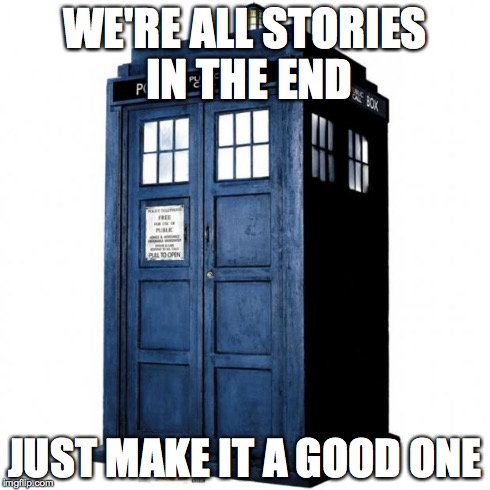
The Doctor–Stories in the End

We had a dear friend over for dinner a couple of nights ago. I’ve known this woman for nearly thirty-five years, and we have worked together for thirty of those years, both as teachers and in our publishing company. She’s a delightful British woman with a heart of gold. She’s involved with prison ministry, she feeds homeless AIDS victims, and she writes children’s books. She’s also very easy with the kids. Nothing fazes her. And to top it off, she even looks like Julie Andrews!

So why was I getting increasingly eager for the evening to end? And why was I so exhausted after she left?

  • Because I’m unused to people visiting our home. We tend not to have people over because it can feel like so much work.
  • Because Katie and I have let ourselves get so wrapped up in this autism thingy that we can lose track of how to relate to people outside of the “tribe.”
  • Because I caught myself wanting to talk about the kids and their challenges, even when it wasn’t necessary or germane to the conversation, and it took energy to stay on topic.
  • Because, much as Katie and I love this person, we inhabit different worlds, and I don’t know how to “be” in her world any more.

Moving Beyond “Past Performance.”

These are all viable reasons. But the more I thought about it, the more I saw that something else was going on. I saw how I’m always on edge around other people—especially when I’m with two or more of my kids. I’m always worrying about which kid is going to act up next and which unique  aspect of our lives I will have to explain this time. Sensory issues? Social missteps? The “oncoming storm” of a tantrum or melt down? World-class perseveration? So I avoid these situations. I don’t look for opportunities to get together with other people or to get the kids out and about as much as I should. And that’s not good.

The thing is, even though I fear the worst, it’s not a foregone conclusion that something bad will happen. It’s true that when things do go south, they head there with a quickness that can make the head spin. But that’s not always the case.

Thinking about this, I recognized some other assumptions or expectations I have—and not just about visitors. “We can’t all go out to dinner; it’ll get too messy.” “I know that Mass is going to be a disaster this Sunday because so-and-so had a rough week at school.” “Another IEP meeting? What’s going to go wrong this time?”

See what I’m doing? In each of those situations, I’m accepting a negative narrative for our life, and I’m letting that narrative drive my decision. Of course, some of my concerns are justified. Things can get pretty challenging for us. People can (and often do) misunderstand us. School teachers and administrators still have a way of minimizing our kids’ challenges.

So yeah, we’ve got some history to draw from. But just as those investment firm commercials tell you, past performance is not necessarily an indication of future results. And the worst thing I can do is expect bad results. Sure, there are some things I know will cause immediate problems. But a lot of other events and situations inhabit that gray area where the outcome is far from predetermined. The problem is, I’ve been painting that gray area black recently, with the result that our kids aren’t getting the opportunities to develop their social skills and coping mechanisms—not to mention the fun they could be missing out on.

Make It a Good One.

So here’s to branching out. Here’s to taking steps—baby steps at first—toward exposing our kids, and ourselves, to new experiences. It’ll probably be a bumpy ride, but they’re usually the best ones. As The Doctor once told Amy Pond, “We’re all stories in the end. Just make it a good one, eh?” So here’s to changing the narrative so we can make it the best story in the world!

Hope. Faith. Love.

Groovy Love

For those who don’t know, I’m a Catholic, and I take my faith kind of seriously. I also like to laugh at how quirky Catholicism can be at times. Among all the Christian denominations, we have got to be the most precise bunch. It’s likely because of our ties to the Roman Empire. Compared to the Greeks, who tended to be more philosophical and flexible, the ancient Romans were legal-minded sticklers for precision. How else did they manage to conquer the world?

Off the top of my head, I can think of two ways that our Roman roots show up. First, there’s our almost innate desire to define doctrines to the umpteenth decimal point: mortal versus venial sin, degrees of cooperation with evil, specific requirements for fasting, for receiving communion, and all that. Then there are the numbers. So many numbers. Just look at the sevens for an example: seven deadly sins, seven corporal works of mercy, seven spiritual works of mercy, seven sacraments the Seven Founders of the Order of Servites. Then there are the threes: Father, Son, and Spirit; poverty, chastity, and obedience; Scripture, Tradition, and the Magisterium. And, of course: faith, hope, and love.

It’s this last trilogy that struck me today. I recalled how St. Paul talks about faith, hope, and love being the only three gifts of God that last, and how “the greatest of these is love” (1 Corinthians 13:13). And it got me to thinking about how these three virtues are the most important things we need as parents—and doubly so as parents of special-needs children. Forget Doctor Spock. Forget Doctor Phil. Even forget Doctor Who. All those self-help books at Barnes & Noble? Rubbish. All those listicles about parenting on Buzzfeed? Worthless. If you have faith, hope, and love, you’ll do just fine.

And because I’m Catholic, I will now tell you the right order in which you need them. *Clears throat*

Hope.

Every parent begins with this one. A child is born. He is beautiful, innocent, full of promise and potential. We look on this tiny person that is the result of our love, and we are gobsmacked. We have such high hopes for this little baby. Not necessarily that he’ll be an astronaut or a top chef or a CEO—although that would be great. We hope that he’ll grow and flourish and find happiness and love. That she’ll find her own special someone with whom she can make a family of her own. We dream of school plays and soccer tournaments and Christmas trees and family trips. We dream of (and dread) the driving lessons, the first date, the prom, and graduation day. Holding this little blessing in our arms, we can’t help but dream of the future.

Then the child grows up, and we see things that challenge our hope. Perhaps speech is delayed. Maybe he takes far too long to learn how to walk or use the potty. Maybe she doesn’t know how to mingle with her classmates in preschool. Maybe he always cries at the doorbell or any sudden noise. Something’s not quite right, and we worry about the future. Then the word “autism” enters our vocabulary, and we feel hope draining away. What about the prom? What about graduation? What about finding love? Is it all possible?

That’s when we look to . . .

Faith.

It’s faith that keeps our hope alive. Faith in our child’s innate goodness. Faith that he really does want to do well and to succeed. Faith in the team of care providers that we stumblingly assemble to give him every chance at a full and rewarding life—whatever that means. Faith in a God who would never abandon a child of his.

That faith sees us through the melt downs, the tantrums, the tone-deaf schools, and the unthinking or unaware neighbors. It lifts us up when our kid begins to go south, whether because of regression or oppositional behavior or depression or anxiety. It sustains us through the long, wearying days and helps us sleep at night. When hope begins to fade, faith tells us that despite what we are seeing now, better days are ahead. It gives us assurance that what we hope for will come to pass (Hebrews 11:1). It may not look like what we expected, but it will come. And so we press on, fueled by faith, toward that vision that we have hoped for.

But what happens when even faith wavers? What if the child we have worked with, prayed for, fought for, and even clashed with, simply is not making progress? Maybe he can’t overcome the next hurdle, or maybe he just doesn’t want to. Whatever the case, what do you do when hope has dissipated and you can’t place your faith in any of the resources you once relied on?

You still have . . .

Love.

And in the end, you know that’s all you really needed. Your dreams may not be fulfilled. Your doctors and therapists may be at an impasse. Your prayers don’t seem to be working. Nothing is going right, and you don’t know if anything good is on the horizon.

It doesn’t matter. He’s your son. She’s your daughter. And you can’t help but love. Even when you want to throw up your hands in despair, you know that this is your child, and that knowledge brings you back to sanity. It softens your heart, if only just enough to let you take the next step forward.

No matter what happens, love wins out. It may take years, but it will win. Because a child who knows he is loved, no matter what, will always have a glimmer in his heart, and that glimmer will offer some protection, some encouragement, some guidance in the dark days. Just as God looked at us and couldn’t help but love us, even when we felt lost and hopeless, we can’t help but feel love when we look at our children.

So even if he never learns to use the toilet, even if she never speaks a word, even if he ends up living all alone or in your basement, there’s always love. Good old, stubborn love. Because it’s the one thing—the only thing—that will matter in the end.