Conventional Wisdom

IMG_2492

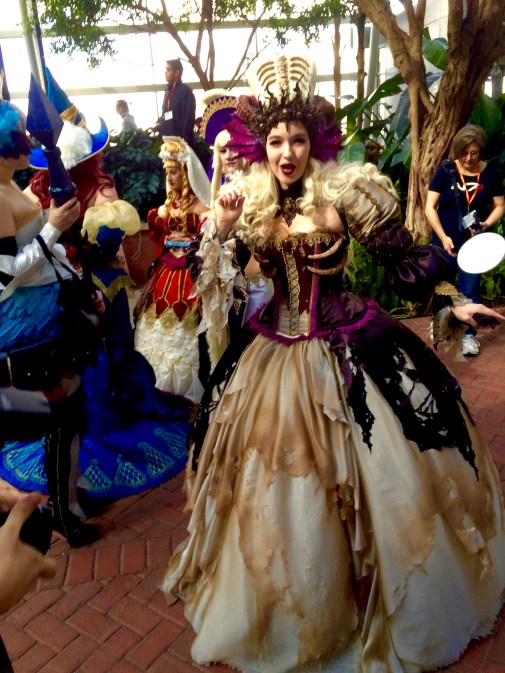
Random participants at the 2016 Katsucon Convention.

So my 15-year-old girl had a lot of fun this Saturday. Her dream came true when we pulled up to the Gaylord Hotel outside of Washington, DC, for her first anime convention. She had been preparing for this for months, figuring out who she should dress as and then fretting over every little detail of her cosplay costume.

Of course, she didn’t go alone. Dutiful dad that I am, I joined her. I had checked out the group’s website, and found the dress code, which included such rules as “At least one inch of fabric over the nipples” and “All play weaponry must be concealed when you are outside the convention center.” I also saw that there were a number of panel discussions, ranging from “How to Sew Your Own Plush” to the late-night, age-restricted “Introduction to Japanese Bondage Techniques”—complete with demonstrations. Well, okay, then!

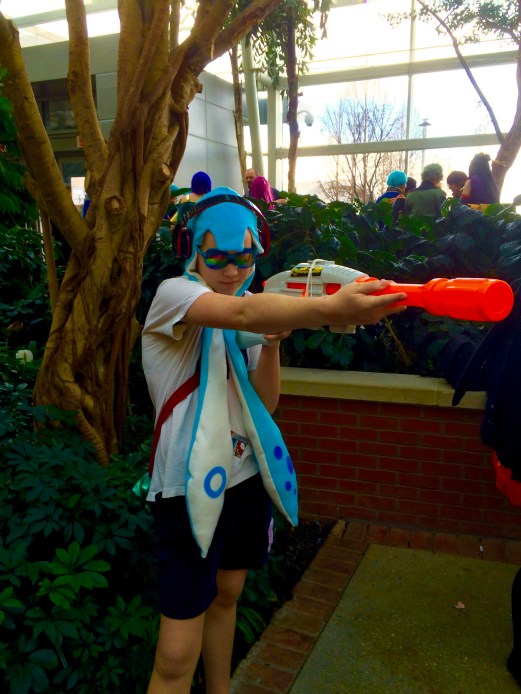
Anyway, from the moment we entered the convention hall, we were surrounded by people of all ages, shapes, sizes, colors, and gender configurations. Almost all of them were dressed as their favorite character from anime or sci-fi or fantasy or just about anything else. There were Pokémon, elves, storm troopers, satyrs, Halo soldiers, flying monkeys, creepers, and Splatoon squids. And many, many others. More than 15,000 of them. I was one of the few who hadn’t dressed up—just jeans, sneakers, and a sweatshirt. I guess I could have said I was going as Awkward Suburban Dad, but I would have needed some identifying totem, like a DirecTV remote or a Black & Decker power tool to make the costume believable.
IMG_2496

My girl, the Splatoon Inkling.

I didn’t know what my girl would want to do there for six whole hours. None of the panel discussions interested her, and the exhibit hall wasn’t all that big. But it turns out I didn’t have to worry. She knew exactly what she wanted to do. Apart from a half-hour in the exhibit hall, we spent most of the time wandering around the convention center and the hotel’s public spaces. She was so very excited to see everyone’s costumes, and she took pictures. Lots and lots of pictures. Her wandering wasn’t calculated, but it didn’t matter. We went here, then there, then back here, then over there, then back again. All the while, she kept cooing about how happy she was to be there.

Work the Crowd.

Then she got an idea, which she picked up from observing some veteran cosplayers. She found a spot in an open area in the busy hotel lobby and just stood there waiting for people to come and take her picture. It was quite a sight: she in her very simple, decidedly amateur, costume, flanked by a portly Japanese princess on one side and a svelte, leather-clad female vampire on the other.

I stood about 25 feet away so that I could keep a watchful eye on her but give her some freedom. Over the next hour, hundreds of people walked past, most of whom didn’t pay her any attention. A few people stopped to take her picture, and a couple of folks talked with her for a bit—including one young man from France whose friendliness prompted me to hover more closely. But overall, I was happy. “This is so good!” I thought. “My little girl is getting out there; she’s spreading her wings, taking risks, and enjoying it.”
IMG_2500

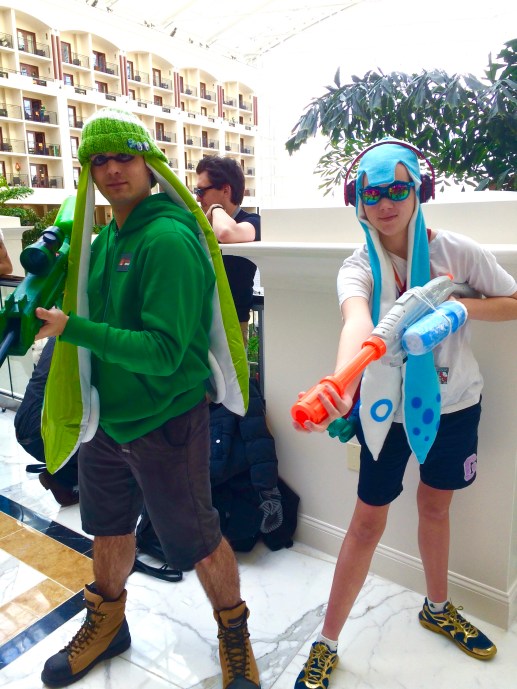
Not too close to my daughter, Frenchie!

From there, we moved to a different location, where she stood for another 90 minutes. Only this time, she didn’t just stand there. She began waving her gun in front of her, occasionally “shooting” at some of the passersby. She looked like a slo-mo version of those people who stand on the street corner twirling an advertising sign. And that worked a lot better. Not only did she get many more requests for pictures, but she also got other characters to interact with her—the Halo soldiers, for instance, shot back at her.

So my girl had a good day. So good, in fact, that she’s already planning her outfit for a similar gathering in August. I think Katie’s going to take that one, though. Once a year is enough for me!

Taking It in Stride.

So what did I think of the whole thing? It was eye-opening. I spent my Saturday surrounded by people with a passion for a subject that was almost completely foreign to me. It took a little getting used to—seeing grown men and women dressed up so exotically and play-acting as cartoon characters.

Looking around at all the elaborate, ultrageeky costumes, I was brought back to my earlier years, when I would have dismissed this whole thing as just a bunch of maladjusted, self-indulgent nerds lost in a synthetic fantasy world. “Get a life!” I would have said under my breath. And I most certainly would not have allowed my children to get involved in such arcane doings. But then I went ahead and had actual, real life kids. Kids with autism. Kids with different brains and different neurologies than mine. And as a result I have learned to take a load of supposed weirdness in stride. So no, it wasn’t all that odd for me. In fact, after the initial adjustment, it felt completely normal.
IMG_2491

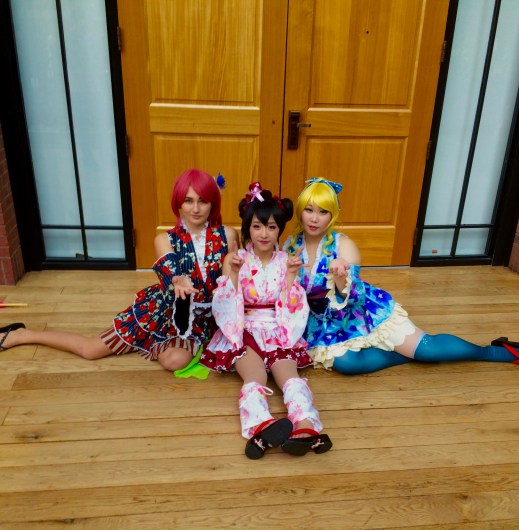
“Don’t mind us. We’re just sitting on the floor of this hotel lobby being fabulous.”

One of Us.

One brief scene from the day cemented this for me, and it’s an image that I suspect will stay with me for a long, long time. During our wanderings, I caught sight of one fellow who looked like he was in his early twenties. He stood out in part because he wasn’t dressed up as anything—just jeans and a tee shirt. He was on the up escalator, and he was holding a plush Pokémon. All the way up the escalator, he was nuzzling the thing, smiling broadly at it, and talking excitedly to it. He flapped his hands occasionally and bounced happily on the balls of his feet. He looked so happy, I couldn’t help but smile.

That’s when it hit me. This was not some poor unfortunate soul to be pitied. This was a happy, adjusted man enjoying a day out on the town. He looked healthy and well fed. He had clothes on his back and shoes on his feet. His hair was mussed up but not unkempt. He was in the midst of a huge crowd navigating a virtual rabbit warren of meeting rooms, lobby spaces, and exhibit halls, but he showed no signs of anxiety or disorientation. He was having the time of his life. I realized I was looking at him not as “one of those,” whatever “those” might mean. He wasn’t an “other.” He wasn’t even part of a different tribe. We were both part of the same tribe. But it wasn’t that he had joined my tribe and become “one of us.” Somehow, over the years of watching and learning from my kids, I had joined his tribe.

I was one of his.

The Story That Never Was

FullSizeRender.jpg

This is a story about a story that never became a story. Got that? A story. About a story. That never became a story.

A couple of weeks ago, I wrote a blog post about an incident that happened in our house over the holidays. But because it was a story about a couple of the older kids, I didn’t hit the Publish button right away. My older kids are on Facebook now. They have virtual friends. They’re connected to some of their cousins. And the story I was telling could be interpreted in more than one way. I saw it as an illustration of some of the challenges that teenagers on the spectrum face—along with a hopeful, encouraging conclusion about how my kids are working through these challenges. But other people might focus only on the challenges and the difficulties, and they might get the wrong impression about my kids.

See, I know a thing or two about ASD. I get it in ways that many other people don’t. Sure, my story might help people understand autism a little better, but at what cost? The way my kids’ friends perceive them? The way my kids perceive themselves? Was I putting them out there in the wrong way? It didn’t seem so to me, but I wasn’t sure.

So I did something I had been thinking of doing for a few months. I told them that I occasionally post stories about being an ASD dad on social media. Then I e-mailed my story to them and asked if they’d be okay with my posting it.

They were and they weren’t.

One of them had an easygoing response. “Whatever raises awareness, Dad, I’m okay with. I know you’d never make me look bad. I don’t even have to read your story. Go ahead and publish it if you think it will help.”

The other one was not okay. “I don’t want people to think I’m a nervous, insecure, insane, freak!” That’s all I needed.

And so the story never became a story.

Careful . . .

It seems we’ve entered a new era. When I started this blog back in 2012, it was easy to tell stories because the kids were young and unconnected. Now I have to be more selective. But that’s okay. I’m sure there will be plenty of stories to tell that don’t run the risk of putting them in a bad light. Stories like this one about my boy’s success at singing in the chorus. Or this one about my daughter correcting one of her teachers. Or this one about the Catholic psychologist who wrote some really messed-up stuff about ASD and who I convinced to issue an apology.

Part of me will miss telling some of the harder stories—not because I want to embarrass my kids, of course. I’ll miss it because there’s this perception about ASD out there that it mostly affects little kids, and that’s just not true. There are plenty of stories about young children, who are so damned cute and whose parents are just beginning to come to grips with a new diagnosis.

But there’s another whole population of ASD folks out there. They’re older, and it’s not so cute when they do some of the quirky things that autistic kids do. When someone is five, he’s precocious; when he’s 15, he’s rude. She’s given much more leeway when she’s three because she’s expected to “outgrow” her autism; when she’s doing the same thing at 13, she’s stubborn, willful, or disturbed. Of course, none of this is accurate, but it’s how they are perceived.

So I’ll be more careful. I’ll look for the stories that emphasize how awesome my kids are. Or how far the autism community has come in gaining acceptance—and how much further it has to go. Or how much Katie and I are learning and growing as we raise our kids. Or God knows what else. Because our kids are still autistic. They will be even when they become adults. And the world needs to see that this very broad autism spectrum runs not just from low- to high-functioning, but from infancy to old age as well.

Now, would you believe me if I told you that my story-not-a-story was the best thing I had ever written? No? Well, you’ll never know, will you?


Lots of Snowflakes

IMG_2449

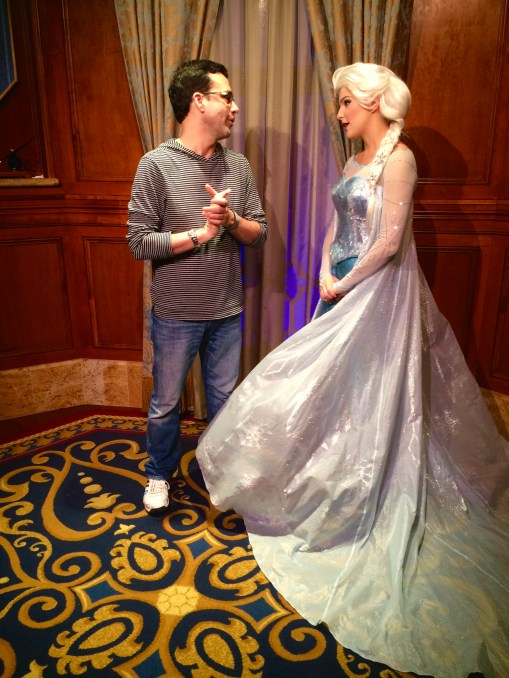
My next stop was the enchanting kingdom of Arendelle, where I visited Queen Elsa. Like the other people I spoke with, she was very happy to record a message to kids on the autism spectrum. She got it right away when I explained why I was asking her to do this. You see, Elsa has special, unique abilities that most people didn’t understand, and this made her feel like an outcast. She was even denounced as a “monster” by the Duke of Weselton. She hid away for years, staying in the shadows, because she was afraid of her powers, which she couldn’t control. She also stayed in hiding because of how guilty she felt for having accidentally hurt her sister, Anna.

As you can see, Elsa was living under a dark cloud of oppression—much of it undeserved. I told her that many kids on the autism spectrum can feel that way as well. They can stand out from the crowd. They can feel as if they are too different from the people around them. Even worse, those things that make them different can overwhelm them and make them say or do hurtful things. Like Elsa, they can be bound up in guilt and fear. Some even build a colorful, imaginative world of their own, a refuge from the world where they are free to be themselves. But like Elsa’s ice castle, this refuge can turn into a prison as they remain isolated from the people who love them.

Elsa thought that her castle would protect her. She thought that it would be the one place where she express everything unique and awesome about herself. But then the outside world came crashing in. She became a prisoner of people who didn’t understand, people who didn’t love, and that made her more miserable than before.

It took an act of true love to finally set Elsa free—her sister Anna’s complete acceptance of her and her willingness to sacrifice her own life to protect her. That was the key. Knowing how much she was loved helped her lose all the negative thoughts she had had about herself—all the fear and guilt and isolation that was swirling around inside of her.

The best part about Elsa’s story is that her freedom didn’t mean that she became “normal” like everyone else. She was still the same shy young woman with a unique talent. But because she was surrounded by love, she learned how to harness that talent and use it for good. She let go of the bad stuff and embraced the good. And because of that, she was no longer subject to her powers; now they were subject to her. In the end, Elsa was free to be the one-of-a-kind person she always was. And that’s what she wanted to share with everyone.

Words for the Warriors

Screen Shot 2016-01-19 at 10.03.31 PM

Sorry about the low resolution. The sun was setting.

After visiting Aladdin and Jasmine in Agrabah, I hopped over to China to spend some time with Mulan. Because of the time difference, it was evening already. When I asked her if she would record a video message for kids on the autism spectrum, she told me she was delighted to do it. “But why me?” she asked. So I explained.

After spending years preparing for, and dreading, the role that everyone expected of her—that of a demur, domestic housewife—Mulan felt like a failure. “Why is my reflection someone I don’t know?” she wondered. It frustrated her to feel that she couldn’t live up to people’s expectations. Looking at the world around her, she wasn’t sure where she fit in or if she would fit in at all. She wanted to be herself, but she was afraid how people would react. She was afraid, too, that she would have no future unless she became someone she wasn’t.

But then war came, and Mulan’s aged father was ashamed that he couldn’t help defend his homeland. Mulan saw her opportunity and, like Joan of Arc, she disguised herself as a soldier and took his place. After an awkward start, Mulan blossomed into a confident, self-possessed woman and led an army into battle against the Huns. Finally free to be the person she always had been, Mulan saved her kingdom and restored honor to her family’s name. Not bad at all!

I explained this to Mulan and told her how similar her story is to many people on the autism spectrum. Like her, many of them are frustrated or feel inferior because they don’t fit most people’s expectations. They may not talk. They may not be interested in sports. They may prefer to spend time cataloguing their bug collection instead of going to a birthday party. People might call them “awkward” or “quirky” or far worse. Feeling like they don’t fit in, they may be tempted to give up on their dreams. I told her they needed to think of themselves as warriors willing to fight negative stereotypes. They needed to become strong so that they could make a difference in the world. And they needed the inner strength to look at their reflection and see just how awesome they really are.

Hearing all of this, Mulan was more than happy to record the video. In fact, she was downright eager to tell talk about how it’s okay to be different—as long as you’re true to yourself. She told them . . . well, see for yourself.

A Whole New World of Awareness

IMG_2439

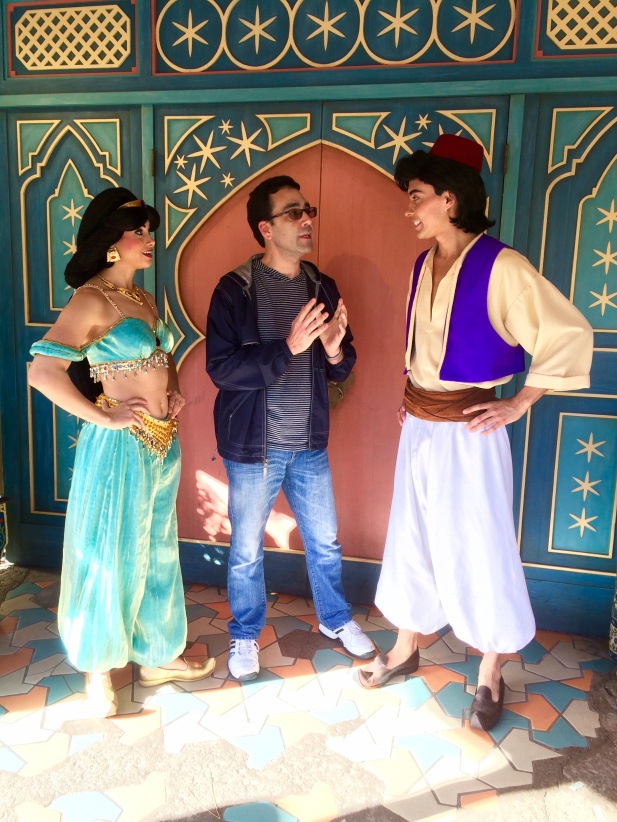
Here I am, posing with Aladdin and Jasmine, prince and princess of Agrabah. I’ve always liked their story, and not just because the Genie is such a hoot. There’s something touching and inspiring about this couple, and I was eager to tell them what an inspiration they were.

Always called a “street rat,” Aladdin didn’t think he would amount to much. He resigned himself to accepting what other people said about him and  acted like a street rat. But then he met Genie, who transformed him into Prince Ali and helped him win Jasmine’s heart. Aladdin’s adventures showed him that it was possible for him to break out of the restrictions people had put on him. And so, emboldened by his newfound courage, he defeated the sorcerer Jafar and set Agrabah free.

For her part, Jasmine was a thorn in her father’s side. She insisted on marrying for love and not for political expedience. In fact, her determination not to be confined by other people’s expectations had a major role in inspiring Aladdin to break out of his shell.

IMG_2437

So meeting Aladdin and Jasmine was fun. But it was even more rewarding telling them about some of the challenges that kids on the autism spectrum face. I told them how much potential these kids have—that they’re “diamonds in the rough,” just as Aladdin was. I also told them how easy it could be for these kids to accept a lesser vision for their lives simply because of the way other people treated them.

As sad as they were to hear all this, there were also touched to learn how many of these children are deeply loved by their parents and that their parents weren’t going to give up until they gave their kids the best possible future. This moved Aladdin especially, since he grew up alone and had no one to take care of him. Talking with them, you could tell how happy they were to see these kids being surrounded by such love and encouragement.

And so they were more than happy to send a little message to all the ASD kids out there. Click on this link to see their special message.