Do They “Get” Religion?

We had quite a bit of drama last Sunday over getting the kids to church. One in particular—our second, a 12-year-old girl with Aspergers—gave us a lot of grief. First, there was the feigned illness excuse. Then there was the pulled muscle stratagem, in which she faked a sore back because she had been throwing the football with her brothers the day before. Then, when all else seemed lost, she pulled a very clever ploy: the constipation gambit. Just one minute before we absolutely had to get out the door, she ducked into the bathroom, locked the door, and protested that she really had to go, warning us that it would take a long time.

By this point, I was done. I had been working with the others, trying to get them ready, all the while fielding this girl’s anxious protests. So by the time she played her final card, I gave up and told her to stay home. I also made sure that the computers were not accessible. I may have been done, but I was not going to be anybody’s fool!

Then came the afternoon, when she was set to go to Sunday school, or CCD as we Catholics call it. She had sworn up and down all day that she would not try to get out of it, but as soon as the time came, the same old excuses came up. Only this time with far more emotion: desperation, anxiety, fear, anger, recrimination, exaggeration. You name it, she threw it at us. Again it was clear that, short of physically throwing her in the car and dragging her to class, it just wasn’t going to happen. (Note: she’s big for her age, and not all that easily moved. If I were to try the physical approach, I would likely look like an abusive dad.)

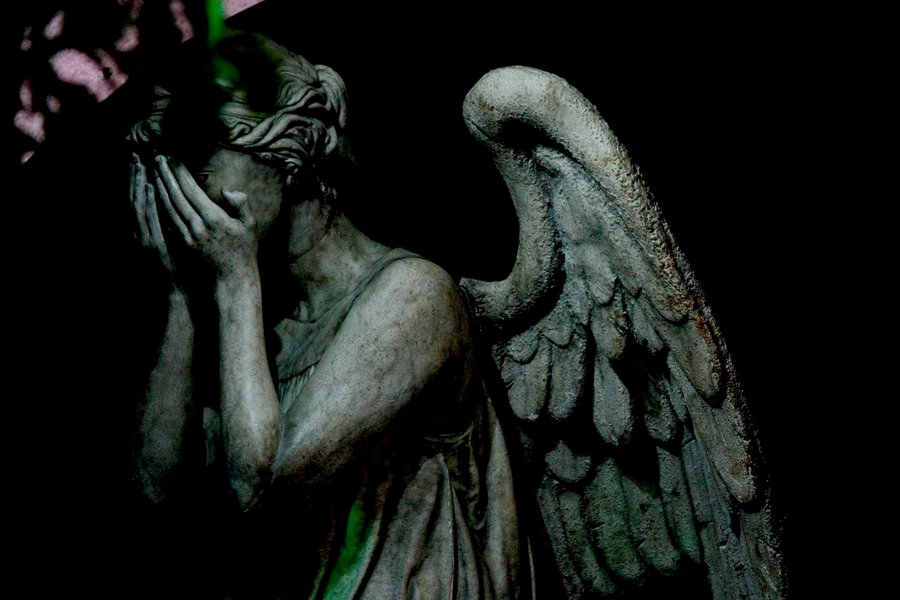
This was all so frustrating for me. This girl is getting close to her confirmation, and to this point everything related to God or faith or the Church has been a struggle. As you can guess from previous posts, I take my faith pretty seriously, and one of my highest goals is to see all my kids come to a personal embrace of their faith, just as Katie and I have. But this is probably the best picture of how this girl’s guardian angel must feel on Sundays.
Image

Literal Brains, Spiritual Truths.

It took me a few years to get to the point where I’m not all that surprised by this. For quite a while I tried to force my expectations on them, wondering if they would ever accept the faith that is so important to Katie and me. It’s hard to admit that this may never happen because of their ASD, but I’ve come to realize that it’s a very real possibility, if not a downright probability.

After all, teenagers on the autism spectrum tend to have a harder time with religion than their neurotypical peers. ASD kids are very concrete thinkers. Inference and abstraction are foreign concepts. So the thought of an invisible Person whose presence and influence can be detected by intuition and emotion can seem absurd. Aspies tend to be fiercely independent and unwaveringly evidence-based, so there’s not much room for faith in a brain like that. There’s not much room for the idea of submitting one’s heart and mind to an exterior, mysterious God. If my girl were in the upper room with St. Thomas, she would have outdone him in his demand to probe the wounds of Christ before believing that he had risen from the dead.

All this can make the whole idea of a religious service, whether it’s a solemn Mass or a nondenominational electric guitar-fueled gathering, extremely foreign. Then, when you consider all the sensory issues involved—incense, lots of unfamiliar people, loud music, all that sitting and kneeling and standing—it’s a melt down waiting to happen.

At times this has left me wondering if I should even bother to teach the faith to my children. Maybe it would be better just to aim for good, moral kids who stay out of trouble. If their brains are wired so differently, why pretend they’re going to “get it” anyway?

Meeting God.

But I just can’t do that. I may have to accept a different script for my children’s lives than I had intended, but I’m still not giving up. For all the trouble it can cause, and for all the creativity it can demand to get them to Mass, I still believe it’s worth it.

That’s because I believe in a God who acts—and who acts dramatically. You see, while many of my convictions about religion were formed by the Catholic intellectual tradition—I studied philosophy and theology at a Catholic liberal arts college—these convictions came to life for me because of a deep interior conversion experience.

It’s a long story, but suffice it to say that when I was a junior (32 years ago this month, in fact), I had an experience of God that was intensely personal. Everything I had learned in my brain became real to my heart, and I was convinced beyond a shadow of a doubt that God was real, that Jesus loved me, and that his Holy Spirit was alive and working in my life. I felt a joy I had never known before, as well as a freedom from guilt and a new sense of purpose to life. I’m convinced that without this experience, I would have lost interest in God years ago.

That’s why I’m not giving up. I know that God is bigger than ASD. I know that he loves my kids. And if he loves them, he can’t help but want to show them his love. So I believe that somehow, somewhere, in some manner, he will do for my children what he has done for me. He’ll make himself known and touch their hearts. I don’t know when. And I certainly don’t know how. But I believe deeply that he will do it. I just have to adjust my expectations of what that will look like.

Doing My Part.

So in the mean time, I’ll keep doing what I can. I’ll keep making sure that they have the data in their minds so that when God moves, it can transfer to their hearts. I won’t try to force faith on them. And I certainly won’t get my expectations too high about their emotions or their spiritual intuitions. Where some of my friends’ older kids are beginning to own their faith, I’m not expecting my kids to do that any time soon. At this point, my main concern is to make sure that the information is there. It’s to help them feel as comfortable as possible in church. I know they may never be all that comfortable. But at least it’s a start.

So here I am doing my part. The rest is up to you, God. Good luck!

And if it never happens for them, if they never “get” the experience I had, I won’t sweat it. As I said above, God is bigger than ASD. He’s also bigger than any one model of religious experience or salvation. Even if they can simply come to accept the premises of faith and try their best to live an upright life, I’ll be happy.

Because you made them the way they are. You know who they are. And you won’t let them down.

O Necessary Sin!

Earth


A few days ago, I came across this post on another autism parent’s blog, and it got me thinking, again, about the question of God and his role in stuff like this. The author is an associate pastor in a nondenominational church in Oregon. He has five kids, one of whom is on the severe end of the autism spectrum. In the post, he talks about how the Christian faith is a “lousy force field.” He says that being a Christian and belonging to a church really doesn’t insulate you from all the bad stuff that happens out in the real world. “It’s a lie,” he says. “We are living neck deep in the stink of life just like everyone else.”

Exactly. That’s our experience as well. Believing in God, going to church, having a regular prayer time, etc. None of it guarantees you a problem-free life. It may help you face the challenges when they come. It may help make you more peaceful, more patient, and more trusting. But it won’t shield you from the bad stuff. It should help protect you from sin and all the bad stuff that is the direct result of your own personal sins. But it won’t shield you from the bad-things-happen-to-good-people stuff.

I’ve got to hand it to this fellow for being honest about how broken he feels by his son’s situation. He doesn’t try to put a brave face on everything because he doesn’t want to give Christianity a bad name. He’s clearly been through the wringer, and he’s not going to deny it.

I also want to commend him for his determination. He hasn’t given up on God. He’s still out there helping people. He’s still pouring himself out for his church and leading a congregation in prayer—all with the goal of bringing them in touch with God. Really inspiring!

When Bad Stuff Hits.

But what this post got me to thinking about, again, was something I hinted at in a more recent post of mine: My kids on the spectrum have a prophetic role to play in this world. And for that reason, I am beginning to think that their ASD is part of God’s plan—for them and for the people whose lives will intersect theirs.

Here’s the thing: We want our children to be perfect. We want them to have good health, a good education, a bright future, no real problems or major roadblocks on the way to happiness.

But then autism happens. Or cerebral palsy. Or mental retardation. Or childhood diabetes. Or a host of other genetic, uncontrollable diseases and disorders. Suddenly the dream of a near-perfect life is gone. Our hopes are shattered. We worry constantly about our children’s futures. Their present is a long list of treatments, medical bills, and huge adjustments to everyday life. What happened? We had such beautiful plans, and now they seem smashed to pieces.

Quite often, too, we begin to wonder where God is in all of this. How could he let this happen to our innocent little child? What kind of Father is he anyway? I know a thing or two about fatherhood, and in no way does this fit into my definition. Many people, hurt and disenchanted, turn away from God. Others try to comfort themselves with analgesic statements drawn from inspirational posters and Chicken Soup for the Soul books. Anything to help reconcile our plans and dreams with the far more difficult reality thrust upon us and our children.

Frying Other Fish.

But what if this was part of God’s plan all along? What if this was part of the way he dreamed our children into existence from the start? After all, the Bible tells us that every hair on our heads is counted (Matthew 10:30). It tells us that God knit us together in our mother’s womb, and that every day of our lives is already written in his book (Psalm 139:13, 16). Drawing on a particularly memorable description of the act of conception, it tells us that God poured us out like milk and curdled us like cheese (Job 10:10). If he was so intimately involved in our children’s creation, how could something like this slip in unintended?

Actually, it’s not too hard to imagine that God had a hand in this. His ways aren’t our ways, are they? We may want a comfortable home in the suburbs, good schools, and a promising career for our kids, but I suspect that God has other fish to fry. Not that he has anything against the middle-class American dream, but I think his sights are set a good deal higher. He seems to be much more interested in a world marked by love, compassion, justice, and mercy. He seems to care more whether the people he created look and act like his Son—a poor carpenter who didn’t have a place to lay his head.

So how is he going to get this to happen? Certainly not by giving everyone the same homogenized, perfect, problem-free lot in life. If there were no poor, there would be no generosity. If there were no sickness, there would be no compassion. If there were no hardship, there would be no growth in character. There would only be one big, bland, barrel of blah. Yes, God wants to give us good gifts. But the gifts and the goodness he has in mind far outweigh the trinkets and gewgaws we often ask for.

No, there has to be sickness. There have to be disorders. There have to be natural injustices like autism, down syndrome, and MS. It’s all part of the “happy fault” and the “necessary sin of Adam” that we Catholics exult in at the Easter Vigil.

So no, life isn’t fair. It isn’t supposed to be fair—at least not according to our standards. It’s about how we take what God gives us and use it to build his kingdom.

A Royal Calling.

That’s why I think kids with special needs have a valuable, prophetic role to play in this world. In a way, they are God’s word to us. They call us to a deeper, more meaningful life. With their innocence and vulnerability, they invite us to become more than the collection of our possessions, our education, and our ambitions. They call us to become Christ for them, even as we see Christ in their eyes.

The pastor I mentioned above ended his post with these words:

I don’t know whether Jackson will be fully restored in this life or the next, but he will be restored. It will happen. That means my son and others like him—the ones who for centuries have been forgotten, bullied, mocked, and thrown away—they will be heralded like Kings and Queens, and celebrated like rock stars.

While I pray every day for my kids’ healing (and I’m not always sure what that means), I get the sense that their full restoration won’t happen this side of eternity. They have too important a part to play. But I do believe that in this life they will be “heralded” like the royalty they are—if by only a few people. In my heart I try to do that every day, and I firmly believe that they’ll find other people who will treat them with just as much honor and reverence. People who will love and accept them for everything about who they are—not in spite of it.

I know that’s how God looks at them.

Solidarity from Rome

It took me a couple of days to find it, but here it is: the Vatican’s message to families touched by autism. On every April 2, World Autism Awareness Day, the Pontifical Council for Healthcare Workers publishes something like this. On one hand, we can read these official statements as little more than that—official, almost boilerplate language that can be applied to any other disability. All you have to do is swap out “autism” with “cerebral palsy” or “depression” or some other brain disorder. Or we can read these messages as words from the heart, intended to offer something personal to the ones affected by this disorder.

I choose the second option. And not just because I happen to be a Catholic. When I read Archbishop Zimowski’s words, I saw that he really does get some of the challenges of ASD and of having a child on the spectrum.

More Than Just Loss.

For one thing, he spoke of the feeling of “loss,” but also of “amazement,” that parents of ASD children can experience. And that strikes me as right. Hearing the diagnoses for my kids—one after another after another—was like a stab in the heart each time. Especially when we got the news the first time, I was stunned. “Loss” was definitely the first thing I felt. The sense that this beautiful son of ours had lost his future. The sense that my wife and I had lost any hope for having a full relationship with him. The fear that he would lose any opportunity for an independent life. And, yes, the fear that we had lost our future as a happily retired couple with no worries about our grown children.

But at the same time, there was a sense of amazement. It didn’t happen all at once. But over the next few days, as I got used to the word “autism,” I was amazed at how beautiful, loving, and genuinely happy my boy was. (Mind you, he was only three years old at the time, and every kid at that age is really cute. But still. . .) I was amazed at how much more my heart went out to him. I was amazed at how deeply he could respond to me, even though he had yet to speak a word and at times appeared lost in his own world. I was amazed that, even in the midst of my loss, I never thought it was completely hopeless. Somehow I knew that God had our boy in his hands and that a path would open up before him over time. And slowly, through therapy, our own understanding and advocacy, and a growing awareness about ASD in the broader world, I am beginning to see this path—for him as well as for his other ASD siblings. Finally, and most important, I am amazed at how much these kids show us the face of Christ.

Solidarity.

The other thing that Archbishop Zimowski speaks about is the sense of solidarity that the Church feels with people on the autism spectrum and their families. It’s a pledge to walk with us, alongside of us as brothers and sisters. Not in a patronizing, pitying way but as our peers who see the value, the beauty, and the vital role of those struggling with this disorder. This, I think, is one of the greatest gifts that the Church can give to families like ours. In a world that tends to assess people’s worth based on their material contribution to society, the Church is telling us that our kids offer something just as important, if not more so. I wrote about this just a few days ago, and it has been sticking in my mind ever since.

The good archbishop knows he cannot offer expert help. He knows he doesn’t understand our challenges half as clearly as we parents do. But he also knows that we don’t expect that from him, or from the Church as a whole. We’ll find the experts elsewhere. We’ll find the clinical help we need from, well, clinicians, not priests or bishops. As Peter told the lame man, “Silver and gold I do not have, but what I have I give to you: In the name of Jesus, stand and walk.”

We may not find therapy in the Church, but we will find acceptance. We know we will find people who can see our kids in the same way they see every other child: as a gift and a mystery. Of course, this doesn’t always happen. No parish is perfect, after all. But that’s what makes these words so much sweeter. We know we belong. We have the words to prove it. And we have the Spirit behind the words to remind us whenever we feel otherwise.

So on behalf of Katie and my kids, I’d like to say “Thank you” to Archbishop Zimowski for his message. I’d also like to say “Thank you” as well to Pope Francis, who in just the few weeks since his election has done so much to show the world what solidarity really looks like. And I’d like to say “Thank you” to every priest and parishioner who has ever welcomed us and shown us the love of Christ.

Pint-Sized Prophets?

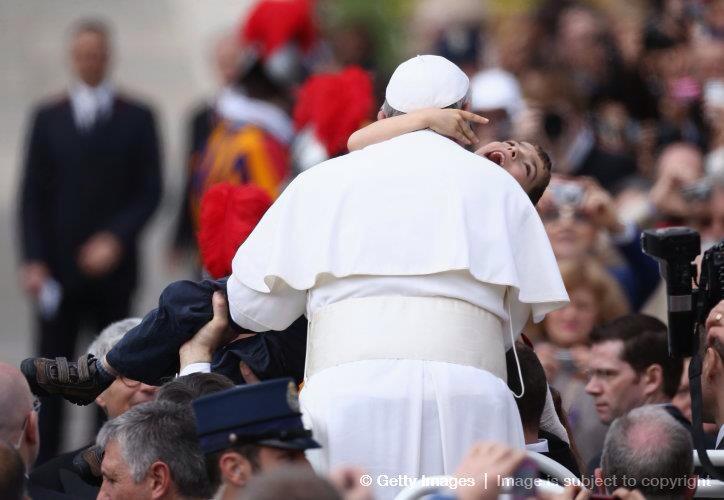
Pope-holding-Dominic

Just this morning, I came across a story written by Paul Gondreau, a theology professor at Providence College in Rhode Island. He and his family happened to be in St. Peter’s Square in Rome on Easter Sunday and were present when Pope Francis toured the Square in his popemobile. The picture you see here is of the pope embracing Gondreau’s eight-year-old son, Dominic, who has Cerebral Palsy.

It was a moving sight, and it made its way to the Internet and numerous news outlets around the world. (Not unlike his first popemobile ride, when he also had the car stopped so that he could give a special embrace to a disabled man in the crowd.)

In so many ways, the picture speaks for itself. But Gondreau’s brief article on the event makes a couple of moving and important points.

First, he relates a comment that a woman in the Square made to his wife afterward: “You know, your son is here to show people how to love.” Gondreau talks about how this comment turns our everyday thinking on its head. Parents of children with disabilities are called to give more than the usual amount to their kids: more help, more guidance, more advocacy, more money, more time, more therapy, more of everything. And we often focus on all that we have to do or all that we have to give. But what Pope Francis highlighted—and what Gondreau picked up on—was how much our children give to us. While we’re busy giving our children all they need, they are busy giving us huge lessons in what it means to love. They’re teaching us how to give and give and give—not by demanding it of us but by drawing it out of us. Just as Jesus gave himself for us not because we stormed heaven and demanded our rights but because his heart warmed at the sight of us, and he couldn’t help but become one of us and share in our pain and need.

Second, by framing the whole thing in terms of a vocation, Gondreau finds a way to answer the “why” question that every parent of a special-needs kid asks. Why did this happen? Why him and not someone else? What did he (or we) do to deserve this? In my very first post on this blog, I wrote that asking “how” is far more helpful than asking “why.” Well, I’m not so sure any more. I think you need to be working on the “why” if you want to know “how.” And to say that it happened because God wanted more professors in the art of love is clearly one very encouraging, hope-filled answer.

Of course, that raises the possibility that God actually gave your child autism or cerebral palsy or some other genetic disorder. In fact, it almost pushes you toward that kind of conclusion. I don’t want to get into that really thorny question here (perhaps later), but my own experience tells me that when I look upon my kids—specifically with their challenges and disabilities—as God’s gracious gift to me and to the world, my heart softens. I find more patience, more peace, and a renewed willingness to fight for them. I find myself, too, looking upon other people—especially those who don’t get my kids—with more kindness and compassion. Bitterness recedes, and fear diminishes. Hope grows, along with a little more wisdom and clarity on how to proceed through each challenge that we face.

Early in his article, Gondreau referred to Mother Teresa of Calcutta, who talked about performing “small acts with great love.” That’s one way into this vocation. But I like another saying of hers even more. She called it the “Five-Fingered Gospel.” Carefully counting out each finger on one hand, Mother Teresa would tell people, “You. Did. It. To. Me.” Everything we do, especially for the poorest and most vulnerable and most needy among us, we are doing to Jesus. She spoke often of meeting Jesus “in the distressing disguise of the poor.” For her, that was the heart of the Christian message, and I’m beginning to agree with her. I can’t tell you how helpful it is to know that in caring for my kids, especially in the midst of a huge melt-down or in some other difficult moment, I have the privilege of meeting almighty God. If my heart is right and my mind is clear, I imagine myself caring for Jesus at that moment, just as people in the gospels washed his feet; wrapped him in swaddling clothes; and took his exhausted, wearied body down from the cross and laid it in his mother’s lap.

None of this diminishes the pain and the difficulties, of course. But maybe it will help us learn how to love and accept the situations we are in rather than try to run and hide from them or get swallowed up in anxiety or anger. Imagine the kind of world it would be if the least and the most challenged among us were treated as gifts and not glitches—as prophets and not problems.

Happy Easter, everyone.

Come, Lonely One

As the season of Lent begins, I thought I’d go link to a post on the website for the Jesuit magazine America. On their Scripture blog, Fr. Terrance Klein, a professor at Bonaventure University wrote:

The grace of insight often seems to accompany great sorrow, the sort we suffer alone, because no other can fully feel our pain. . . . The 11th century Byzantine Christian monk, Symeon the New Theologian, viewed suffering in deeply personal terms: the loneliness of suffering was a form of intimacy with God. In his prayer to the Holy Spirit, he wrote, “Come Lonely One, to him who is alone.” . . . When suffering cannot be avoided, the Christian should do more than accept it with resignation. However long and arduous the effort to do so, we should receive suffering as a call to intimacy with the Man of Sorrows.

I like this reflection, because the image that Klein paints—an image of suffering as a call to intimacy with God—helps me make some sense out of the difficulties that my kids on the autism spectrum are facing and will likely face in the future.

At the risk of sounding maudlin, I know that my kids are going to encounter more challenges, more setbacks, and, to put it bluntly, more suffering in this world than their neurotypical peers. It’s just the way things are. They will never quite fit in; they will likely have fewer friends. Some of them may never marry or have children. They will be more alone than most of their peers. The world is unfair, and in some ways my kids got the short end of the stick.

But it’s not just the social aloneness they will face. There’s also the aloneness that comes from knowing that you’re different. You feel that difference deep down. But if you have an autism spectrum disorder, you may not know how to process it. You sense that people don’t “get” you. You’re not even sure that you “get” yourself. Even though you sense that it’s not true, you still can’t help feeling “less” than the people around you, and that causes an inner isolation that can get right down to the core of who you are

Accepting the Invitation.

According to Fr. Klein, you have two options when it comes to responding to this kind of aloneness. You can shrug your shoulders and accept it with a sad resignation. Or you can receive it as an invitation from God. My goal as a parent is to help my kids accept the invitation. I want to assure them that no matter how different they may feel, no matter how harshly they are judged, no matter how little they think they fit in, there is a deeper truth at work in their lives, a much more hopeful truth than the false truths they feel tempted to accept.

Here are some of the dimensions of this truth.

• There is a mystery to their autism—a mystery that involves an invitation to a deeper relationship with God. In their aloneness, my kids have a great opportunity to identify with, and to discover more deeply, Jesus, who was the loneliest man in history. They have the chance to understand that Jesus was more different than anyone else who walked the earth, but he never let his difference isolate him. Instead, he continued to pour out his life for other people, hoping to bring them closer to God. All this means  that my kids have the opportunity to find their stories in Jesus’ story. As isolated as they may feel, they have a unique opportunity to become men and women for others, just as he did.

• I believe that if they grow up in an environment of faith, people who face more than the “fair share” of hardships end up more reflective. They are able to look at the world from a critical distance, and to see life with a deeper and more stable set of priorities. This makes them more apt to come in touch with the deeper regions of the heart, where God dwells, and to find there the strength and good humor they will need for their challenging lives.

• Drawing from the writings of St. Symeon, Klein talks about the “grace of insight” that comes to those who suffer. It’s a grace that can make sufferers into prophetic voices and prophetic witnesses. This tells me that simply by the witness of their lives well lived, my kids can testify to a greater purpose and power than what the average person expects. They can point people to the deeper and more meaningful dimensions of life. In short, their inwardness, their relationship with God, can make my kids into signs of God’s presence and love—if they choose to accept his invitation

Why Not Why?

In an earlier post, I said that asking why so many of my kids have this challenge was not nearly as important as asking how I could help them make the most of it. Well, this post from Fr. Klein warns me not to be so sure. Why isn’t always a bad question to ask—and it’s not always a question God hates to answer.

And that’s a good thing, because the question won’t go away. Some of my kids are beginning to ask this question, so I may as well try my best to find some answers to help guide them.

In the mean time, it’s encouraging to know that God is with my children in a special way. As Fr. Klein wrote, no other person can fully feel their pain. But Jesus can. And he is inviting them to discover his answers to their questions. I only pray that I will be up to the task of helping them find the answers—to accept the invitation that God has given them.

So why did this happen? Is it possible that God has something important for my kids to accomplish? That he has invited them to know him with a special intimacy, and to become his prophetic voices in this world? I can’t rule this out. Of course, I don’t pretend that my kids are superior or more spiritual by nature. I have daily evidence to the contrary! But maybe, just maybe, they have a special calling to manifest Christ’s presence in the world. Maybe God gave them this cross so that his strength can shine through their weakness and otherness. Maybe he wants to teach them peace and intimacy with him in the face of their isolation so that they can radiate that peace to the people around them. In the mean time, I will continue to pray that Jesus, the Lonely One, will come to them when they feel the most alone.