Dissecting a Victory

So today was the big day. We had our eligibility meeting at the school to determine if our fourth child, a third-grader, qualified as being on the autism spectrum according to the school district’s definitions. And I’m happy to report that the IEP team (consisting of the school psychologist, the speech therapist, our son’s teacher, the assistant principal, our private psychologist, and Katie and me) all agreed that he met the district’s criteria for being identified as ASD.

A Good Day.

On one level, not much has changed as a result of this new designation. He is still receiving the same services he received under his previous designation as “Language Impaired.” We’ll revisit his Individualized Education Plan later in the school year to see if he needs more help than he’s currently receiving.

But having him identified as being on the autism spectrum is also a safeguard for the future. Should things go downhill for him in the social/emotional sphere, as it has done for our older daughter, school officials will know that part of it is because he has autism. And that will alter the way they intervene and how they will help him.

Should he run into further glitches in his auditory processing, his short-term memory, or his ability to adapt to new surroundings (like changing classes in middle school), it will be that much easier for accommodations to be put in place to help him.

And since kids on the autism spectrum tend to be literal thinkers, it will be easier for him to access special-ed helps as the curriculum begins to demand more inferential thinking and not just rote memory or quick calculations. He can learn these skills, but he’s probably going to need more help in making the jump from the literal to the figurative.

So this was a good day. It was a long time coming, too—the fruit of a couple of very tense preliminary meetings and hours and hours of preparation on our part. It came after we had to challenge the previous assistant principal’s thinly-veiled insinuations that we didn’t know what we were talking about and that she was the real expert in autism. It came after a couple of years of seeing his school-related melt downs increase in frequency and intensity. And it came on the heels of two similarly long-fought victories for his older brother and sister. That makes us three for three. Quite a lot to celebrate, don’t you think?

Walking a Rocky Road.

So why, as Katie and I left the meeting with our son’s new designation in hand, did I not hoot and holler in victory? Why was there a lump in my throat instead of a smile on my face?

Because my son still has autism. Because yet another official organization has recognized—and thus reminded me—that he has a disability that will impair him for the rest of his life.

Don’t get me wrong. I’m glad for what we did. It’s going to protect our boy through his entire educational career. It’s going to open the door to a set of services and accommodations that will help him learn how to live in this strange world filled with neurotypical people.

But I know that through that door lies a path of misconceptions and of challenges that I wish he would never have to face. A path where potential friends may not understand him and may even reject him.

A path where potential employers may not see the gifts he has to offer.

A path where the joys and comforts of a family of his own may be forever elusive.

It’s a rougher, rockier path than most of his peers will be walking. And that’s never a fun thing to think about.

A Sobering Reminder.

We got a stark illustration of this just a few hours after that all-important IEP meeting. Katie called me at work to let me know that our boy had had a rough day at school. Because he didn’t complete a homework assignment over the weekend (we thought he had), he received a 40% grade.

It wasn’t a huge assignment, and it wasn’t a big deal. But in his literal brain, it was a complete and total failure. He came off the bus with his fists clenched, his brow furrowed, and his jaw trembling in a heartbreaking mix of anger and shame. Katie tried to help him work through it, but the rest of the afternoon was a complete loss: melt downs over new homework, high-pitched tantrums at his “annoying” younger brother, and anxious, hyperactive “stimming” that was so intense that I was afraid he might hurt himself.

He did calm down eventually, and we got his homework done. In fact, once he got all his frustration and anxiety out, he sailed through most of the work. He’s a pretty smart kid, after all. He just needed to expend himself before he could get his brain back in gear.

So this is the challenge he will be facing—and Katie and me along with him: how to manage the down side of his autism so that all his gifts and talents can shine. Because he really is a sweet, innocent, affectionate, intelligent, perceptive fellow. He has so much to offer. There is so much he can accomplish. He has the potential to enrich the lives of countless people. He just needs more help than most in getting there. He may have some serious glitches, but he’s an awesome kid. I just want everyone else to be able to see that.

It’s our hope that today’s “victory” will help this happen.
A Little Bit about Me

A couple of weeks ago, I joined a Facebook group called “Real Husbands of Autism.” It’s curated by a number of top autism bloggers who write from the father’s point of view. Many of the posts are fun and lighthearted, but there are also some really good insights and sharings about life on the spectrum.

Well, this evening, one of the Autism Dads invited all members to revisit the “25 Things About Me” post that they wrote when this was all the rave on Facebook a few years ago. So I dug mine out and updated it a bit. So if you’re wondering who I am, look no further.

1. Marriage: 15 years. 6 kids. 5 cats. 4 houses. A dog. And a bird (who is no longer with us).

2. All six of my kids have an ASD diagnosis.

3. I write an occasional, painfully amateur blog about my family and ASD.

4. Although I’m 51, I still feel like I’m 30.

5. I lived in Tehran during the revolution that ousted the Shah in 1979. Next to my conversion, it remains the most influential event of my life.

6. I was a teenage muleteer. For a high school production of Man of La Mancha. In Tehran. Under martial law. With my brother, Dan. So that I would get an A in Honors English. Because of a tyrannical teacher/director. And his nutty choreographer. And a jaded but lovable music director. And I loved every minute of it.

7. I could never imagine myself as anything other than Catholic—even though I have had a few very tempting opportunities to try.

8. I have the perfect job: I get paid to read the Bible and edit a magazine all about it.

9. I have published 13 books, but I’m convinced that *the* book is still inside of me.

10. I was a member of a Christian covenant community in the Washington, D.C., area for 13 years (1982-1995).

11. After 11 years in Florida, I still think of myself as a Marylander.

12. I am an undying, uncritical fan of Disney World. Don’t mess with the Mouse!

13. I think Ann Arbor is a really cool city. If only it weren’t in Michigan!

14. Before the kids and the autism and all the rest, I used to bike all the time. My goal was to beat my record of a half-century. But I never did. <sigh>

15. When my mother died at the age of 62, her last act was to place her hand on my wife’s pregnant belly and pray a blessing over our first child—her first grandchild.

16. I think Charles Schulz is genius. He is one of my greatest inspirations.

17. There is no better food than homemade biscotti.

18. Before I was diagnosed with celiac disease in 2011, I used to bake my own biscotti.

19. I love to sing. Even if my kids try to cover my mouth when I do.

20. I have the best wife in the world: perceptive, generous, honest, loyal, affectionate, patient. And she doesn’t mind when I sing.

21. In November of 1996, I attended Mass with Pope John Paul II in his private chapel, with only about 25 other people.

22. I do not read as much—or as fast—as I would like.

23. I don’t much like cats. But I love Katie, my cat-loving wife.

24. I want to be buried on the hill at my alma mater, Mount St. Mary’s University in Emmitsburg, MD. That place will always feel like home to me.

25. My all-time favorite quote: 
”Sam turned to Bywater, and so came back up the Hill, as day was ending once more. And he went on, and there was yellow light, and fire within; and the evening meal was ready, and he was expected. And Rose drew him in, and set him in his chair, and put little Elanor upon his lap.
He drew a deep breath. ‘Well, I’m back,’ he said.”
(The last lines of The Lord of the Rings)

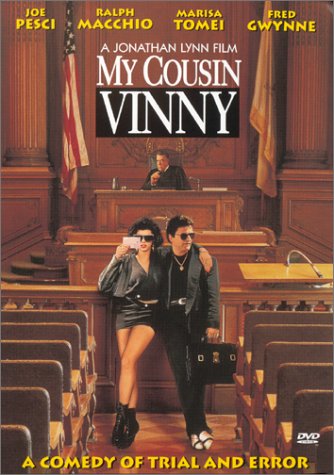
Leo Zanchettin, Prosecuting Attorney

VinnyWell, it’s that time of the year again—the beginning of school and its attendant Rite of Introduction. That’s when you get to meet your kids’ teachers and size them up. Are they the type who live solely by the rules and standardized tests? Are they the kind who have high expectations for their students (a good thing), but don’t know how to help their exceptional students meet those expectations (a not so good thing)? Are they the kind who will look at you like you have two heads when you tell them that your child has an autism spectrum disorder? Will they be quick to respond to your e-mails and questions? Or will you have to pry it out of them?

It’s also the season for IEP meetings. Those wonderful exercises in diplomacy, tact, and tongue-biting. Those opportunities to do penance for your past sins and to try mightily to avoid any future sins.

A Successful Pre-Trial Hearing.

I’ve been thinking about IEP meetings a lot recently, because we have a big one coming up in a couple of weeks. It’s for our fourth child, who is entering third grade this year. Last February, we had a pretty tense gathering with his IEP team at school, when we requested that he be tested and formally recognized as being on the autism spectrum. After a ninety-minute “discussion” on the issue, Katie and I prevailed, and the process of testing him was put into motion.

To this day, I don’t know what turned the tables. For the first hour, I was sure we were going to be denied. But then out of nowhere, the assistant principal began passing out consent forms. Katie thinks it had something to do with the fact that I used the word “irresponsible” in describing the administration’s response to my son’s needs, but I’m still not convinced.

Anyway, the school took all the time it could in conducting the tests, so we couldn’t meet before the end of the school year to discuss the test results. So now we are gearing up for the very important get together, when the school will either agree with us and formally designate him as needing ASD services, or they will give some new variation on the standard line: “he seems fine to us.”

I’m not too worried this time. We’ve got enough evidence from the school’s own testing as well as diagnoses from our therapists to win the day. Granted, schools can be pretty clever when it comes to finding a way out of these things. But we’re getting familiar with the tactics and are learning how to counter them. This is, after all, the third time we’ve been down this road.

I Hate It.

But here’s the thing. I hate these meetings. And not primarily because I have to deal with a skeptical, reluctant team of educators and administrators. What I hate more is the fact that I have to convince them. I have to take them by the hand and walk them through our all the aspects of our son’s ASD.

I have to rehearse every “academically relevant” way in which his disorder manifests itself—including the melt downs over homework and the inability to read social cues and the sometimes tragic, sometimes comical things that come from this inability.

I have to become something of an NSA agent taping his conversations and culling through them to find the evidence of his uneven pragmatic language skills.

I have to pore over all of his testing data, highlighting every deficit so that I can show how it relates to his ASD and how it will affect his ability to move through the curriculum.

I have to give special emphasis to his challenges and deficits and defects (God, I hate that word). When a teacher says something like, “But he’s so cute and charming,” I get to agree, but I can’t dwell on his good qualities for too long. I have to get right back to his needs.

In other words, I have to build a case against my own son, sort of like the way a prosecuting attorney would build a case against a criminal. Because the school will hang on to any positive inkling about him and use it to deny him the services he needs.

That’s what I hate.

Because he’s such a good kid. He’s smart. He’s sensitive. He’s energetic. He’s loving and kind. He’s got the brightest light in his eyes and the liveliest spring to his step I’ve ever seen (yes, he’s a toe-walker). Here he is, my own flesh and blood, and I have the singular privilege of telling a group of low-level bureaucrats everything that’s “wrong” with him.

A Smile on My Face and a Pit in My Stomach.

What’s not to hate?

But we do it, as we’ve done for two of our other children. As we’ll likely have to do for two more. We do it because we want them to get the “free and appropriate public education” that is their right by law. We do it because we want them to be given a fair chance to learn and grow and develop and make a positive contribution in a world that can seem so alien to them. We do it because we love them too much to let them or their school think that just squeaking by is good enough.

So there I’ll be in a couple of weeks, patiently and carefully building a case against my own son. I’ll do it with a smile on my face and a pit in my stomach. And I’ll be praying the whole time that I not lose my cool. Because I want what any parent wants: the best for my kid.

Autism Blues Celebrates 1000 Ausome Things #AutismPositivity2013

autismpositivityflasblog7

So here we are at the end of another Autism Awareness/Acceptance Month. This year, I discovered this really interesting site. It’s a “flash blog” called Autism Positivity. I’m guessing that a flash blog is something like a flash mob. It appears out of nowhere, does something really cool, and then disappears. The goal of this flash blog is to present 1,000 pieces from people touched by ASD—pieces that celebrate the positive side of the ASD constellation.

So what’s “ausome” about being an ASD dad? Simply put: my family.

• First, there’s my oldest, a thirteen-year-old boy with PDD-NOS. Socially, he’s catching up with his peers. He’s beginning to find his “tribe” in the heartless scrum that is middle school. He has a quick wit and a nimble mind. He also has a rich vocabulary. So what if he sometimes can’t distinguish between the literal and figurative speech some of his friends use? It’s helping him learn the ways of that alien species, the neurotypical adolescent.

• Then there’s my twelve-year-old daughter. She is as aspie as they come, and she knows it. And she owns it. And she uses it to her advantage as often as we’ll let her. She can retreat into her own rich, private world for hours but still come out of herself when she sees the need. She clearly marches to her own drummer, but she is beginning to show that she “gets” where her brothers and sister are at. Plus, she has my mother’s smile. What’s not to love?

• Then comes my nine-year-old son, whose Aspergers reminds you of Mozart or Albert Einstein. Intellectually, he’s got enough wattage to light up the Manhattan skyline. He can’t stand to wear denim jeans (“They hurt!”), and he is never happier than when he’s on the computer building new worlds in Minecraft. A passionate soul, he has an exaggerated sense of justice, taking deep offense at every joke or slight. But that same passion can fuel him for hours as he builds complex Lego structures without a blueprint or develops a new outside game for his younger siblings to play.

• Next up, my seven-year-old son, who has high-functioning autism. He has the brightest smile in the universe and the sweetest disposition—when he’s not melting down. And when he does melt down, he recovers with amazing speed and is very quick with a repentant hug and heartfelt words of contrition. He doesn’t quite know how to make friends on the playground yet, but it doesn’t bother him. He’s content just to swing on his own, staring into space dreaming his dreams.

• Then there’s my five-year-old little girl, who has ADHD and may well be aspie. She’s an impish little spitfire of a thing. Some might call her restless or easily distracted. I call her Little Pip because she’s always hopping around. A daddy’s girl from the day she was born, she loves nothing more than a warm cuddle or a kiss on the cheek. What does she dislike? Clothing tags. Hates them with a passion. Now if only I could get her to look me in the eye!

• Then there’s the youngest, a four-year-old boy with PDD-NOS. He too is perpetually on the move—except when he decides to “plank.” He is extremely passionate about Angry Birds—so much so that he will play the game with any projectile he can find. Including his dinner. Which, of course, cannot be eaten sitting down. He is very good at mind-blindedly annoying his siblings. Or his mom. Or his dad. But he often gets a pass, because he does it with such a broad grin that we tend to melt.

• Finally, there’s my wife. (No, I’m not going to tell you her age.) She’s not on the spectrum, so she’s not officially “ausome.” But it doesn’t matter, considering how awesome she is. Day in and day out, she lays down her life for her kids and never complains about the work. No regrets. No recrimination. No remorse. Just a lot of love and a dogged determination to help our kids become the best version of themselves possible. A psychologist friend once told me that raising one special-needs kid is about as demanding as raising three neurotypical kids. So there’s Katie, raising the equivalent of 18 children, and doing it with nothing but grace, wisdom, wit, and energy.

So that’s what’s ausome about ASD. It’s funny, but because we live and breathe this stuff every day, we can’t always tell when our kids are being aspie or being just plain kids. We simply don’t know what neurotypical looks like!

But that’s probably the biggest blessing of all. The labels don’t matter. What matters is the love. What matters is enjoying our kids for the wonderful constellation of gifts and challenges each of them has. What matters is knowing what every dad should know: that to touch your child is to touch heaven itself.

Dude!

Take a look at this story about an aspie fellow trying to survive a conversation with an alien species—in this case a neurotypical alpha male. It’s really quite entertaining, but it also gives a glimpse into all the work that folks on the spectrum often have to put into supposedly normal, everyday interactions. If only the exchange had been videotaped!