“We Are Not Diseased”

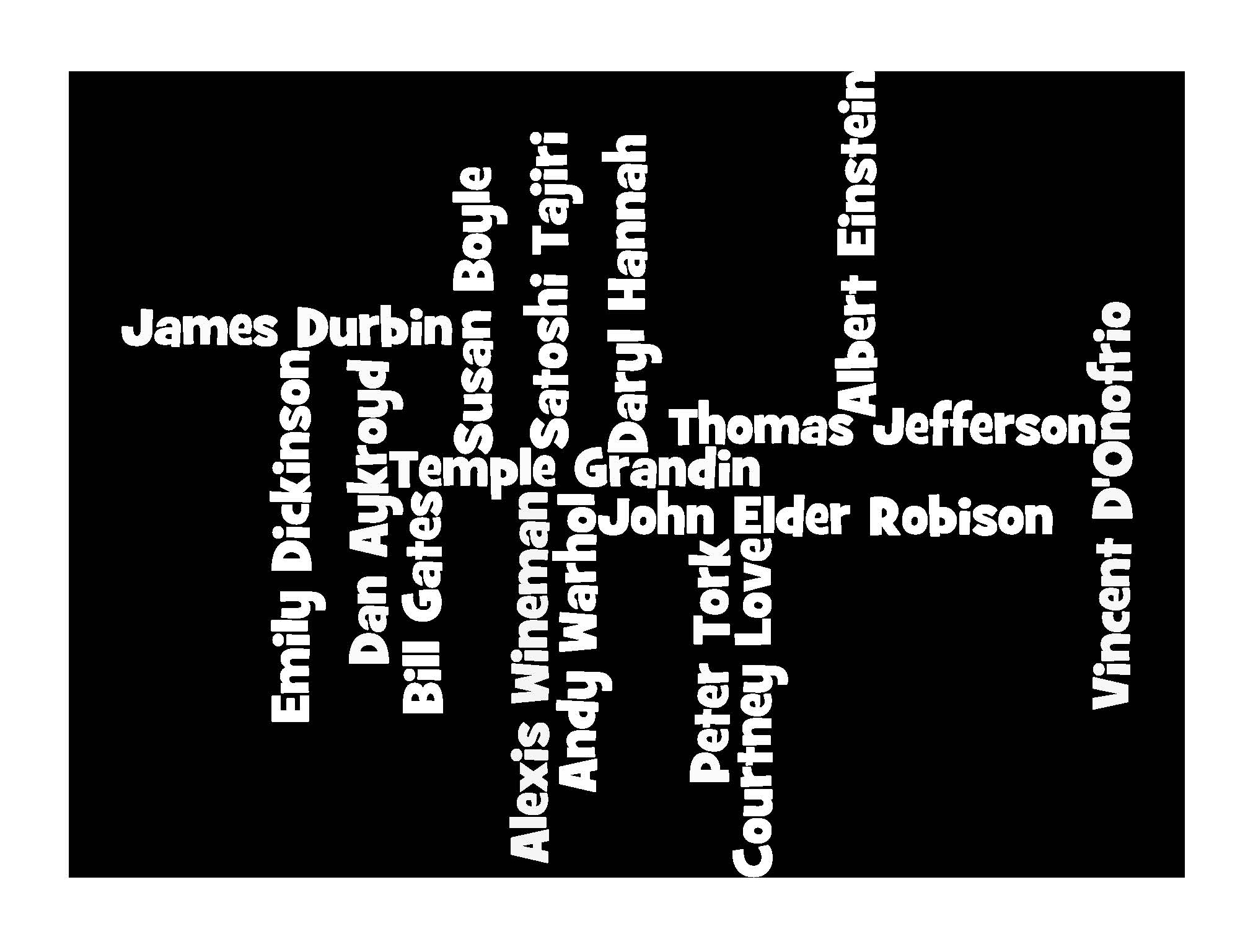
Famous Autistics Word Cloud 5

I’ve been feeling pretty good lately, and I’ll tell you why. My oldest daughter (14) did something that impressed me no end. Her Health class has been studying mental illness for the past couple of weeks. You know, the usual teenage awareness stuff: depression, anxiety, anorexia, suicide. It was all going pretty well, too. No negative blowback from my girl, even though she’s keenly aware of her own diagnoses.

But then the class turned to ADHD, and this happened. Introducing the lesson, her teacher said something like, “Now let’s look at another disease, ADHD.” This prompted my daughter (who has ADHD along with autism) to raise her hand. “Excuse me,” she said, “but ADHD is not a disease. I have ADHD, and I’m just fine.” The teacher, caught off guard, apologized for having misspoken, and then moved on with the lesson. Pretty impressive, wouldn’t you say? She definitely deserved an attagirl for advocating like that.

However, when she told us the story that night, I could tell she was more upset than she let on at school. Because she tries hard to be good in class, she kept her response there short and polite. But she let it all out at dinner. “We’re not diseased,” she declared, pounding the table with her fist. “We’re different, not less. Why do people do this to us? I can’t believe he said this. And he’s a Health teacher. He should know better!”

I couldn’t agree with her more, and I told her so. I also told her how proud of her I was. It was wonderful to see that my daughter has her head screwed on straight and doesn’t tolerate nonsense. She gets that ADHD—and autism, for that matter—is nothing to be ashamed of. She gets that she’s not diseased or locked in to a life of limitations. She has hopes and dreams and ambitions, and she’s determined to accomplish them—no matter how much BS she has to deal with along the way.

A Quick Pivot.

All of this got me thinking about recent events, especially the mass shooting at Umpqua Community College in Oregon. News of that attack seemed to be a kind of tipping point in the gun control debate. With President Obama taking to the podium yet again, this time sounding exasperated and even disgusted, people are talking about gun violence more seriously. And that’s a good thing.

But all this attention has its down side. For every time another mass shooting occurs, talking heads on TV and the radio pivot almost instinctively to the topic of mental illness. They decry the sorry state of mental health care in the country, and suggest that if we only did better at this, massacres like these wouldn’t happen. And when I hear stuff like this, I cringe. 

Stigmatizing the “Other.”

Of course, I’m all for improved mental health care, but there is no real science linking mental illness to mass shootings—or to shootings in general. In fact, those with mental illness are far more likely to be the victims of such catastrophes than the perpetrators. As The New York Times recently reported, “Fewer than 5 percent of gun crimes are committed by people with mental illness; fewer than 5 percent of people with mental illnesses commit violent crimes.” And so I cringe every time mental illness enters the conversation. I can already feel the damage that it will do to people with mental illness.

  • I see the way it stigmatizes them.
  • I see how it turns them into a class of “others” who are alien to “normal” people and inferior to them.
  • I see how, intentionally or not, this kind of talk stirs up fear, which makes it harder for the people to find the acceptance and help they need.
  • I see how it presents them as weak and out of control, when quite often they’re stronger than their peers—with the strength that comes from adversity.

Something else troubles me about this conversation, though. Whenever mental illness is brought up in the context of a mass shooting, autism follows fast on its heels.

Mental What?

I commented on this back in 2012, when MSNBC host and former Florida congressman Joe Scarborough insinuated that James Holmes, the Aurora, Colorado, theater shooter, had autism, and that this was a major reason for his attack. Scarborough’s comments prompted a huge outcry, and he later issued a semi-apology. But it was too late; the damage had already been done.

But now it has happened again. Not long after the Oregon shooting, a Facebook page popped up called “Families against Autistic Shooters.” It was vicious and hateful—and more than a little ill-informed. Fortunately, the page didn’t last very long. But the fact that it showed up at all demonstrates that we still have a lot of work to do.

The speed with which people glide from mental illness to autism is as confusing as it is disheartening. ASD is not a mental illness. It just isn’t. It is a neurological difference (disorder if you must) in which the autistic person’s brain is wired differently from the typical person’s brain. But it’s not an illness. You can’t control it with medication, as you can control OCD or anxiety. You can’t shock it away with electrodes as you can do to severe depression. You can’t “overcome” it through talk therapy or yoga or meditation. You can’t even pray it away. It just is, and the best thing you can do is make room for it.

Words Matter.

I’m not saying that everything is rainbows and unicorns for autistic people—especially those with more severe manifestations of the condition. But let’s not call it an illness or a disease. That’s where the word cloud at the top of this post comes in. It’s a list of famous, successful people, all of whom are autistic. Ask any one of them, and I doubt any one of them would call themselves mentally ill. And they shouldn’t.

Words matter. They tell you what something is—and what it isn’t. If you call a cat a fish, and try to put it in a tank full of water, you’ll be doing an injustice to the cat. (You’ll also end up a bloody, scratched-up mess.) If you call autism a disease and treat it like a disease, you are doing something very similar—an injustice to autistic people. For calling it a disease naturally opens the door to discussions about cures. And that can get pretty dangerous. Just ask the people who have been subjected to bleach enemas and chemical castration in the name of a “cure” for autism.

If you accept that autism is a difference and not a disease, you’ll treat it differently. Instead of spending your time and money looking for a cure, you’ll try to help autistic people navigate a neurotypical world. You’ll dedicate yourself to educating the public about the gifts and talents that autistic people have to offer, as well as the challenges they face. You’ll make it easier for others to accept autistic people for who they are, and you’ll work to eradicate stigmas and bogus information related to it. And that’s how you make autistic people’s lives better.

Lighten Up.

So lighten up on the autism stuff. People with autism already have enough to deal with. Don’t make them scapegoats as well—unless, of course, you want to deal with my daughter.

“I’ll Miss the Kick-Ass Bitch”

jail-cell-bg

The following depiction of a homeless woman with mental illness was posted by my brother on Facebook a couple of days ago. It was so moving that I thought I’d share it with all of you.

A bit of background: My brother is an attorney in the public defender’s office in the suburbs of Baltimore. He acts as legal counsel for those who cannot afford their own lawyer. A good portion of his clientele are drug offenders. Many of them are homeless. Many also suffer from mental illness. And he’s there to make sure they get the legal counsel that is their constitutional right. It’s a job he has had for decades, and he relishes it. Anyway, here’s his story. I dare you to read it and not be moved.

“I Need Help!”

A long-time client of mine who became a dear friend was killed in a hit and run homicide. She was chronically mentally ill. Her illness eventually forced her mother to put her out. She kept coming back to see mom. After a few days, things would get out of hand. Her mother, understandably, had to get a protective order to keep my friend away.

She was on disability, but that paid only enough for her to rent a room in someone’s house. That always ended badly. The police were called. She went from one shelter to another. Again, it would work out for a while, then she would run out of her meds or lose them or have them stolen. She’d be asked to leave. They would eventually ban her because of her behavior. No medication always led to bad things. So my friend would eventually end up homeless. Alone. It was hard for her to be around people. But when everything was under control, strangers liked her. She had a genuine and open smile.

Not too long ago, I was visiting a client who was housed in the same unit as my friend was. She had to be locked in her cell because she had acted up. I heard her screaming louder than anyone could bear to hear, “I need help.” It went on for so long that I had to cut my visit short.

The last time I saw her, in a holding cell just before she was released, she told me that all she wanted to do was hug her mother. Just once. Now, my mother isn’t here to hug. I can’t imagine knowing that mom is not far, but she genuinely needs the law to keep her daughter away. Only one hug.

She died alone. The coward who hit her just kept on going. She was homeless. She was disposable. She was invisible. She was so funny that tears would literally stream down my cheeks when she got on a roll. She told me that when I needed help, the kick-ass bitch (her) would straighten things out. She was a human being. She was my friend. She was a human being.

She died alone on the street.

She was killed early last Monday morning. I found out about it Tuesday afternoon. Wednesday morning, it hit me like a cyclone. Spun me around. I remembered that a friend always says Mass on Wednesdays near my office. I met him in the parking lot, sobbing. He asked the people there to pray for her. They are a small group of retired nuns. Some in their eighties, a few over ninety. They will pray for her. I will pray for her. I’ll miss the kick-ass bitch.

Homeless, Hopeless, Helpless.

It is a sad fact that many people with mental illness end up like this woman—homeless, hopeless, and helpless. Disposable, as my brother said. So many end up in prison because they have nowhere else to go. In fact, there are those who purposely commit crimes so that they will at least have a shot at food and shelter. That’s how low they have fallen. That’s how much society has failed them.

I have written before about my children having comorbid conditions along with their autism: OCD, anxiety, and the like. These are mental illnesses, plain and simple. The only difference between them and this woman is demographics. I make a decent living. Katie and I are able to provide a stable, loving home environment where they can grow and thrive. We make sure that they receive the medical and psychological care they need so that they have a good chance of living independent, self-sufficient lives. Of course, none of this is a sure-fire guarantee, but the odds are significantly better.

Many, many people are not so lucky. They are the forgotten, the ignored, the abused, the ragged people living on the margins. Thank God for people like my brother—true advocates and servants who are committing themselves to helping these people as much as possible!

Survey Opportunity

So a few days ago, I received a note on this blog alerting me to a study being done at Fordham University concerning the effects of spirituality on autism parents. It looks like a really good opportunity parents to help researchers understand one of the most  underreported aspect of many their lives. So I’m posting the note here, and encouraging everyone to participate. Note that it is concerned with how “spiritual variables may contribute to or detract from growth.” So this is meant to look at the topic objectively, and not ideologically.

So take a look at the note, and follow the link for the study. Let’s try to help the researchers get as full a picture as possible. Thanks!

Hello. My name is Elizabeth Tobin. I am a graduate assistant for Dr. Mary Beth Werdel, Ph.D., an assistant professor of Pastoral Care and Counseling at Fordham University in New York. We are conducting an anonymous study to explore spirituality as a coping resource for parents raising a child with an autism spectrum disorder.

The goal of the study is to increase our understanding of the ways spiritual variables may contribute to or detract from growth following the potentially stressful life experiences of raising a child with an autism spectrum disorder. It will take approximately 20 minutes to complete the survey.

I wonder if you could help us find parents by posting a link to the research study on your blog? We would be very grateful for any help you could provide.
If you have any questions about the project you may contact Mary Beth Werdel at mwerdel@fordham.edu

Survey link:
https://fordhamgsas.co1.qualtrics.com/SE/?SID=SV_5sBcgemYr8orrmd

Words from the Unwise

Lawsuit-Officer-handcuffed-elementary-school-students-with-ADHD

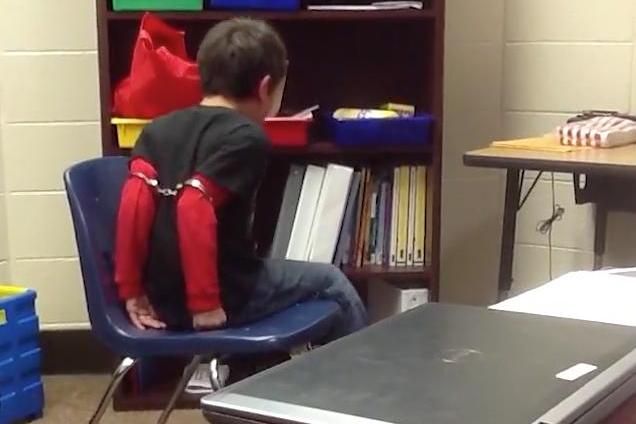
So this bit of news has been making the rounds the past couple of days among autism and other special-needs parents. It seems that in two unrelated incidents, a police resource officer in a Kentucky grade school put an eight-year-old boy and a nine-year-old girl in handcuffs in order to restrain them—cuffing them around their biceps because their small hands would slip through the cuffs. Both students have ADHD, and the girl also had a history of some kind of trauma.

The school was aware of the children’s diagnoses, as was the police officer who cuffed them. Both students had been removed from their classrooms because of disruptive behavior, and when the principal was unable to contain the situations, the officer took over, employing the handcuffs. (Note: watch the video at the top of the article at your own risk. It’s very disturbing.)

According to the report, the girl was especially upset by the situation, to the point of needing psychiatric treatment in a hospital. Understandably, both sets of parents are suing the officer involved.

This is a very sad story, especially in a time when attention has already been focused on police officers abusing their power and mistreating people who live on the margins. These incidents may not rise to the level of Freddie Gray or Michael Brown, but they come pretty darned close.

I don’t want to say much about the incidents—I don’t like stating the obvious or dwelling on people’s stupidity. But I do want to look at the article that described the situation. Actually, not the article (although it does have a couple of really embarrassing typos), but the utterly irresponsible headline that was assigned to it:

Lawsuit: Officer handcuffed mentally disabled kids as punishment.

Disabled? Mentally? What does that even mean? The report only talks about ADHD and some unspecified trauma. It’s not as if the kids had been lobotomized or anything. There’s nothing in the report that indicated the students were “disabled” in the sense that most people understand that term.

It doesn’t take a genius to see how this terminology places a kind of perception filter over the whole story.

“Oh, the kids must have been truly and deeply disturbed.”

“I can understand why the principal let the officer shackle the children.”

“These are mentally disabled kids—it’s not as if they were ‘normal’ kids. I guess it’s okay.”

It may not seem like a huge deal—just a matter of poor wording. But in this time when the Americans with Disabilities Act is celebrating its twenty-fifth anniversary, we don’t need to be going backwards. Remember, it was the ADA that ushered in the era of person-centered language. So we talk about a man with schizophrenia rather than calling him a schizophrenic. We talk about a woman who can’t walk instead of calling her a cripple. And we talk about a child with ADHD rather than calling him mentally disabled. Or at the very worst, we call him a child with a disability.

It shouldn’t be rocket science at this point in our history, and yet here we are. We’re still using hurtful, discriminatory words. Words that justify abuse, fear, and marginalization.

ADHD Hall of Fame.

But that’s not all. Terms like “mentally disabled” give the impression that the kids are slow learners or are academic underachievers. It puts them in a category of “less than,” when there is absolutely no evidence in the article that this is the case. For all we know, these kids could be total freaking geniuses who happen to have ADHD. It’s not uncommon, after all for this combination to occur.

Here, for instance, is a list of some well-known, very successful people who also have ADHD:

  • Virgin Airlines CEO Richard Branson
  • Quarterback Terry Bradshaw
  • Musician Justin Timberlake
  • Pulitzer Prize Winning Journalist Katherine Ellison
  • Comedian Whoopi Goldberg
  • Actress Michelle Rodriguez

Would you call any of them “mentally disabled”?

Words from the Unwise.

It’s possible that the editor who created this headline thought the article would get more views if he or she used a provocative title. Or maybe the editor was trying to allude to the recent police brutality stories. But it was a very poor choice of words. It’s deeply offensive, and it did a huge disservice, both to the story and more important, to the kids.

But hey, I guess we’re making some progress. At least the headline didn’t call the kids retarded.

A Fortunate Slip of the Lip

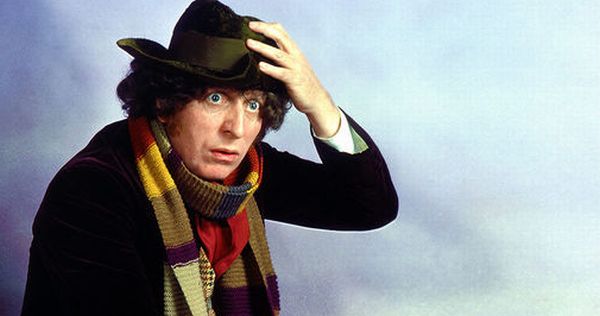
Fourth Doctor Gobsmacked

Note: This post originally appeared as a guest post on the awesome “Confessions of an Asperger’s Mom page. Many thanks to Karen for inviting me to share my story with her readers. You should definitely check out her blog, as well as her Facebook page. She has a lot of wisdom to share.

I could have sworn he was downstairs. Really. I wouldn’t have said what I did if I knew he was in his bedroom—well within earshot. As Katie and I were going up the stairs this afternoon, I was recounting how this kid (#4, nine years old) had taken such good care of his younger brother (#6, six years old) at the neighborhood pool. If I had known he was in his bedroom, at the top of the stairs, changing out of his bathing suit, I would not have said, out loud:

“And [this kid], our autistic son, did really well today. So much for the old myth about empathy!”

“Dad? What does ‘autistic’ mean?”

My heart sank. It was probably the first time he ever heard himself described as autistic.

It’s not that I was hiding it from him. I had been wanting to tell him for some time now. I just didn’t know how to do it. And I didn’t want to manufacture some Hallmark moment where there would be this big reveal and a whole new understanding. I wanted it to be natural and, well, right. (Plus, I was also a little chicken.)

No Good Opportunity.

You see, he’s one of six, and they’re all autistic. His two older brothers and older sister already know about their diagnoses—and they found out more or less by accident as well. At least, it didn’t happen on my terms and in a way that I wanted it to. (Insert chicken squawks here.)

So autism is pretty much the lay of the land in our family, and that means he doesn’t really stick out at home enough to wonder why he’s different. All the kids present a pretty consistent profile of being on the higher-functioning end of the autism spectrum, so he’s got a built-in tribe of autistics to relate to.

He also manages to blend in pretty well with his peers at school—at least so far. He’s only in fourth grade, too which means that his classmates are too busy running around on the play ground to pay much attention to his quirks or language glitches. Plus, he works hard to try to fit in. It’s not perfect, and it can lead him to come home tired, moody, and explosive. But it works.

So there didn’t seem to be any need to explain autism to him. (Squawk!!)

Stumbling into The Talk.

Anyway, there I was, completely unprepared for the talk. But there was no getting around it; I had to answer his question.

I brought him into our room along with Katie, and asked him, “What did you hear me say?”

“You said I was autistic and I have empathy.”

“That’s right. Do you know what empathy means?” (I was stalling for time.)

“No.”

“It means that you care about how other people feel. It means that you can feel their feelings, and you want to help people who feel bad. That’s a really good thing, and I’m so glad you are like that.”

“Okay. What about autistic?”

I hesitated, not sure exactly what to say. Then Katie stepped in and saved me. “It means you think outside of the box.”

O merciful intervention! I knew that this kid thinks too literally to grasp metaphors like that. But that was a good thing; it gave me something concrete to react to. I didn’t have to come up with a complete explanation out of nowhere. The talk was happening all by itself.

Autism Is. . .

So I told him that “outside of the box” means that God made his brain a little different than most other kids’ brains. I talked about the cool gifts this brain gives him, like his laser focus on math and cooking and singing. He’s got some real talents there. Then I talked about challenges like how he can have a hard time putting words together or how he sometimes struggles understanding when someone’s talking to him. I hit on a couple of others, like emotional regulation and his need to jump around and get giddy sometimes. Then came the Big Finish.

“So there’s something a little different about you. That doesn’t make you weird. Just different. Autism isn’t a disease or a sickness. It just makes you special. Got it?”

“Yeah.”

“Any questions?”

“No. Can I go type on the computer now?”

“Sure thing. Knock yourself out.”

No Drama.

And that was that. No fuss. No drama. No nothing. None of the baggage that the world gives to the word autism. None of the baggage that I can give it, either. Just another word to help him describe himself.

In a way, I’m glad that it happened like this. I didn’t have time to worry about developing the perfect speech. I didn’t have the luxury of turning it into a thing, which might risk emphasizing the difference more than I wanted. I didn’t have enough of a chance to screw it up, either.

I also liked the way it became just another thing that happened today. Mind you, I’m not sure how much of it he really grasped. But I didn’t want to push. It doesn’t really matter anyway. We began a conversation today that will unfold and deepen over time.

No Big Deal.

So there you have it. My son found out that he is autistic, and he’s doing just fine. An inopportune-but-opportune moment presented itself, and we did our best with it.

It may not sound like the best approach, but there’s something really appealing and “normal” about things like this happening within the natural flow of everyday life. It helps the kids see that it’s not a big deal. It’s one facet of who they are, and it has no bearing on how much we love them or how much dignity or value they have—in our eyes or in God’s eyes.

That’s four down, two to go. I think I’m getting the hang of this thing. So bring it on!