Who’s Speaking for Whom?

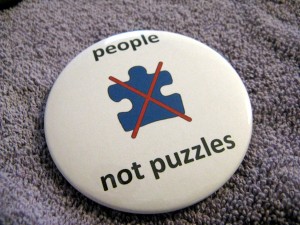
people-not-puzzles-300x225So there was a bit of a dust-up in the autism community this past week. Suzanne Wright, one of the co-founders of the well-known advocacy group Autism Speaks, published an article about the group’s conference in Washington, DC. In the article, Wright characterized families touched by autism in rather vivid terms:

These families are not living. They are existing. Breathing—yes. Eating—yes. Sleeping—maybe. Working—most definitely—24/7.

Wright goes on to describe the challenges that many families with autism face: financial worries, therapy challenges, concerns about their children’s health and safety, anxieties about the future. All in an attempt to rouse policymakers to come up with some kind of strategy to address the coming “national emergency” of all these autistic children growing up and becoming a huge burden on society:

Close your eyes and think about an America where three million Americans and counting largely cannot take care of themselves without help. Imagine three million of our own – unable to dress, or eat independently, unable to use the toilet, unable to cross the street, unable to judge danger or the temperature, unable to pick up the phone and call for help.

It’s an impassioned, heartfelt call—even a demand—for action.

An Aspie Pushes Back.

Well, many people with autism found the letter deeply offensive. They thought that it overemphasized the burden that many families face and, worse, that it dehumanized the people with autism that Autism Speaks purports to speak for. Painting an extreme picture, Wright gave the impression that all people with autism are as helpless as those with the most extreme forms of the disorder. They are all part of a “national emergency” that needs to be addressed immediately. Critics also detected a subtext implying that the goal of Autism Speaks was to rid the world of people with autism: to cure it and prevent it. And they saw in that desire a rejection of who they are.

The article was so one-sided that even a member of the organization’s science board—an fellow with Asperger syndrome named John Elder Robison—resigned his position in protest.

We do not like hearing that we are defective or diseased, he wrote. We do not like hearing that we are part of an epidemic. We are not problems for our parents or society, or genes to be eliminated. We are people.

This isn’t the first time that Autism Speaks has drawn fire like this. In 2009, the organization produced a video, I Am Autism, that also painted a bleak picture of the disorder. In it, autism itself spoke about how it is coming to take away our children, bankrupt us, and destroy our marriages. It spoke, again, as if children with autism were so defective that they were no longer “there.”

A Two-Edged Sword.

All this controversy got me thinking some more about my own experience.

On one hand, I can relate to the picture painted by Autism Speaks. I know what it’s like to be scared about my children’s future. I know what it’s like to feel worn to the bone from dealing with autism-related challenges from my kids. I know how it feels to face financial limitations or to have to explain one or another child’s unusual manner to a neighbor at the park or a stranger at the store. I know what it’s like to grieve when the news of a child’s diagnosis is delivered—I’ve done that one six times!

But that’s not the whole story. My kids aren’t problems. They aren’t the sum of their challenges. They are smart, funny, and innocent. They are perceptive, clever, and talented. The more I get to know what makes them tick, the more I am learning that autism is behind some of the things that make them so awesome.

Moving toward Acceptance.

I see how Autism Speaks’ approach can strike a chord, especially among those with young children or those struggling to embrace a recent diagnosis. In a sense, they’re saying, “Hey, we get it. It’s hard. It’s painful. It’s scary. But you’re not alone. We’re here, and we understand how tough this is.”

I don’t think, however, we’re meant to stay at this point of feeling overwhelmed, terrified, or devastated. In each autism-touched family that I know, there comes a point when everyone calms down, takes a breath, and readjusts their expectations. There comes a point when they are able to look past the label and see the beauty and goodness in their children. It’s supposed to be a natural progression, like the five stages of grief identified by Elisabeth Kübler-Ross: denial, anger, bargaining, depression, and acceptance. Sooner or later, you have to get to acceptance. You can’t stay stuck in anger or depression. You have to keep moving—if only because your kids are moving, and you have to keep up with them!

By constantly banging the drum about a national epidemic, by playing the fear card over and over again, organizations like Autism Speaks inhibit people from moving to the point of accepting their children as precious gifts from God. They also are complicit in fostering a kind of victim mentality in families touched by autism. “Look at how hard our lives are. Look at how damaged our children are. Pity us! Help us!”

Who’s Talking?

In the past, I supported Autism Speaks 100 percent. I wore their lapel pin and wrist band to help raise awareness. I followed their blog. I attended seminars sponsored by them. I even raised a good amount of money for them.

But now I’m not so sure. As John Elder Robison said, I’m not sure that Autism Speaks really does speak for my kids. I don’t want my kids growing up feeling like victims. I want them to be victors. I want them to use all their gifts—even the ones that autism has given them—to show the world that people like them can make a huge difference. I want them to embrace everything about who they are, even their autism, and turn it into something that glorifies God and lifts up the people around them. And they can’t do that if they think of themselves as problems or burdens.

Autism awareness is important, but only if it leads to acceptance. Not just pity or tolerance but acceptance.


Hey! Dads Rock Too!

I had a good chuckle when I came across this blog post today. Called, “20 Reasons Moms of Kids with Special Needs Rock,” it has such gems as “Because we have bad days and breakdowns and bawl-fests, and then we pick ourselves up and keep right on going,” and “Because we never stop pushing for our kids.”

Lists like these are fun to read because while they do give some insights, they mostly include items that we can relate to—items that most parents of “typical” kids have often no clue about. But it struck me that dads need the occasional shout-out as well. After all, they have their part to play as well. At least they should be playing their part! So without too much tought, all in good fun, and in no particular order, I would like to propose to you . . .

Image

20 Reasons Why Dads of Kids with Special Needs Rock

1. Because we are sticking with it, day in and day out, when many dads give up or skip out. No wimps here!

2. Because we listen to our wives’ worries, fears, and frustrations patiently without trying to “fix” everything.

3. Because we take on our share of the load in everything, including the laundry and the diapers and the dishes.

4. Because we fight for our kids at every IEP meeting, never backing down or giving in.

5. Because many of us work 40-plus hours a week and don’t bat an eye when we come home to absolute chaos. We just dive right in and get to work.

6. Because we guard date night jealously, even zealously.

7. Because we have memorized the alphabet soup of our kids’ diagnoses—and we understand what they mean

8. Because we know that marriage is not about gourmet meals, nightly sex, and an immaculate house.

9. Because we have no problem staring down the gawkers at the mall and in the park.

10. Because we know what “fun” means to our kids, and we aren’t too proud to share it with them. Even if it means wearing silly hats or rolling around on the floor.

11. Because we know how to “gently” restrain a flailing, screaming, melting-down child.

12. Because we don’t complain when the money earmarked for our favorite hobby has to go to insurance or a new therapist instead.

13. Because we don’t care if the other “dudes” our age seem to be having more fun.

14. Because we never say, “That’s her problem, not mine.”

15. Because we have learned how to suck it up and not gripe and complain. Especially not to our wives. Most of the time.

16. Because we can spot the difference between a spoiled-brat tantrum and a genuine melt down at twenty paces. And we know how to respond accordingly.

17. Because we don’t mind when our wives fall asleep on the sofa at 8:30 in the evening.

18. Because special-ed teachers tremble when we enter the room.

19. Because we have learned how to see goodness, beauty, and progress in every tough situation.

20. Because we never, ever, ever give up.

Do They “Get” Religion?

We had quite a bit of drama last Sunday over getting the kids to church. One in particular—our second, a 12-year-old girl with Aspergers—gave us a lot of grief. First, there was the feigned illness excuse. Then there was the pulled muscle stratagem, in which she faked a sore back because she had been throwing the football with her brothers the day before. Then, when all else seemed lost, she pulled a very clever ploy: the constipation gambit. Just one minute before we absolutely had to get out the door, she ducked into the bathroom, locked the door, and protested that she really had to go, warning us that it would take a long time.

By this point, I was done. I had been working with the others, trying to get them ready, all the while fielding this girl’s anxious protests. So by the time she played her final card, I gave up and told her to stay home. I also made sure that the computers were not accessible. I may have been done, but I was not going to be anybody’s fool!

Then came the afternoon, when she was set to go to Sunday school, or CCD as we Catholics call it. She had sworn up and down all day that she would not try to get out of it, but as soon as the time came, the same old excuses came up. Only this time with far more emotion: desperation, anxiety, fear, anger, recrimination, exaggeration. You name it, she threw it at us. Again it was clear that, short of physically throwing her in the car and dragging her to class, it just wasn’t going to happen. (Note: she’s big for her age, and not all that easily moved. If I were to try the physical approach, I would likely look like an abusive dad.)

This was all so frustrating for me. This girl is getting close to her confirmation, and to this point everything related to God or faith or the Church has been a struggle. As you can guess from previous posts, I take my faith pretty seriously, and one of my highest goals is to see all my kids come to a personal embrace of their faith, just as Katie and I have. But this is probably the best picture of how this girl’s guardian angel must feel on Sundays.

Image

Literal Brains, Spiritual Truths.

It took me a few years to get to the point where I’m not all that surprised by this. For quite a while I tried to force my expectations on them, wondering if they would ever accept the faith that is so important to Katie and me. It’s hard to admit that this may never happen because of their ASD, but I’ve come to realize that it’s a very real possibility, if not a downright probability.

After all, teenagers on the autism spectrum tend to have a harder time with religion than their neurotypical peers. ASD kids are very concrete thinkers. Inference and abstraction are foreign concepts. So the thought of an invisible Person whose presence and influence can be detected by intuition and emotion can seem absurd. Aspies tend to be fiercely independent and unwaveringly evidence-based, so there’s not much room for faith in a brain like that. There’s not much room for the idea of submitting one’s heart and mind to an exterior, mysterious God. If my girl were in the upper room with St. Thomas, she would have outdone him in his demand to probe the wounds of Christ before believing that he had risen from the dead.

All this can make the whole idea of a religious service, whether it’s a solemn Mass or a nondenominational electric guitar-fueled gathering, extremely foreign. Then, when you consider all the sensory issues involved—incense, lots of unfamiliar people, loud music, all that sitting and kneeling and standing—it’s a melt down waiting to happen.

At times this has left me wondering if I should even bother to teach the faith to my children. Maybe it would be better just to aim for good, moral kids who stay out of trouble. If their brains are wired so differently, why pretend they’re going to “get it” anyway?

Meeting God.

But I just can’t do that. I may have to accept a different script for my children’s lives than I had intended, but I’m still not giving up. For all the trouble it can cause, and for all the creativity it can demand to get them to Mass, I still believe it’s worth it.

That’s because I believe in a God who acts—and who acts dramatically. You see, while many of my convictions about religion were formed by the Catholic intellectual tradition—I studied philosophy and theology at a Catholic liberal arts college—these convictions came to life for me because of a deep interior conversion experience.

It’s a long story, but suffice it to say that when I was a junior (32 years ago this month, in fact), I had an experience of God that was intensely personal. Everything I had learned in my brain became real to my heart, and I was convinced beyond a shadow of a doubt that God was real, that Jesus loved me, and that his Holy Spirit was alive and working in my life. I felt a joy I had never known before, as well as a freedom from guilt and a new sense of purpose to life. I’m convinced that without this experience, I would have lost interest in God years ago.

That’s why I’m not giving up. I know that God is bigger than ASD. I know that he loves my kids. And if he loves them, he can’t help but want to show them his love. So I believe that somehow, somewhere, in some manner, he will do for my children what he has done for me. He’ll make himself known and touch their hearts. I don’t know when. And I certainly don’t know how. But I believe deeply that he will do it. I just have to adjust my expectations of what that will look like.

Doing My Part.

So in the mean time, I’ll keep doing what I can. I’ll keep making sure that they have the data in their minds so that when God moves, it can transfer to their hearts. I won’t try to force faith on them. And I certainly won’t get my expectations too high about their emotions or their spiritual intuitions. Where some of my friends’ older kids are beginning to own their faith, I’m not expecting my kids to do that any time soon. At this point, my main concern is to make sure that the information is there. It’s to help them feel as comfortable as possible in church. I know they may never be all that comfortable. But at least it’s a start.

So here I am doing my part. The rest is up to you, God. Good luck!

And if it never happens for them, if they never “get” the experience I had, I won’t sweat it. As I said above, God is bigger than ASD. He’s also bigger than any one model of religious experience or salvation. Even if they can simply come to accept the premises of faith and try their best to live an upright life, I’ll be happy.

Because you made them the way they are. You know who they are. And you won’t let them down.

Blues Radio

web-maxell-blown-away-guyYesterday was an easy Saturday, when I had the luxury of running a few errands on my own. Normally, I enjoy these rare events when I can get out and knock a few things off my to-do list. But today was different. I just couldn’t slow down my racing mind as I drove around town. Like a car radio that was stuck in “Seek” mode, I kept changing stations from one worry to another.

<click> To thoughts about one of my daughters, whose perseverations and OCD-like anxiety have increased dramatically the past few months. On the short, ten-minute drive to her tumbling class last week, she asked Katie over and over and over again, “Are we going to be late? I can’t be late. Please hurry up, Mom, I don’t want to be late. My friends won’t like me if I’m late.” (Katie left ten minutes early to stave off these worries—but to no avail.)

<click> To thoughts about another son, who can’t control himself when a cascade of negative emotions comes over him. The slightest word of correction will send him into a rage, as will the smallest disappointment or denial of a preferred activity. I have worked and worked with him, trying to teach him “cooling thoughts” and self-calming activities, but none of it helped. Now we have to turn to medication to help regulate his emotions.

<click> To thoughts about how to convince a glacier’s-paced school system to give my son the help he needs in social and pragmatic language skills. He’s a whiz at simple mathematics and spelling, but he doesn’t always get nonverbal cues, and he can have a hard time expressing himself clearly. The inferential thinking involved in reading comprehension and word problems is a challenge for him, but his teachers are reluctant to do more, since his other skills are buoying up his grades. “He’s not failing, so what’s the problem?”

<click> To thoughts about the son who can spend hours at a time in his room watching his favorite YouTube personalities talk about video games. His self-isolation is giving him a short temper with his siblings and keeping him from the few friends he has. But it’s like pulling teeth to get him to interact.

<click> To thoughts about finances and all the visits to therapists, psychiatrists, counselors, and doctors for everyone. And then there’s the private, Aspergers-only school our two oldest ones attend—and which at least one more will likely end up in.

<click> To thoughts about our daughter the hoarder and what it’s going to take to get her to part with some of the things she has collected—or at least organize her bedroom so that we can see the carpet. And to thoughts about what makes her so anxious that she feels such a deep need for all these toys. For a recent overnight trip, she stuffed more than twenty of her plush Pokémon figures into a backpack just to keep them by her side. They never saw the light of day, but she refused to be parted from them. “They help keep me calm.”

Daddy’s Home!

By the time I had finished my run and was pulling into our neighborhood, I was feeling pretty depressed. So many unanswered questions. So many problems needing to be solved. So many signs pointing to the challenges my kids have yet to face. (Not to mention, my errands were a bust. No store I visited seemed to have anything I was looking for.)

This is what it can be like living with autism and Aspergers—especially in a world that reduces things and people down into their various components. You wind up seeing everything in terms of the goal, the challenge, the problem, the next “thing” that needs to be addressed. With so many kids on the spectrum, Katie and I have to juggle a variety of diagnoses and an even wider array of manifestations of them. So it’s easy to focus on the problems and miss out on the bigger picture.

It took me a while to come back down to earth and remember that my kids are more than the conglomeration of their problems. It helped a lot when, as I walked through the front door, our youngest popped up off the sofa and ran to me, his face beaming with delight. “Daddy! You came home! I missed you so much!” Then his brother, four years older, came down from his bedroom and shouted, “Yay! Daddy’s home!” and then began jumping up and down with great gusto and doing his signature spinning headstand on the sofa.

None of the challenges went away, of course. They are all very real and still demand my attention. But none of them can overshadow the innocence that these kids have. Even my oldest two, for all their adolescence, have a childlikeness about them that melts my heart. They all have their melt downs and tantrums, but they still have that wide-eyed wonder and openness that tells me there’s still loads of hope. It’s when they shut out the world—or shut me or Katie out—that I need to be concerned.

I suppose the fact that I see my kids in such a reductive way every now and then is, I suppose, to be expected. I’m just glad that today my kids helped me move beyond this partial vision so that I could see with my heart and not rely on my racing mind.

The next time I’m out on my own, I’ll listen to NPR.

Dissecting a Victory

So today was the big day. We had our eligibility meeting at the school to determine if our fourth child, a third-grader, qualified as being on the autism spectrum according to the school district’s definitions. And I’m happy to report that the IEP team (consisting of the school psychologist, the speech therapist, our son’s teacher, the assistant principal, our private psychologist, and Katie and me) all agreed that he met the district’s criteria for being identified as ASD.

A Good Day.

On one level, not much has changed as a result of this new designation. He is still receiving the same services he received under his previous designation as “Language Impaired.” We’ll revisit his Individualized Education Plan later in the school year to see if he needs more help than he’s currently receiving.

But having him identified as being on the autism spectrum is also a safeguard for the future. Should things go downhill for him in the social/emotional sphere, as it has done for our older daughter, school officials will know that part of it is because he has autism. And that will alter the way they intervene and how they will help him.

Should he run into further glitches in his auditory processing, his short-term memory, or his ability to adapt to new surroundings (like changing classes in middle school), it will be that much easier for accommodations to be put in place to help him.

And since kids on the autism spectrum tend to be literal thinkers, it will be easier for him to access special-ed helps as the curriculum begins to demand more inferential thinking and not just rote memory or quick calculations. He can learn these skills, but he’s probably going to need more help in making the jump from the literal to the figurative.

So this was a good day. It was a long time coming, too—the fruit of a couple of very tense preliminary meetings and hours and hours of preparation on our part. It came after we had to challenge the previous assistant principal’s thinly-veiled insinuations that we didn’t know what we were talking about and that she was the real expert in autism. It came after a couple of years of seeing his school-related melt downs increase in frequency and intensity. And it came on the heels of two similarly long-fought victories for his older brother and sister. That makes us three for three. Quite a lot to celebrate, don’t you think?

Walking a Rocky Road.

So why, as Katie and I left the meeting with our son’s new designation in hand, did I not hoot and holler in victory? Why was there a lump in my throat instead of a smile on my face?

Because my son still has autism. Because yet another official organization has recognized—and thus reminded me—that he has a disability that will impair him for the rest of his life.

Don’t get me wrong. I’m glad for what we did. It’s going to protect our boy through his entire educational career. It’s going to open the door to a set of services and accommodations that will help him learn how to live in this strange world filled with neurotypical people.

But I know that through that door lies a path of misconceptions and of challenges that I wish he would never have to face. A path where potential friends may not understand him and may even reject him.

A path where potential employers may not see the gifts he has to offer.

A path where the joys and comforts of a family of his own may be forever elusive.

It’s a rougher, rockier path than most of his peers will be walking. And that’s never a fun thing to think about.

A Sobering Reminder.

We got a stark illustration of this just a few hours after that all-important IEP meeting. Katie called me at work to let me know that our boy had had a rough day at school. Because he didn’t complete a homework assignment over the weekend (we thought he had), he received a 40% grade.

It wasn’t a huge assignment, and it wasn’t a big deal. But in his literal brain, it was a complete and total failure. He came off the bus with his fists clenched, his brow furrowed, and his jaw trembling in a heartbreaking mix of anger and shame. Katie tried to help him work through it, but the rest of the afternoon was a complete loss: melt downs over new homework, high-pitched tantrums at his “annoying” younger brother, and anxious, hyperactive “stimming” that was so intense that I was afraid he might hurt himself.

He did calm down eventually, and we got his homework done. In fact, once he got all his frustration and anxiety out, he sailed through most of the work. He’s a pretty smart kid, after all. He just needed to expend himself before he could get his brain back in gear.

So this is the challenge he will be facing—and Katie and me along with him: how to manage the down side of his autism so that all his gifts and talents can shine. Because he really is a sweet, innocent, affectionate, intelligent, perceptive fellow. He has so much to offer. There is so much he can accomplish. He has the potential to enrich the lives of countless people. He just needs more help than most in getting there. He may have some serious glitches, but he’s an awesome kid. I just want everyone else to be able to see that.

It’s our hope that today’s “victory” will help this happen.