Hey, Look! We’re on the Internet!

IMG_2390

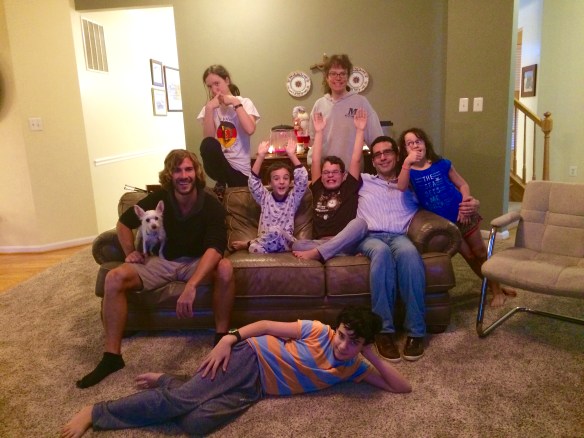
No, seriously. Christopher Ulmer, a young special-ed teacher from Florida, came and interviewed us for a project he’s working on called Special Books by Special Kids. He’s been traveling the East Coast recording  his encounters with special-needs families along the way.

Here’s a link to the video. Just about all of the kids show up—all except our youngest, who was too wrapped up in video games to be bothered with an interview. Enjoy!

The Best Christmas Present Ever

IMG_2299

Some random thoughts as I watch my son perform in the Frederick Children’s Chorus Christmas concert.

  • I never thought I’d see this day. This is the kid who didn’t talk until he was four years old, and here he is on stage, singing! This is the kid who couldn’t sit still to save his life, and here he is patiently and carefully following the director’s every move. This is the kid who could zone out at any point and lose track of his surroundings, and here he is completely and totally engaged in the concert.
  • Look at him up there singing so enthusiastically! That autistic black-and-white thinking has enabled him to focus so completely on getting everything right, just as he has practiced it for the past four months. He is doing everything exactly as he has been taught. Every movement executed with great precision. Every word enunciated clearly and crisply. That smile radiating so innocently.
  • Seeing him so dedicated to the performance here helps me understand what he meant when he complained about chorus practice a few weeks ago. He didn’t enjoy it, he told me, “because it was too much fun.”
    — “What? I can understand not fun enough, but how can you have too much fun?”
    — “Oh, you know, all the other kids were goofing off too much, and I wanted to get down to work. They were having too much fun when I was serious about learning the music.”
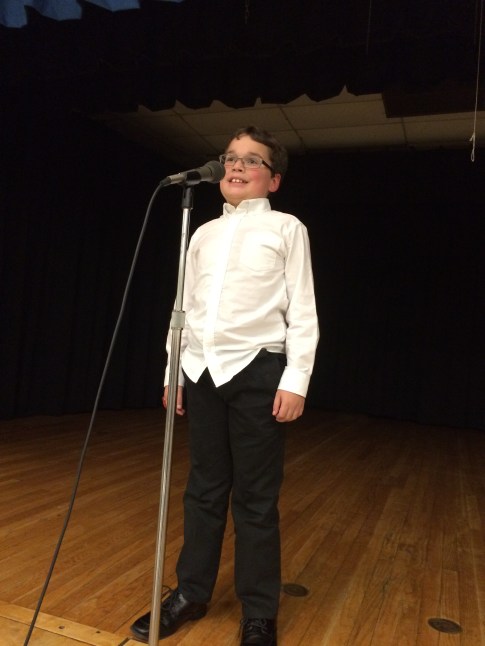
  • See that picture up there? That’s the same kid at his school’s winter concert. Yes, he is in two choruses—the school chorus and the much more competitive citywide chorus. At the school’s concert, not only did he sing in the chorus, he had a solo. My son. On stage. By himself. With a microphone.
  • I used to wonder what the future looked like for him. Would he be able to live on his own? Would he find a job? Friends? Love? Now I’m dreaming about how far he’ll go in life. It seems like the sky’s the limit for this kid.
  • His other passion, in addition to music, is cooking. He often helps Katie around the kitchen. Just the other night he and I baked Christmas cookies together. He was so confident and competent, so invested in what we were doing, so willing to learn and experiment. I don’t doubt for a minute that his dream job—owning his own restaurant—is within reach. It’s not just a pipe dream that I humor; it’s a real goal that I absolutely can see him accomplishing.
  • I see what you can do, son. When I remember what you were like a few years ago and see what you are accomplishing right now, I am convinced that your future is very bright. It’s so bright that my eyes are beginning to sting. Hang on a second while I wipe them with this tissue.
  • This is the best Christmas present I could ever receive.

Soooo Tired . . .

Madeline Kahn Tired

How tired am I? Let me count the ways.

Physically, I’m tired from the early morning wake-ups from the youngest and the late-night conversations with my wife about the kids’ various challenges.

Emotionally, I’m tired from managing melt downs, redirecting perseverations, calming anxieties, and comforting socially unaware kids.

Mentally, I’m tired from attending doctor appointments with my kids and trying to keep track of which child uses which medicine, and the various effects and side effects each one experiences.

Organizationally, I’m tired from trying to figure out how to schedule therapy sessions for the kids and still keep on top of my fifty-hour-a-week job, as well as take care of Katie. And myself.

Motivationally, I’m tired from trying to help the kids who tend toward anxiety to keep moving forward and not give in to their frustrations.

Spiritually, I’m tired from battling dealing with my own bouts of fear, frustration, and anxiety.

Yes, I’m tired. And if I’m tired, just imagine how tired my kids must be. But that’s a different subject for a different post.

An Attitude against Platitudes.

I don’t like to complain because I don’t want sympathy or, worse, pity. But the plain truth is that this autism parenting gig is hard work. There are so many twists and turns to ASD that it’s next to impossible to try to plan for the next challenge. Because every person with autism is mind-bogglingly unique, there is no reliable road map to guide you through the terrain. And because most other ASD parents are worn out traveling their own path, it can be hard to connect with fellow travelers—at least anyone  who has the time and energy to listen. (Thank God for Facebook!)

So if I don’t like to complain, why am I . . . complaining? Because every now and then I like to offer a corrective to the platitudes that special-needs parents can hear. Sayings like:

  • I don’t know how you do it.
  • God only gives special kids to special people.
  • You must be really strong to handle all of this.
  • I could never do all that you have to do.

PTSD Parents.

Mind you, these sayings are usually offered in good faith and come from a place of love and respect, so I don’t want to dismiss them—or the people who say them. But idealizing special-needs parents can be similar to the way we lionize the men and women in the military. We call them heroes and warriors and guardians of our freedom. And usually that’s what they are. But such vaunted language can cloak the emotional and psychological trauma that many who have been in combat have experienced. We sanitize the brutality and dehumanizing power of war by putting “Support Our Troops” magnets on our bumpers and applauding soldiers in the airport. But these very soldiers are bearing a burden few of us can imagine—and the Veterans Administration is woefully underfunded..

I don’t mean to compare my experience to that of someone who has been shot at, or worse, who has had to kill a fellow human being. But according to a University of Wisconsin study, parents of special-needs children often exhibit stress levels comparable to combat soldiers. In fact, many of these parents are diagnosed with PTSD or situational depression. And looking back on some of the instances of high drama we’ve experienced over the years, I can easily see how this is the case. As I said above, this is hard stuff.

But back to the not complaining point. The thing is, we don’t think about how hard it is all the time, so we don’t usually complain. It usually happens only when we get really, really tired. Usually  we’re just too  busy trying to keep up and keep awake. It’s not that we’re heroic; it’s just that we love our children. Like any other parent does.

Nothing Special.

So to those who say, “I don’t know how you do it,” the answer is easy: I’m not aware of any alternatives. You don’t count the cost when someone you love needs you. You just do what you need to do.

Anyway, thanks for reading. I didn’t have a major point to make. I just wanted to get this off my chest. Katie and I are not heroes. We’re not special or extra blessed. And I’m sure most of you, if not all of you, would handle our situation just as well as we are doing—and maybe a whole lot better! We’re just everyday people trying to take things one day at a time. And we’re tired.

So. . . . Very. . . . Tired.

P.S. For those who don’t recognize it, the picture at the top is of the incomparable Madeline Kahn, as Lili von Shtupp, singing the song, “I’m Tired” in Mel Brooks’ Blazing Saddles. Here’s a link to the song. And if Mel Brooks isn’t your thing, well that’s a crying shame. Let me offer you a different visual.

Tired-Minion-Coffee-Best-Funny-iPAD-iCloud-WallPaper

“We Are Not Diseased”

Famous Autistics Word Cloud 5

I’ve been feeling pretty good lately, and I’ll tell you why. My oldest daughter (14) did something that impressed me no end. Her Health class has been studying mental illness for the past couple of weeks. You know, the usual teenage awareness stuff: depression, anxiety, anorexia, suicide. It was all going pretty well, too. No negative blowback from my girl, even though she’s keenly aware of her own diagnoses.

But then the class turned to ADHD, and this happened. Introducing the lesson, her teacher said something like, “Now let’s look at another disease, ADHD.” This prompted my daughter (who has ADHD along with autism) to raise her hand. “Excuse me,” she said, “but ADHD is not a disease. I have ADHD, and I’m just fine.” The teacher, caught off guard, apologized for having misspoken, and then moved on with the lesson. Pretty impressive, wouldn’t you say? She definitely deserved an attagirl for advocating like that.

However, when she told us the story that night, I could tell she was more upset than she let on at school. Because she tries hard to be good in class, she kept her response there short and polite. But she let it all out at dinner. “We’re not diseased,” she declared, pounding the table with her fist. “We’re different, not less. Why do people do this to us? I can’t believe he said this. And he’s a Health teacher. He should know better!”

I couldn’t agree with her more, and I told her so. I also told her how proud of her I was. It was wonderful to see that my daughter has her head screwed on straight and doesn’t tolerate nonsense. She gets that ADHD—and autism, for that matter—is nothing to be ashamed of. She gets that she’s not diseased or locked in to a life of limitations. She has hopes and dreams and ambitions, and she’s determined to accomplish them—no matter how much BS she has to deal with along the way.

A Quick Pivot.

All of this got me thinking about recent events, especially the mass shooting at Umpqua Community College in Oregon. News of that attack seemed to be a kind of tipping point in the gun control debate. With President Obama taking to the podium yet again, this time sounding exasperated and even disgusted, people are talking about gun violence more seriously. And that’s a good thing.

But all this attention has its down side. For every time another mass shooting occurs, talking heads on TV and the radio pivot almost instinctively to the topic of mental illness. They decry the sorry state of mental health care in the country, and suggest that if we only did better at this, massacres like these wouldn’t happen. And when I hear stuff like this, I cringe. 

Stigmatizing the “Other.”

Of course, I’m all for improved mental health care, but there is no real science linking mental illness to mass shootings—or to shootings in general. In fact, those with mental illness are far more likely to be the victims of such catastrophes than the perpetrators. As The New York Times recently reported, “Fewer than 5 percent of gun crimes are committed by people with mental illness; fewer than 5 percent of people with mental illnesses commit violent crimes.” And so I cringe every time mental illness enters the conversation. I can already feel the damage that it will do to people with mental illness.

  • I see the way it stigmatizes them.
  • I see how it turns them into a class of “others” who are alien to “normal” people and inferior to them.
  • I see how, intentionally or not, this kind of talk stirs up fear, which makes it harder for the people to find the acceptance and help they need.
  • I see how it presents them as weak and out of control, when quite often they’re stronger than their peers—with the strength that comes from adversity.

Something else troubles me about this conversation, though. Whenever mental illness is brought up in the context of a mass shooting, autism follows fast on its heels.

Mental What?

I commented on this back in 2012, when MSNBC host and former Florida congressman Joe Scarborough insinuated that James Holmes, the Aurora, Colorado, theater shooter, had autism, and that this was a major reason for his attack. Scarborough’s comments prompted a huge outcry, and he later issued a semi-apology. But it was too late; the damage had already been done.

But now it has happened again. Not long after the Oregon shooting, a Facebook page popped up called “Families against Autistic Shooters.” It was vicious and hateful—and more than a little ill-informed. Fortunately, the page didn’t last very long. But the fact that it showed up at all demonstrates that we still have a lot of work to do.

The speed with which people glide from mental illness to autism is as confusing as it is disheartening. ASD is not a mental illness. It just isn’t. It is a neurological difference (disorder if you must) in which the autistic person’s brain is wired differently from the typical person’s brain. But it’s not an illness. You can’t control it with medication, as you can control OCD or anxiety. You can’t shock it away with electrodes as you can do to severe depression. You can’t “overcome” it through talk therapy or yoga or meditation. You can’t even pray it away. It just is, and the best thing you can do is make room for it.

Words Matter.

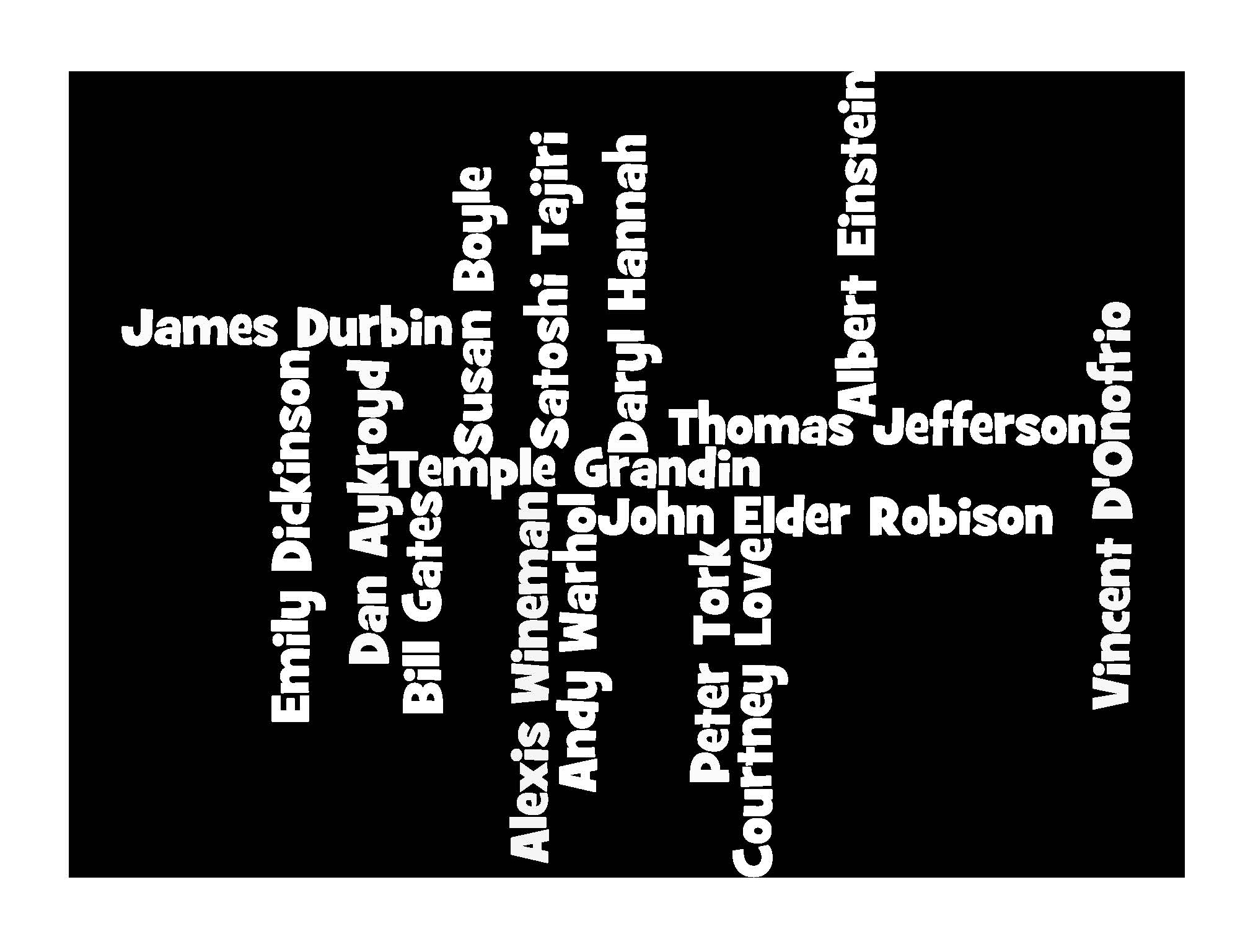
I’m not saying that everything is rainbows and unicorns for autistic people—especially those with more severe manifestations of the condition. But let’s not call it an illness or a disease. That’s where the word cloud at the top of this post comes in. It’s a list of famous, successful people, all of whom are autistic. Ask any one of them, and I doubt any one of them would call themselves mentally ill. And they shouldn’t.

Words matter. They tell you what something is—and what it isn’t. If you call a cat a fish, and try to put it in a tank full of water, you’ll be doing an injustice to the cat. (You’ll also end up a bloody, scratched-up mess.) If you call autism a disease and treat it like a disease, you are doing something very similar—an injustice to autistic people. For calling it a disease naturally opens the door to discussions about cures. And that can get pretty dangerous. Just ask the people who have been subjected to bleach enemas and chemical castration in the name of a “cure” for autism.

If you accept that autism is a difference and not a disease, you’ll treat it differently. Instead of spending your time and money looking for a cure, you’ll try to help autistic people navigate a neurotypical world. You’ll dedicate yourself to educating the public about the gifts and talents that autistic people have to offer, as well as the challenges they face. You’ll make it easier for others to accept autistic people for who they are, and you’ll work to eradicate stigmas and bogus information related to it. And that’s how you make autistic people’s lives better.

Lighten Up.

So lighten up on the autism stuff. People with autism already have enough to deal with. Don’t make them scapegoats as well—unless, of course, you want to deal with my daughter.

No Rules, New Rules, One Rule

IMGP4810

So last night, the Fourth of July, held a minor victory as our oldest kid did pretty well facing his fear of fireworks. All the kids did pretty well, in fact, with each one showing a little more improvement in the sensory processing realm. Plus, they got to stay up later than usual. Mind you, we didn’t go anywhere for fireworks. We’re just talking about the small-time crackers and roman candles that some folks in the neighborhood set off. Still, progress is progress.

Anyway, this morning we ended up paying for the late night and the extra stimulation. As we were trying to get everyone ready for Mass, we were presented with two very strong tantrum-melt downs from two different kids, one stubbornly tired kid who could barely keep his eyes open, and another one exceedingly anxious about the her siblings’ potentially bad behavior in church.

We tried to roll with it. We really did. But after a while we realized that Mass just wasn’t going to work. It was too risky. So we played hooky. Sort of. Rather than go to our local church, which is only a half-mile away, we loaded everyone in the van and drove twenty miles to Mount St. Mary’s University–my alma mater of a Catholic college.

A Mini Pilgrimage.

The van is a safe zone. Each of them can enter their own world, whether by staring out the windows or by putting on their head phones and listening to music or by taking a quick nap. It’s one way to help them press the reset button, and that’s pretty much what happened. By the time we arrived, they were doing better. Not great, but better.

We spent about an hour there, walking the nearly empty campus and visiting the Grotto, which is a replica of the shrine to the Virgin Mary at Lourdes, France. We ended with a visit to the grotto chapel, where I had the kids sit as quietly as possible for as long as possible (5 minutes) and told them to try to pray. Then we read the Gospel reading they would have heard if they had gone to Mass, I said a few words about it, and we left. Nothing big. Nothing dramatic. And no other people around.

The kids did pretty well overall. We did have to deal with some sensory issues and low-level anxiety. And our toe-walker started to complain about pain in his legs from all the uphill walking. But I was glad that they got the message that Sunday is more than just another day. It’s still the Sabbath. It’s still the day that we honor God as a family. They saw that the alternative to missing Mass isn’t a free pass to video games.

A New Rule Book.

I don’t like skipping Mass. I really enjoy the closeness to God that I feel there. And for the most part, I can see how it helps the kids. But as far as I could see, there really wasn’t an alternative.

This is one thing that I’ve learned again and again as an autism parent: you have to learn to live by a different set of rules. It seems that everything we do—from church services to school, to recreation to family gatherings—we do differently. And there are times that we have to throw out even our modified rule book. But that’s okay. Because the only rule that really matters is this: Love and accept your kids where they’re at, and they’ll be more likely to follow where you want to lead them.