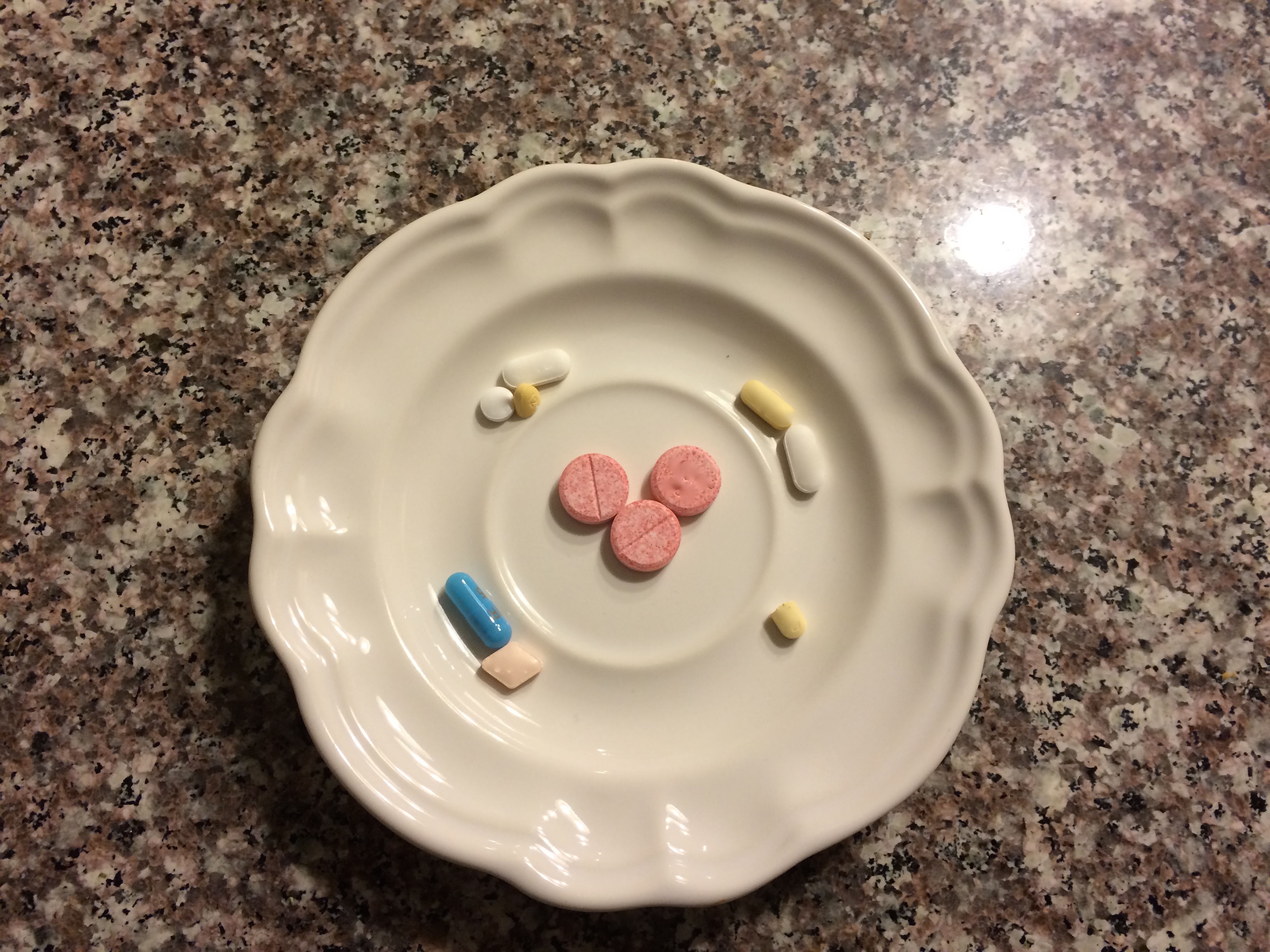
How I Learned to Love the Drugs

Kids' Meds

Here’s a snippet of a conversation I had yesterday evening with my little girl.

Her: Daddy, why does F take medicine?

Me: It helps him not feel so sad all the time.

Her: Okay, so why does L take medicine?

Me: It helps her focus in school and not be too worried.

Her: Well, what about C? What does his medicine do?

Me: It helps him keep calm in school and at home.

Her: And what about B? He takes medicine too.

Me: His medicine helps him not get too angry.

Her: So when will I start taking medicine?

With an internal sigh, I brushed off her last question and changed the subject. I didn’t have the heart to tell her that we were going to start her on a drug trial in a couple of weeks—to help her deal with her anxiety. I figured she’d have plenty of time to think about it when the trial actually began. Nor did I tell her that her little brother was going to start his own trial around the same time. Again, the less said, the better.

So there it is. By the middle of May, all six of our children will be on some kind of psychotropic medication.

Surprised by Sympathy.

It’s interesting. I shared this little dialogue with a couple of autism parenting support groups I belong to on Facebook, and I was kind of surprised by some of the comments. Many posted the symbol for a virtual hug: (((you))), and a few said something like “It’s hard” or “So sad.” But my wife, Katie, had the best response: she laughed. It was, after all, a cute exchange, and it showed how innocent our girl is.

It never dawned on me that this conversation would elicit words of sympathy, but now that I see it through these commenters’ eyes, I think I get it. See, I’ve grown so used to our routine that it seems, well, routine to me. I don’t think of it as unusual, hard, or sad at all. In fact, it’s the thought of not medicating my children that fills me with fear and trembling—for my sake as much as for theirs!

An Evolution of Sorts.

It wasn’t always this way. Back in 2007, when our pediatrician first prescribed a medicated patch to help one of our girls with ADHD-like symptoms, I resisted mightily. I hated the idea of introducing mind-altering chemicals into her sweet little brain. It didn’t help that the doctor told us we’d likely need a prescription steroid to help control the skin irritation that often accompanied the patch. Great! A medicine to counteract the side effects of the original medicine. What could be better? Eventually, however, I gave in.

When the patch didn’t work, we began a three-year odyssey of various other trials (under the direction of two different pediatricians and two different psychiatrists) to help her not only with ADHD but her growing anxiety. One made her giddy and made her gain a lot of weight. Another gave her terrifying nightmares. A third got her so agitated that she ended up biting me on the shoulder in the middle of Mass one Sunday. There were other failures as well, but I can’t recall them now.

It wasn’t until we began working with our third psychiatrist that we found the right combination. Her anxiety diminished considerably. She lost the extra weight. Her grades began to soar. And her demeanor at home, while still needing some help, became much more manageable. The tide was turning, and I was happy—happy enough to let three of our other kids begin their own medicine trials. Thanks be to God, there was a lot less initial drama with them and generally positive results.

Six for Six.

So now our two youngest ones are on the verge of getting prescriptions. Their therapist tells us that she can do only so much with them as they are right now. The little guy is too hyperactive and the little girl is too nervous for any talk therapy to have a lasting effect. “If we can just take the edge off,” she told us, “we might be able to make some headway. But as it is, the cascade of emotions is too strong for them to work through.”

It was a bitter pill to swallow at first, this thought that all our kids need psychiatric medicines. Not only does it get expensive, but it emphasizes their otherness and the challenges they face. Still, it didn’t take me long to adjust. I’ve been down this road a few times already! Plus, the sheer everyday nature of the routine helps a lot. Maybe that’s why my little girl can be so nonchalant about it. She has seen her siblings take medicine twice a day for as long as she can remember. It’s just a part of who we are and how we live.

Embrace the Mess.

That’s probably the way it should be. For everyone. You work and work and work until you find what works for you. You let go of the “picture perfect” life you had envisioned for yourself and your family, and you embrace the beautiful, horrible, glorious, maddening, sanctifying mess that God has given you. And as you do, you find that he’s embracing you as well.

He’s probably laughing, too.

Serenity Now!

As my kids are getting older I’m finding myself in an unexpected position. You see, five years ago, when the diagnoses were coming fast and furious, I went through somewhat of a crisis of faith. So many challenges were cropping up. Fears for my kids’ futures began to loom large. I grieved the loss of my vision for my family. But then came a period of relative calm. I came to a clearer understanding and acceptance of our situation. I resolved to fight for my kids’ rights at school. I determined that nothing would come between Katie and me as we took up the challenges that we faced. I had, to a large degree, made peace with it all. Yes, it was going to require extra work to help our kids be successful, but by gum, we were going to do it. We were going to be the autism family!

But there’s something about this autism thingy that took me by surprise. It shifts and swirls. It’s never the same thing year after year—or month after month. I’m finding myself surprised at some of the challenges my kids are facing as they get older. Some are completely new, while others are just more intense versions of what we saw a few years ago.

So while I honestly have made peace with a number of aspects of our family’s make-up, I’m also feeling more at war with others. Not war as if I’m fighting against my kids, mind you. More like a war within myself in terms of embracing our latest “new normal.” Let me try to explain.

Serenity Now . . .

I’ve made peace with the fact that my kids are going to be different. In many ways, I enjoy their differences—their quirky take on life, their brutal honesty, the innocence with which they approach life. I’ve also made peace with the fact that I’m going to be advocating for them and teaching them to advocate for themselves for quite a few years to come. Even though it sounds like a cliché, different, not less really does describe our kids as well as the way we look at them.

I’ve made peace with the fact that my family is going to stick out, and not just because there are so many of us. For instance, on those rare occasions when we go out to eat, I’ve come to expect the unusual. Like one kid will get up and start wandering around the restaurant because he or she can’t sit still. Or another will have to go stand outside halfway through the meal because of sensory overload. Or a third will end up curled up on his chair or under the table to avoid the noise. People will stare, but it doesn’t bother me anymore.

I’ve made peace with the fact that members of our extended family, well-intentioned and big-hearted as they are, won’t always get it. It doesn’t bother me that I’ll probably be explaining things until the day I die. It doesn’t bother me, either, when one of them offers unsolicited advice based on what works for his or her neurotypical child. It doesn’t even bother me that our kids aren’t involved in all the extracurricular activities that their peers enjoy. That’s probably because I’ve also made peace with the fact that we’re going to be spending more time in therapists’ waiting rooms than on soccer fields and tennis courts.

Finally, I’ve made peace with the fact that money will always be tight. With therapies and related health problems, our expenses are more than the average family’s. Plus, we’ve got six kids!

Insanity Later . . .

I haven’t made peace with the thought that our kids still have a long way to go. Now that our oldest two are well into adolescence, I’m getting a sense of the wild ride that comes when you mix autism with hormones. I’m also getting glimpses of the difficulties they’ll face as they lurch toward independence. I don’t know if I’ll ever be ready for those. Schools have behavioral counselors. Churches usually are welcoming, understanding places. But employers—well, that’s a completely different story.

I haven’t made peace with the other diagnoses that have come attached to our kids’ ASD. It’s bad enough that they have social and communication deficits. Do they really have to deal with crippling depression, intense mood swings, OCD, and emotional dysregulation? Does it really have to be so hard for them?

I haven’t made peace with the fact that many of my kids will find it hard to establish and maintain relationships in the real world. The thought of them being alone kills me—even more than the thought that some of them may never leave home. It kills me to think about all the people who will overlook how cool and kind and sharp and loveable our kids are. Our kids deserve to be loved!

Finally, I haven’t made peace with the way I let our ASD-dominated life close in on me. We don’t often do things as a family, because some of our kids will have a hard time. We don’t live too far from Washington, DC, with sites like the White house or the National Air and Space Museum. But a few of our kids simply cannot handle crowds. So we don’t go. Our hometown is surrounded by mountains and woodlands. But a few of our kids become very anxious when exposed to the sounds and smells of nature. So we don’t go. Just the idea of taking some kids to the movies makes me break into a cold sweat. I know there are ways to help them through all of this. I also know which ones might do well in a museum and which ones might do well in the woods, so I can always divide and conquer. But I just don’t have the fight in me. I’m often too worn out by the daily challenges of ASD life to even consider trying something new.

Dammit!

I know, I know. I’ll probably end up making peace with these things, just as I did with the others. I know, too, that God isn’t finished with me or my kids yet. But dammit, wouldn’t it be nice to catch a break every now and again? Does everything have to be so difficult?

I guess in some ways I’m like every other parent. I want the best for my kids, and I hate it when they struggle. The only difference is that my kids have more struggles than the average kid, so I have to be stronger to help see them through it.

And believe me, I will. Just let me catch my breath first.

Five Years with Autism

Five years.

Sixty months.

Two hundred and sixty weeks.

One thousand, two hundred and eighty-six days.

That’s how long we’ve been living with autism. Actually, scratch that. We’ve been living with it for fourteen years, but we didn’t know what it was until five years ago. We were a little slow on the uptake.

Five years is a kind of a milestone, isn’t it? So naturally, I did a bit of looking back at both the highlights and the lowlights to see how far we’ve come and to think a little bit about the future. Here’s what I came up with.

From Fear to Acceptance.

First, the diagnoses themselves. From the first one, when our lives began to change, to the last one, which was more or less a given, I can see somewhat of a progression.

• With the first diagnosis, in March of 2009, there was fear. Would he ever talk? Would he ever be independent? Would he wander off one day and get hit by a car? Would he spend the rest of his life alone?

• Then came the second diagnosis, in May of 2009. This time, there was a combination of relief and anger. Relief because we finally had a name for her quirkiness and emotionality. Anger at her pediatrician, who had told us it was only a matter of bad parenting.

• Then came the third diagnosis in September of 2010. This time, there was mostly guilt. Guilt because of all the lost years. Guilt because this was our oldest, so he had to bear the most years of our misunderstanding him. The signs were there early on, but I didn’t want to see them.

• With the fourth one, in March of 2011, there was a sense of validation. I had called it early on this time. This little fellow spent almost an entire year insisting that he wear nothing but red shirts and shorts. He would also get so absorbed in building Legos that he would forget to go to the bathroom.

• Then came the fifth in early 2012. This time, there was laughter. I had seen so much with the first four that nothing was a shocker. Besides, by this time, my attention had turned to working with the kids’ schools. Frankly, I had bigger fish to fry than to react to something I was beginning to think was inevitable.

• I’m sure I felt something when the last diagnosis came during the summer of 2013. I just can’t remember what it was. Nonchalant acceptance, maybe? More or less, I took it in stride. Nothing could shock me anymore. It just gave us more insight into this sweet little girl.

Not Just Labels.

But besides the accumulation of labels, there are some other milestones. During this time, I have:

• Attended more than 30 IEP meetings at three different schools.

• Spent nearly $50,000 in autism-related medical and psychological treatments, schools, medicines, and therapies for my kids.

• Lobbied our state representatives for increased funding for our local autism center—and won.

• Taken more than 15 stress-relieving day trips to Disney World.

• Seen the dissolution of two friendships—one close, the other not so much—because of misunderstandings or judgments about our family.

• Seen two other friendships slip into casual acquaintances. Not because of any malice but because our paths rarely cross any more. (Let’s face it. I rarely cross paths with anyone these days!)

• Met other autism parents online, in whom I have found encouragement, humor, common experiences, and wisdom.

• Fallen more deeply in love with my wife, whose commitment to our kids never ceases to inspire me.

• Made peace with God over the whole situation. Ironically, I bear fewer external markers of my faith than I have in decades (e.g., commitment to a Bible study, membership in a small faith community, parish involvement), but I feel more strongly connected to the Lord and my faith than ever before.

Accepting a Constant Presence.

So yeah, it’s been a wild ride. There have been wonderful triumphs, like the day our four-and-a-half-year-old finally got potty trained. And there have been crushing blows, like the day one of our kids, in a full-scale melt down, grabbed a kitchen knife and threatened to cut himself. There have been strings of days when we’ve wondered if it could ever get any worse. And there have been times when everyone seemed to be firing on all cylinders and we could breathe easier.

But through the ups and the downs, autism has been a constant presence. I know I said a few years ago that not everything is about autism, but I don’t think that’s true any more. Autism is an integral part of who my kids are, and that means it shows up in just about every aspect of their personalities. They’re not being autistic only when they’re melting down or misinterpreting social situations. They’re just as autistic when they’re happy and making excellent progress. They do everything a little bit different, and that’s part of what makes them so unique.

I guess this means that I no longer look at autism as a scaly, ravenous monster ready to devour my children. There are days, mind you, when it seems like that’s happening. But there are many more days when it feels more like an awkward, galumphing puppy that you have to keep an eye on—you don’t want it peeing on your floor or chewing your furniture!

So have I come to a point of acceptance? Yes and no.

Accepting my kids and their unique neurologies? Absolutely.

Accepting the fact of their diagnoses? Pretty much, although there are times that I lose sight of it.

Accepting that this is how they’re going to be forever? No. I’m not trying to fix them, but I am trying to teach them how to be as successful as possible in a world that can seem so bizarre, alien, and even frightening.

What’s around the Corner?

And that’s where the future comes in. As I stand at the five-year mark, I can be proud of what we’ve accomplished, even as I peer nervously around the corner to see what’s still waiting for us. I know every year will have its own challenges and triumphs. I also know better than to assume that the worst is behind us. No one can say that with any degree of confidence. But I can say that the past five years have changed and shaped me in ways I never expected. They have shattered old misconceptions and built up new, stronger convictions. They have revealed a shallowness in my heart and taught me how to love more selflessly. And they have taught me never to put limits on what I—or Katie or any of my kids—can do.

There are many more obstacles to overcome, many more challenges to face down, many more threats to neutralize. There’s so much more we haven’t experienced yet, but I think we’ll be able to handle it.

Just as we’ve done for five years.