
Dispelling the Cloud, Removing the Chip

Oriole

So I was out of town a couple of weeks ago at a meeting of the Catholic Biblical Association. It’s an annual gathering of biblical scholars that I attend as an “associate” member—someone who isn’t really a scholar but who works with the Bible on a regular basis and who would benefit from hearing research reports from the full members. One of the things I enjoy about this gathering is the collegial atmosphere. For the most part, everyone is treated equally: the great, the near-great, and the just plain silly. You are not looked down upon if you don’t have a PhD; you are welcomed just as much as the most celebrated, published scholar.

At the conference, I had the pleasure of sharing dinner with an old friend whom I hadn’t seen in a few years. Like the others, he is a respected scholar and researcher, but he is also a born teacher who brings a pastoral approach to his studies. Plus, he’s from Canada, so he has niceness encoded into his DNA. The last time we met, I had told him a little about our fourth child, whose high-functioning autism we were just learning about. This was our first diagnosis. We didn’t know about the others until later on. So it was only natural for him to ask me this time how our boy was doing and how the rest of the family was adjusting to his uniqueness.

That’s when the discomfort began. Should I tell him that all six of our kids are on the spectrum? Do I have the emotional energy to give a minor tutorial in the ins and outs, the mysteries and challenges of ASD? I’ve been down this road before with a lot of other people, and I was getting tired of it.

I debated changing the subject, but I respected this fellow too much to stay shallow. So I dove in, with a lump in my throat.

An Impromptu Community.

As it turns out, I didn’t have to worry. My friend, along with a couple of others at our table, listened carefully and asked insightful questions. They showed genuine concern for our kids. They shared their own experiences and understandings of autism. We ended up talking together about how God is and is not at work in challenging situations like mine. So what began as a general “How’s it going” conversation grew into a shared reflection on mercy, grace, compassion, justice, and perseverance. It was as if we had formed an impromptu community of faith.

Mind you, I did feel somewhat uncomfortable being the center of attention for so long. I was afraid that the conversation would decline to the kind of pity and mock-sympathy that I detest. But another part of me thoroughly enjoyed the conversation. There was something distinct about it. Everyone there was immersed in Scripture and its teachings, so our discussion had a strong faith dimension to it. Of course, not every Scripture scholar is a saint, but it was clear that these people had taken Jesus’ words to heart and were striving to live in the love of God. That’s no small thing.

The Cloud and the Chip.

Rather than feeling drained, as I usually do after “raising autism awareness,” I left the conversation feeling energized and encouraged. And that got me thinking. You see, I’m not used to having such genial discussions about my kids—and especially, not with people who don’t know me well. I have spent so much of my time the past few years advocating for them in a cash-strapped school system and among neighbors who (with a few exceptions) didn’t have patience for anything outside the status quo. So I wasn’t expecting such a kind reception of my story.

Add to that the fact that I didn’t have that many friends in Florida. Katie and I spent so much time with our kids, and that made it hard to meet new people. Plus, we lost a couple of friends due to our kids’ challenges, and these losses left me defensive, guarded, and cynical. I didn’t want to get to know anyone else. “Why bother?” I’d think. “It’ll only turn out bad.” I didn’t realize it until after having left Florida, but I had spent the better part of four years walking around with a cloud over my head and a chip on my shoulder.

A New Beginning?

That seems to be changing now. A couple of months ago, we moved back to Maryland, where Katie and I both are from. It’s something we had been wanting to do for quite a while, but never had the chance. We knew that Maryland schools were better, and most of our family is there. So when the opportunity finally arose for me to be transferred back to my company’s home office, we grabbed it—and we’re really glad we did. The school year hasn’t started yet, but all of our preliminary meetings have been extremely encouraging. Accommodations we could only dream of in Florida were offered to us without our even having to ask for them. Programs are in place here that we had never heard of down South—programs to help ASD kids not only survive but thrive.

What’s more, and I don’t exactly know why, there seem to be a lot more families with ASD in our new hometown. Maybe it’s because of the higher population density. Maybe it’s because there are more doctors here who are trained to spot the signs of autism. Or maybe the parents are just better informed. Whatever the reason, that increase in numbers brings an increase in awareness and acceptance. So we’re feeling like we fit in here better than we did down there. It doesn’t feel as lonely.

And then there’s family. All of my siblings are within an hour’s drive, and most of Katie’s siblings are even closer. Plus, Katie’s parents are just a ten-minute walk away. So there’s a lot more support where we are now, and our kids are surrounded by more than twenty cousins ranging from age three to twenty-six.

All these factors have helped me relax a little bit. With increased awareness and acceptance, our kids have a better shot. With family around, we have ready-made friends and social situations. With a more accommodating school district, we hope to have fewer fights and less tension. A few days ago, I wrote that our family’s future is beginning to look brighter. Maybe I’m just fooling myself. Maybe we’re in a bit of a lull right now, a respite between crises. Or maybe with this fresh new start Katie and I are able to see our situation and our kids in a different light. Whatever the case, I’m enjoying it—almost as much as I enjoyed my conversation with those biblical scholars who reflected a God who loves and cares for his people.
It’s All About Us

Video

I’m so proud of my oldest daughter. All by herself, without telling us, she produced this video for a project in her Aspergers-only school. She doesn’t often tell us what she’s thinking—not uncommon for any 13-year-old girl and even more prevalent with girls on the spectrum—so I was blown away when I saw this.

Who’s Speaking for Whom?

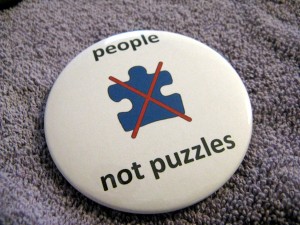
people-not-puzzles-300x225So there was a bit of a dust-up in the autism community this past week. Suzanne Wright, one of the co-founders of the well-known advocacy group Autism Speaks, published an article about the group’s conference in Washington, DC. In the article, Wright characterized families touched by autism in rather vivid terms:

These families are not living. They are existing. Breathing—yes. Eating—yes. Sleeping—maybe. Working—most definitely—24/7.

Wright goes on to describe the challenges that many families with autism face: financial worries, therapy challenges, concerns about their children’s health and safety, anxieties about the future. All in an attempt to rouse policymakers to come up with some kind of strategy to address the coming “national emergency” of all these autistic children growing up and becoming a huge burden on society:

Close your eyes and think about an America where three million Americans and counting largely cannot take care of themselves without help. Imagine three million of our own – unable to dress, or eat independently, unable to use the toilet, unable to cross the street, unable to judge danger or the temperature, unable to pick up the phone and call for help.

It’s an impassioned, heartfelt call—even a demand—for action.

An Aspie Pushes Back.

Well, many people with autism found the letter deeply offensive. They thought that it overemphasized the burden that many families face and, worse, that it dehumanized the people with autism that Autism Speaks purports to speak for. Painting an extreme picture, Wright gave the impression that all people with autism are as helpless as those with the most extreme forms of the disorder. They are all part of a “national emergency” that needs to be addressed immediately. Critics also detected a subtext implying that the goal of Autism Speaks was to rid the world of people with autism: to cure it and prevent it. And they saw in that desire a rejection of who they are.

The article was so one-sided that even a member of the organization’s science board—an fellow with Asperger syndrome named John Elder Robison—resigned his position in protest.

We do not like hearing that we are defective or diseased, he wrote. We do not like hearing that we are part of an epidemic. We are not problems for our parents or society, or genes to be eliminated. We are people.

This isn’t the first time that Autism Speaks has drawn fire like this. In 2009, the organization produced a video, I Am Autism, that also painted a bleak picture of the disorder. In it, autism itself spoke about how it is coming to take away our children, bankrupt us, and destroy our marriages. It spoke, again, as if children with autism were so defective that they were no longer “there.”

A Two-Edged Sword.

All this controversy got me thinking some more about my own experience.

On one hand, I can relate to the picture painted by Autism Speaks. I know what it’s like to be scared about my children’s future. I know what it’s like to feel worn to the bone from dealing with autism-related challenges from my kids. I know how it feels to face financial limitations or to have to explain one or another child’s unusual manner to a neighbor at the park or a stranger at the store. I know what it’s like to grieve when the news of a child’s diagnosis is delivered—I’ve done that one six times!

But that’s not the whole story. My kids aren’t problems. They aren’t the sum of their challenges. They are smart, funny, and innocent. They are perceptive, clever, and talented. The more I get to know what makes them tick, the more I am learning that autism is behind some of the things that make them so awesome.

Moving toward Acceptance.

I see how Autism Speaks’ approach can strike a chord, especially among those with young children or those struggling to embrace a recent diagnosis. In a sense, they’re saying, “Hey, we get it. It’s hard. It’s painful. It’s scary. But you’re not alone. We’re here, and we understand how tough this is.”

I don’t think, however, we’re meant to stay at this point of feeling overwhelmed, terrified, or devastated. In each autism-touched family that I know, there comes a point when everyone calms down, takes a breath, and readjusts their expectations. There comes a point when they are able to look past the label and see the beauty and goodness in their children. It’s supposed to be a natural progression, like the five stages of grief identified by Elisabeth Kübler-Ross: denial, anger, bargaining, depression, and acceptance. Sooner or later, you have to get to acceptance. You can’t stay stuck in anger or depression. You have to keep moving—if only because your kids are moving, and you have to keep up with them!

By constantly banging the drum about a national epidemic, by playing the fear card over and over again, organizations like Autism Speaks inhibit people from moving to the point of accepting their children as precious gifts from God. They also are complicit in fostering a kind of victim mentality in families touched by autism. “Look at how hard our lives are. Look at how damaged our children are. Pity us! Help us!”

Who’s Talking?

In the past, I supported Autism Speaks 100 percent. I wore their lapel pin and wrist band to help raise awareness. I followed their blog. I attended seminars sponsored by them. I even raised a good amount of money for them.

But now I’m not so sure. As John Elder Robison said, I’m not sure that Autism Speaks really does speak for my kids. I don’t want my kids growing up feeling like victims. I want them to be victors. I want them to use all their gifts—even the ones that autism has given them—to show the world that people like them can make a huge difference. I want them to embrace everything about who they are, even their autism, and turn it into something that glorifies God and lifts up the people around them. And they can’t do that if they think of themselves as problems or burdens.

Autism awareness is important, but only if it leads to acceptance. Not just pity or tolerance but acceptance.