Come, Lonely One

As the season of Lent begins, I thought I’d go link to a post on the website for the Jesuit magazine America. On their Scripture blog, Fr. Terrance Klein, a professor at Bonaventure University wrote:

The grace of insight often seems to accompany great sorrow, the sort we suffer alone, because no other can fully feel our pain. . . . The 11th century Byzantine Christian monk, Symeon the New Theologian, viewed suffering in deeply personal terms: the loneliness of suffering was a form of intimacy with God. In his prayer to the Holy Spirit, he wrote, “Come Lonely One, to him who is alone.” . . . When suffering cannot be avoided, the Christian should do more than accept it with resignation. However long and arduous the effort to do so, we should receive suffering as a call to intimacy with the Man of Sorrows.

I like this reflection, because the image that Klein paints—an image of suffering as a call to intimacy with God—helps me make some sense out of the difficulties that my kids on the autism spectrum are facing and will likely face in the future.

At the risk of sounding maudlin, I know that my kids are going to encounter more challenges, more setbacks, and, to put it bluntly, more suffering in this world than their neurotypical peers. It’s just the way things are. They will never quite fit in; they will likely have fewer friends. Some of them may never marry or have children. They will be more alone than most of their peers. The world is unfair, and in some ways my kids got the short end of the stick.

But it’s not just the social aloneness they will face. There’s also the aloneness that comes from knowing that you’re different. You feel that difference deep down. But if you have an autism spectrum disorder, you may not know how to process it. You sense that people don’t “get” you. You’re not even sure that you “get” yourself. Even though you sense that it’s not true, you still can’t help feeling “less” than the people around you, and that causes an inner isolation that can get right down to the core of who you are

Accepting the Invitation.

According to Fr. Klein, you have two options when it comes to responding to this kind of aloneness. You can shrug your shoulders and accept it with a sad resignation. Or you can receive it as an invitation from God. My goal as a parent is to help my kids accept the invitation. I want to assure them that no matter how different they may feel, no matter how harshly they are judged, no matter how little they think they fit in, there is a deeper truth at work in their lives, a much more hopeful truth than the false truths they feel tempted to accept.

Here are some of the dimensions of this truth.

• There is a mystery to their autism—a mystery that involves an invitation to a deeper relationship with God. In their aloneness, my kids have a great opportunity to identify with, and to discover more deeply, Jesus, who was the loneliest man in history. They have the chance to understand that Jesus was more different than anyone else who walked the earth, but he never let his difference isolate him. Instead, he continued to pour out his life for other people, hoping to bring them closer to God. All this means  that my kids have the opportunity to find their stories in Jesus’ story. As isolated as they may feel, they have a unique opportunity to become men and women for others, just as he did.

• I believe that if they grow up in an environment of faith, people who face more than the “fair share” of hardships end up more reflective. They are able to look at the world from a critical distance, and to see life with a deeper and more stable set of priorities. This makes them more apt to come in touch with the deeper regions of the heart, where God dwells, and to find there the strength and good humor they will need for their challenging lives.

• Drawing from the writings of St. Symeon, Klein talks about the “grace of insight” that comes to those who suffer. It’s a grace that can make sufferers into prophetic voices and prophetic witnesses. This tells me that simply by the witness of their lives well lived, my kids can testify to a greater purpose and power than what the average person expects. They can point people to the deeper and more meaningful dimensions of life. In short, their inwardness, their relationship with God, can make my kids into signs of God’s presence and love—if they choose to accept his invitation

Why Not Why?

In an earlier post, I said that asking why so many of my kids have this challenge was not nearly as important as asking how I could help them make the most of it. Well, this post from Fr. Klein warns me not to be so sure. Why isn’t always a bad question to ask—and it’s not always a question God hates to answer.

And that’s a good thing, because the question won’t go away. Some of my kids are beginning to ask this question, so I may as well try my best to find some answers to help guide them.

In the mean time, it’s encouraging to know that God is with my children in a special way. As Fr. Klein wrote, no other person can fully feel their pain. But Jesus can. And he is inviting them to discover his answers to their questions. I only pray that I will be up to the task of helping them find the answers—to accept the invitation that God has given them.

So why did this happen? Is it possible that God has something important for my kids to accomplish? That he has invited them to know him with a special intimacy, and to become his prophetic voices in this world? I can’t rule this out. Of course, I don’t pretend that my kids are superior or more spiritual by nature. I have daily evidence to the contrary! But maybe, just maybe, they have a special calling to manifest Christ’s presence in the world. Maybe God gave them this cross so that his strength can shine through their weakness and otherness. Maybe he wants to teach them peace and intimacy with him in the face of their isolation so that they can radiate that peace to the people around them. In the mean time, I will continue to pray that Jesus, the Lonely One, will come to them when they feel the most alone.

When Near-Failure Is an Option

A couple of days ago, I wrote about an episode at my daughter’s school where she was given the short end of the stick when it came time to make up a test she had missed. I’ve thought about it some more, and I realize that this little episode exposes a more general weakness in the way schools deal with high-functioning kids on the autism spectrum.

Looks Are Deceiving.

Kids like my girl look “normal.” They don’t bang their heads against the wall—at least not usually in public. They have average or above-average verbal skills. They are bright and sweet and innocent. They try hard to fly under the radar so that they won’t attract attention. But coping mechanisms like these often hide serious learning glitches and emotional imbalance.

As far as the school is concerned, there’s no need to worry about these kids. Not unless their parents push hard to get their kids special-ed services. And then, the most they are willing to do is place kids like these in “inclusion” classrooms—standard classrooms that are staffed with a teacher and an aide who floats around the room helping kids who need it. But that’s about as far as they go. No different approach to teaching kids with different brains. No sense of what it is that the kid needs. Just an obligation to pound the information into his or her head so that he or she can spit it out when it comes time for standardized testing. If the kid still isn’t doing well, despite the inclusion class, it’s his or her problem, not the school’s.

Hoop after Hoop after Hoop.

You see, schools consider inclusion to be a great, magnanimous gift they are bestowing upon these kids. So parents are made to feel greedy if they dare ask for anything else, like access to a guidance counselor or extra help in a challenging subject. Even if their child clearly needs it.

This begins very early on in the process. You have to jump through all kinds of hoops just to get an IEP for your child in the first place. In most cases, you literally have to wait for a child to fail before a school will do anything. As long as a student—no matter how smart—is pulling at least a D average in core classes, there is no need to do anything. He or she is “meeting standards.”

Never mind how hard it is for that kid to complete homework after working so hard to keep it together at school. Never mind how anxious, fearful, or even depressed that kid is becoming because of the stressful environment. Never mind that this kid is really, really bright and could tear the place up if given the chance. Nope. He has to fail first. And by the time that happens, so much ground has been lost—educationally, socially, and emotionally—that it’s a long, hard climb to get back on top of things.

“Are You Serious?”

And then come the humiliating meetings parents have with school administrators as they try to advocate for their children. There are the not-too-subtle insinuations that if you were a better parent, your child wouldn’t be failing. “All you have to do is use more charts and folders to keep her organized.” “Are you giving him consequences when he doesn’t do his homework?” “Well, if you didn’t have so many kids. . .”

There’s the attempt to blame the student. “She doesn’t need support. She’s just lazy.” “He simply needs to apply himself more.” “If he’d just do his homework, we wouldn’t be having this conversation.”

There’s the attempt to discount or diminish the situation. “I see that you have a diagnosis from a psychologist. Well, private practitioners tend to exaggerate things to keep you coming back. They’re more interested in their bottom line than anything else.” “It’s just a phase. My kids went through a tough patch as well. I’m sure he’ll pull out of it.” “Are you sure your child has autism? She seems fine to me.”

And then there’s this classic line: “Some kids just aren’t cut out for school.”

As If. . .

These are all things we’ve been told in parent-teacher conferences and at IEP meetings. As if we aren’t trying to teach our kids discipline and responsibility. As if we just want to milk the system for everything we can get out of it. As if we enjoy having to explain our kids’ challenges over and over again. As if we were under the spell of some Svengali-like psychologist who is milking us for every dollar we have.

But the reality is that no parent wants to go through any of this. I can’t tell you how many times I have felt a pit in my stomach when preparing for an IEP meeting or a parent-teacher conference. It’s not the exhilaration that I’ll be getting something special for my precious little child. It’s the dread of having to rehearse, yet again, the symptoms and the challenges that my kid faces. It’s the sober realization that I am not only responsible for educating my children. I’m also responsible for educating their educators so that they can see the way ASD affects my kids—and the way their teaching methods help or hurt them.

What disturbs me the most is that my kids are smart. They’re talented. They’re perceptive and creative and curious in their own way. But their teachers can’t see it because they’re hidebound by a one-size-fits-all approach to education. Their main goal is to get the kids ready for state-mandated standardized testing. So as long as they can get the right data into their kids’ brains—as long as their kids can regurgitate that data on a test—they have discharged their duties. And so any child whose brain is wired differently is left to flounder.

Just so long as he doesn’t fail, all is well. After all, isn’t that what inclusion classes are for? To keep on teaching him the same way—no matter how bad the results have been all along?

Of Sore Thumbs and Personal Victories

One of the benefits of living in a swing state during an election year is the high likelihood that one of the candidates or a spouse will show up at a rally pretty much right at your front door. That’s exactly what happened last weekend. Ann Romney, Michelle Obama, and Joe Biden were all within shouting distance of our humble town of Saint Johns, Florida.

Some may consider this a curse more than a blessing. But when I found out that Joe Biden was going to be in St. Augustine last Saturday, I was happy. This could be a great civics lesson for our oldest son. I even got his social studies teacher to approve extra credit if he went to the rally and wrote a report about it. So I headed to the local Obama headquarters to get tickets to the event, to be held at a school gym.

When we got there on Saturday morning, I knew we were in for a challenge. Due to heightened security, everyone had to be screened before they could enter—which meant we had to stand in a long line. As soon as he saw the crowd—and how slowly the line was moving—my boy’s face fell, and he began trying to get out of it.

“Please, let’s just go,” he said plaintively. “There are too many people. I’m really tired. You can’t force me to do this. I don’t need the extra credit. [He really did.] You’re just trying to make it hard for me.”

“Sorry, son. This is one of those situations when you have to do something. You’ll thank me later.”

Not This Time.

Normally, my boy would ramp up his protests, accuse me of a nefarious plot against him, and come up with some outrageous reasons why this just plain won’t work. But not this time. The fact that we were outside helped. It was a beautiful, sunny day, and the line was quiet. So he wasn’t feeling a barrage of negative sensations. It also helped that I kept scratching his back. He didn’t become cheerful, but neither did he explode.

We spent about an hour in line, moving at a glacial pace. Every now and then, he would offer some protest or excuse, but it was pretty mild. If anything, he just seemed glum. He’ll probably never admit to it, but I think he was intrigued with the prospect of being so close to someone so powerful.

When we got into the gym, my heart sank. There were no bleachers or seats of any kind. Instead, everyone was standing—very close together—and talking excitedly. There were already around 400 people inside, their voices echoing in that hollow, tinny way that only gymnasiums can create. Plus, a loudspeaker system was blaring upbeat music. And more and more people kept coming in. I wondered how in the world my son would make it through this thing.

Reluctant but Resigned.

Not to be deterred, I asked the people ahead of us if they would let us through so that my son could see. There were only a few children there, so they were very obliging: we made it right to the very front of the crowd. Not only did that give us a better view of the dais, but it also helped relieve some of his stress. He didn’t feel as hemmed in.

Still, he looked very uncomfortable. He kept his eyes down, his shoulders bunched, and his hands clenched. He asked a couple more times if we could leave, but I kept massaging his shoulders. This is important, I told him. This is part of our history and heritage as Americans. This is a valuable opportunity for him. This is going to happen. And you are going to write about it.

Considering the crowd and the noise and the seemingly endless wait, I was impressed with how well he was doing. His protests were meek, and he met my determination not with an equal and opposite force but with reluctant acceptance. Part of me felt bad for subjecting him to all of this, but I just couldn’t pass this up.

Are You Fired Up?

Not long after we got to the front, a series of warm-up acts graced the dais. A few local officials spoke, a campaign volunteer gave a personal testimony, and an Anglican priest offered a blessing. Each speaker (except for the priest) asked a variation on the question, “Are you fired up?” And, predictably, the audience responded with huge shouts and thunderous applause. I don’t know why I thought of it, but I almost instinctively placed my hands over Richard’s ears with every eruption—and then promptly returned to my massage as soon as the noise died down.

After about 20 minutes of these opening acts, it was announced that the vice president was about to come out. Just then, my son turned and pled with me, “Please, Dad. Let’s go home. I can’t take this any more. My stomach hurts. My head is killing me. My eyes are so sore.” He didn’t sound desperate, but he was clearly getting more upset. “Come on,” I replied. “This is what we came to see. He’s coming out now. Keep breathing and try to hold it together.”

Negotiations Proceeding Apace.

Then came the magic. He didn’t push back. He didn’t break down. He didn’t lash out. He strategized. “How about this?” he asked. “Let’s stay for just 15 minutes more. I can say I saw him, and I’ll have enough to write about.”

I was floored. My son was experiencing a huge sensory assault, but he was fighting it. He was engaging his intellect, not just giving in to the emotional cascade. At that moment, I realized that he wasn’t negotiating with me. He was negotiating with himself. He was telling himself, “You can do this. You don’t have to give in to the noise and the fear and the anger.”

I really wanted to hear the whole speech. I really wanted my son to shake the vice president’s hand. Heck, wanted to shake his hand! But I couldn’t pass this up. “It’s a deal,” I said. With that, he turned back to the dais, tense but determined, while I continued alternating between massaging his shoulders and covering his ears.

Vice President Biden came out, flashed his toothy grin, and launched into his stump speech. And through joke after joke, through zinger after zinger, through applause line after applause line, my boy stood there, sad but focused. Not once during that whole time did he try to back out of our deal. Not once did he try to break away. Not once did he turn around and try to beg his way out of this. He made it through 15 grueling minutes, sullen but intact.

He Talked Back!

As soon as the time was over, we turned and left. Pushing through the crowd, we both heaved a huge sigh of relief. It was over. My thumbs were sore from all the massaging, but I was so proud of my son. It was the first time I saw him talk back to the fear and anxiety. It was the first time I saw him separate himself from the symptoms of ASD. It was the first time he saw himself as a fighter and not a victim. I saw him take an important step toward being an independent young man who wasn’t defined by ASD.

I didn’t tell him all of this right then and there. He seemed too battle-weary for another discussion. But I could tell that he sensed the victory as well. There was a new spring in his step as he walked into the sunlight of a beautiful autumn afternoon.

A Very Blue Saturday Morning

Well, today was the big day. After six months of preparation and fundraising, our whole family took part in the 2012 Walk Now for Autism Speaks in Jacksonville.

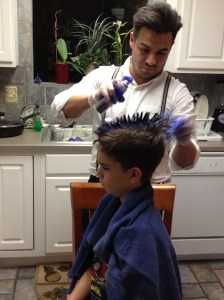
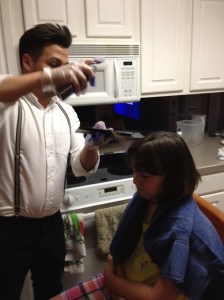
Actually, the “event” began last night, when I got my hair dyed—and my two oldest kids decided to join me. Lee Trevino—yes, that’s his real name—has been cutting my hair for years, and when I told him about my scheme, he immediately volunteered his time to do the actual dyeing. I was willing to come in during his work schedule and pay whatever he charged for such a job, but Lee wanted to donate his time instead. I couldn’t talk him out of it. He has met most of my kids over the years, heard me tell stories about them, and has himself watched them grow up. So on one level it makes sense. But still it was very generous of this talented young Christian man to make a contribution that only he could make.

First up was me, with the full-head treatment. Then came my daughter, who wanted a couple of streaks. Then it was my son’s turn, and he went for a Mohawk.


The next morning, Katie decided the other kids should get a chance to join in the fun. She had secretly bought some more spray-on dye and offered to color anyone’s hair who wanted it. Our two boys in the middle opted out, but the little, fun-loving ones, couldn’t wait. And, of course, Katie decided she’d give it a whirl.

So we got to the place for the walk—an outdoor retail/gathering place along the St. Johns River called The Landing. It was crawling with people from all over Northeast Florida, far more than the last one we attended in 2010. We were even joined by visitors from far, far away.


No, seriously. A group of Star Wars cosplayers was there in full gear. I spoke with one of the Storm Troopers, and he told me that the group gathers every other week for their own stuff, but they also like to attend charity events like this one to lift people’s spirits.

So anyway, after a bit of time hearing moving testimonies from a couple of people—parents of children with autism and the like—the emcee gave a countdown. And everyone began to walk. It was a one-mile round-trip walk along the river. Nothing too challenging, considering the number of children involved—and not a few wheelchairs. So we walked.


When we got back to The Landing, we were all cheered in by the emcee. It was a beautiful day—some clouds, around 84 degrees, with a nice breeze off the river. There was even a Kids Zone set up with a bounce house, animal balloons, and a Home Depot kid-builder spot. Best of all, the kids managed to keep it together (for the most part) the whole morning.

So that’s what happened—at least as far as the little ones were concerned. Katie and I knew something much more important was happening. Thousands of people gathered to celebrate the special people in their lives. They banded together to raise their voice on behalf of the millions of people who have an autism spectrum disorder. They raised nearly $70,000.00 to help raise awareness, fund research, and advocate for this unique and growing population. It was a very positive, almost jubilant, atmosphere as we all saw how many we were. I’ve said it before: dealing with ASDs can make people feel pretty much alone out there. So events like this walk are vital in showing us that we are far from alone!

So we did it. All of us. All of you. You helped me reach my goal, and for that I am exceedingly grateful. You told me that Katie and I have real friends all over the country. Friends who support us. Friends who pray for and with us. Friends who want to help us make a real difference. Thank you so much for your help!

Oh, I almost forgot. Here’s what I looked like all morning long:

Yep, you did that, too!

A Welcome Dose of Reality

Here’s another installment of “Celebrities and ASD,” this time from the world of sports. It seems that former Red Sox pitcher Curt Schilling has a son with Asperger syndrome. He and his wife, Shonda (gotta love that name), wrote a 2010 book about their journey entitled The Best Kind of Different.

“Well, that’s special,” you might say. “Another Jenny McCarthy-like figure talking about how wonderful her child is and how her life has been transformed by this beautiful but different, otherworldly being entrusted to her care.” But you’d be wrong. At least from the Schillings’ interview on the Today show and a more extensive interview they gave to an online sports journalist named Maury Brown.

Here’s what I liked about the Schillings’ story. They’re willing to be real. Shonda (ooh, that name again) is very up-front about the seven years she spent not knowing that their son, Grant, was different. How she didn’t get his lack of responsiveness to her parenting. How she would yell and scream at this kid who seemed to disregard her every command. How she would get really angry at her on-the-road husband for not being around to help her with this “difficult child.”

And then there’s Curt’s admission that he really had a hard time relating to his son—and that he still has a lot of work to do on their relationship. The kid is so intense emotionally—both positive and negative—that he didn’t know what to do with him. He talks about trying to discipline Grant over the phone: shouting at him via long distance, threatening him with loss of privileges, trying to knock some sense into him verbally, all to no avail. Mind you, Schilling is known for speaking his mind pretty bluntly, and his unguarded comments in MLB circles have gotten him in trouble a few times. So it kind of fits that he would be just as direct with his children.

But oh, the reality that this couple brings to the conversation! I love that, because it isn’t easy, and parents are only human. Even after having learned that Grant is on the autism spectrum, they still have tough days—a very important insight. Knowing doesn’t change everything. It takes time and effort to change your expectations. It takes time, and trial and error, to learn how to roll with the punches. As Curt said, every day is like a jack-in-the-box. You don’t know what kind of kid is going to wake up each morning: Mr. Flame-Throwing Grumpy Gus or Lil’ SweetPea the Emotionally Needy Klingon. But they’re learning. They’re adjusting. They’re trying their best to figure the whole thing out and to do right by their son. And this a full three years after Grant’s diagnosis!

I can’t tell you how refreshing it was to see the video and read their interview. It’s so refreshing to know I’m not the only one who can lose it with my kids. Or that I’m not the only one who still doesn’t get them all the time—after all these years. Or that I’m not the only one who has to take a break every now and then lest I get wound so tightly that I snap. Or that I’m not the only one who forgets that all they’re doing is being themselves, being autistic in their own unique ways.

Because really, sometimes it just plain sucks. Every emotion is writ large. Every variation from routine is a potential explosion. Unless of course it’s the kid wanting to change the routine. Then it absolutely has to happen according to the newly announced plan. Every teacher needs a lesson in ASD. Every excursion, even to the flippin’ grocery store, is fraught with peril. Sometimes it just gets to be too much. And that’s why I’m so glad to know that folks like the Schillings are around: real people who don’t mind being honest about how hard it can be.