Words from the Unwise

Lawsuit-Officer-handcuffed-elementary-school-students-with-ADHD

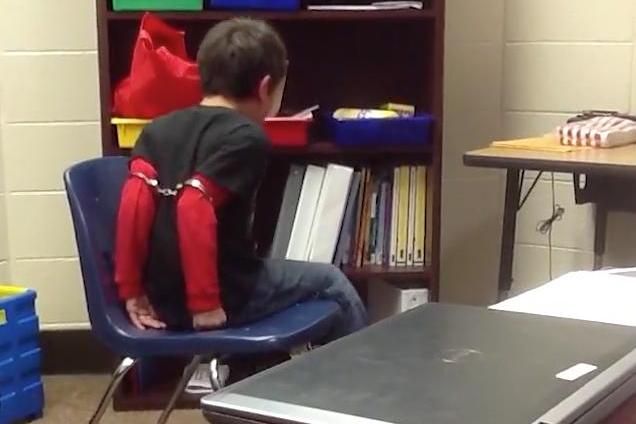
So this bit of news has been making the rounds the past couple of days among autism and other special-needs parents. It seems that in two unrelated incidents, a police resource officer in a Kentucky grade school put an eight-year-old boy and a nine-year-old girl in handcuffs in order to restrain them—cuffing them around their biceps because their small hands would slip through the cuffs. Both students have ADHD, and the girl also had a history of some kind of trauma.

The school was aware of the children’s diagnoses, as was the police officer who cuffed them. Both students had been removed from their classrooms because of disruptive behavior, and when the principal was unable to contain the situations, the officer took over, employing the handcuffs. (Note: watch the video at the top of the article at your own risk. It’s very disturbing.)

According to the report, the girl was especially upset by the situation, to the point of needing psychiatric treatment in a hospital. Understandably, both sets of parents are suing the officer involved.

This is a very sad story, especially in a time when attention has already been focused on police officers abusing their power and mistreating people who live on the margins. These incidents may not rise to the level of Freddie Gray or Michael Brown, but they come pretty darned close.

I don’t want to say much about the incidents—I don’t like stating the obvious or dwelling on people’s stupidity. But I do want to look at the article that described the situation. Actually, not the article (although it does have a couple of really embarrassing typos), but the utterly irresponsible headline that was assigned to it:

Lawsuit: Officer handcuffed mentally disabled kids as punishment.

Disabled? Mentally? What does that even mean? The report only talks about ADHD and some unspecified trauma. It’s not as if the kids had been lobotomized or anything. There’s nothing in the report that indicated the students were “disabled” in the sense that most people understand that term.

It doesn’t take a genius to see how this terminology places a kind of perception filter over the whole story.

“Oh, the kids must have been truly and deeply disturbed.”

“I can understand why the principal let the officer shackle the children.”

“These are mentally disabled kids—it’s not as if they were ‘normal’ kids. I guess it’s okay.”

It may not seem like a huge deal—just a matter of poor wording. But in this time when the Americans with Disabilities Act is celebrating its twenty-fifth anniversary, we don’t need to be going backwards. Remember, it was the ADA that ushered in the era of person-centered language. So we talk about a man with schizophrenia rather than calling him a schizophrenic. We talk about a woman who can’t walk instead of calling her a cripple. And we talk about a child with ADHD rather than calling him mentally disabled. Or at the very worst, we call him a child with a disability.

It shouldn’t be rocket science at this point in our history, and yet here we are. We’re still using hurtful, discriminatory words. Words that justify abuse, fear, and marginalization.

ADHD Hall of Fame.

But that’s not all. Terms like “mentally disabled” give the impression that the kids are slow learners or are academic underachievers. It puts them in a category of “less than,” when there is absolutely no evidence in the article that this is the case. For all we know, these kids could be total freaking geniuses who happen to have ADHD. It’s not uncommon, after all for this combination to occur.

Here, for instance, is a list of some well-known, very successful people who also have ADHD:

  • Virgin Airlines CEO Richard Branson
  • Quarterback Terry Bradshaw
  • Musician Justin Timberlake
  • Pulitzer Prize Winning Journalist Katherine Ellison
  • Comedian Whoopi Goldberg
  • Actress Michelle Rodriguez

Would you call any of them “mentally disabled”?

Words from the Unwise.

It’s possible that the editor who created this headline thought the article would get more views if he or she used a provocative title. Or maybe the editor was trying to allude to the recent police brutality stories. But it was a very poor choice of words. It’s deeply offensive, and it did a huge disservice, both to the story and more important, to the kids.

But hey, I guess we’re making some progress. At least the headline didn’t call the kids retarded.


No Rules, New Rules, One Rule

IMGP4810

So last night, the Fourth of July, held a minor victory as our oldest kid did pretty well facing his fear of fireworks. All the kids did pretty well, in fact, with each one showing a little more improvement in the sensory processing realm. Plus, they got to stay up later than usual. Mind you, we didn’t go anywhere for fireworks. We’re just talking about the small-time crackers and roman candles that some folks in the neighborhood set off. Still, progress is progress.

Anyway, this morning we ended up paying for the late night and the extra stimulation. As we were trying to get everyone ready for Mass, we were presented with two very strong tantrum-melt downs from two different kids, one stubbornly tired kid who could barely keep his eyes open, and another one exceedingly anxious about the her siblings’ potentially bad behavior in church.

We tried to roll with it. We really did. But after a while we realized that Mass just wasn’t going to work. It was too risky. So we played hooky. Sort of. Rather than go to our local church, which is only a half-mile away, we loaded everyone in the van and drove twenty miles to Mount St. Mary’s University–my alma mater of a Catholic college.

A Mini Pilgrimage.

The van is a safe zone. Each of them can enter their own world, whether by staring out the windows or by putting on their head phones and listening to music or by taking a quick nap. It’s one way to help them press the reset button, and that’s pretty much what happened. By the time we arrived, they were doing better. Not great, but better.

We spent about an hour there, walking the nearly empty campus and visiting the Grotto, which is a replica of the shrine to the Virgin Mary at Lourdes, France. We ended with a visit to the grotto chapel, where I had the kids sit as quietly as possible for as long as possible (5 minutes) and told them to try to pray. Then we read the Gospel reading they would have heard if they had gone to Mass, I said a few words about it, and we left. Nothing big. Nothing dramatic. And no other people around.

The kids did pretty well overall. We did have to deal with some sensory issues and low-level anxiety. And our toe-walker started to complain about pain in his legs from all the uphill walking. But I was glad that they got the message that Sunday is more than just another day. It’s still the Sabbath. It’s still the day that we honor God as a family. They saw that the alternative to missing Mass isn’t a free pass to video games.

A New Rule Book.

I don’t like skipping Mass. I really enjoy the closeness to God that I feel there. And for the most part, I can see how it helps the kids. But as far as I could see, there really wasn’t an alternative.

This is one thing that I’ve learned again and again as an autism parent: you have to learn to live by a different set of rules. It seems that everything we do—from church services to school, to recreation to family gatherings—we do differently. And there are times that we have to throw out even our modified rule book. But that’s okay. Because the only rule that really matters is this: Love and accept your kids where they’re at, and they’ll be more likely to follow where you want to lead them.

Hope. Faith. Love.

Groovy Love

For those who don’t know, I’m a Catholic, and I take my faith kind of seriously. I also like to laugh at how quirky Catholicism can be at times. Among all the Christian denominations, we have got to be the most precise bunch. It’s likely because of our ties to the Roman Empire. Compared to the Greeks, who tended to be more philosophical and flexible, the ancient Romans were legal-minded sticklers for precision. How else did they manage to conquer the world?

Off the top of my head, I can think of two ways that our Roman roots show up. First, there’s our almost innate desire to define doctrines to the umpteenth decimal point: mortal versus venial sin, degrees of cooperation with evil, specific requirements for fasting, for receiving communion, and all that. Then there are the numbers. So many numbers. Just look at the sevens for an example: seven deadly sins, seven corporal works of mercy, seven spiritual works of mercy, seven sacraments the Seven Founders of the Order of Servites. Then there are the threes: Father, Son, and Spirit; poverty, chastity, and obedience; Scripture, Tradition, and the Magisterium. And, of course: faith, hope, and love.

It’s this last trilogy that struck me today. I recalled how St. Paul talks about faith, hope, and love being the only three gifts of God that last, and how “the greatest of these is love” (1 Corinthians 13:13). And it got me to thinking about how these three virtues are the most important things we need as parents—and doubly so as parents of special-needs children. Forget Doctor Spock. Forget Doctor Phil. Even forget Doctor Who. All those self-help books at Barnes & Noble? Rubbish. All those listicles about parenting on Buzzfeed? Worthless. If you have faith, hope, and love, you’ll do just fine.

And because I’m Catholic, I will now tell you the right order in which you need them. *Clears throat*

Hope.

Every parent begins with this one. A child is born. He is beautiful, innocent, full of promise and potential. We look on this tiny person that is the result of our love, and we are gobsmacked. We have such high hopes for this little baby. Not necessarily that he’ll be an astronaut or a top chef or a CEO—although that would be great. We hope that he’ll grow and flourish and find happiness and love. That she’ll find her own special someone with whom she can make a family of her own. We dream of school plays and soccer tournaments and Christmas trees and family trips. We dream of (and dread) the driving lessons, the first date, the prom, and graduation day. Holding this little blessing in our arms, we can’t help but dream of the future.

Then the child grows up, and we see things that challenge our hope. Perhaps speech is delayed. Maybe he takes far too long to learn how to walk or use the potty. Maybe she doesn’t know how to mingle with her classmates in preschool. Maybe he always cries at the doorbell or any sudden noise. Something’s not quite right, and we worry about the future. Then the word “autism” enters our vocabulary, and we feel hope draining away. What about the prom? What about graduation? What about finding love? Is it all possible?

That’s when we look to . . .

Faith.

It’s faith that keeps our hope alive. Faith in our child’s innate goodness. Faith that he really does want to do well and to succeed. Faith in the team of care providers that we stumblingly assemble to give him every chance at a full and rewarding life—whatever that means. Faith in a God who would never abandon a child of his.

That faith sees us through the melt downs, the tantrums, the tone-deaf schools, and the unthinking or unaware neighbors. It lifts us up when our kid begins to go south, whether because of regression or oppositional behavior or depression or anxiety. It sustains us through the long, wearying days and helps us sleep at night. When hope begins to fade, faith tells us that despite what we are seeing now, better days are ahead. It gives us assurance that what we hope for will come to pass (Hebrews 11:1). It may not look like what we expected, but it will come. And so we press on, fueled by faith, toward that vision that we have hoped for.

But what happens when even faith wavers? What if the child we have worked with, prayed for, fought for, and even clashed with, simply is not making progress? Maybe he can’t overcome the next hurdle, or maybe he just doesn’t want to. Whatever the case, what do you do when hope has dissipated and you can’t place your faith in any of the resources you once relied on?

You still have . . .

Love.

And in the end, you know that’s all you really needed. Your dreams may not be fulfilled. Your doctors and therapists may be at an impasse. Your prayers don’t seem to be working. Nothing is going right, and you don’t know if anything good is on the horizon.

It doesn’t matter. He’s your son. She’s your daughter. And you can’t help but love. Even when you want to throw up your hands in despair, you know that this is your child, and that knowledge brings you back to sanity. It softens your heart, if only just enough to let you take the next step forward.

No matter what happens, love wins out. It may take years, but it will win. Because a child who knows he is loved, no matter what, will always have a glimmer in his heart, and that glimmer will offer some protection, some encouragement, some guidance in the dark days. Just as God looked at us and couldn’t help but love us, even when we felt lost and hopeless, we can’t help but feel love when we look at our children.

So even if he never learns to use the toilet, even if she never speaks a word, even if he ends up living all alone or in your basement, there’s always love. Good old, stubborn love. Because it’s the one thing—the only thing—that will matter in the end.

A Wibbly-Wobbly Ball of . . . Stuff

Wibbly-Wobbly Ball

Before we start, take a look at this very short clip from Doctor Who, in which The Doctor explains the true nature of time. Trust me, it does relate.

That was pretty good, wasn’t it? Now for the explanation.

In a recent blog post, ASD guru and Aspergers role model John Elder Robison tackled the use of terms high-functioning and low-functioning when it comes to describing people with autism. Here’s what he said:

Much has been written about calling people high functioning or low functioning. With all respect to you and your situation, I don’t do it anymore and I suggest you don’t either.

It’s not accurate, and it’s degrading. . . . Suggesting that “you’re a real high functioning autistic” feels to me a lot like “you talk pretty good for a retard.” People say the former to me all the time today, and they said the latter to me quite a bit 50 years ago. I didn’t like it then and I don’t like it now.

Robison then goes on to talk about how dividing people up based on their “functioning” status misses the point of how autism works:

We now know that our functional level changes with time and other factors. As bright and capable as someone like me can seem, I can have meltdowns during which I become essentially nonfunctional and have no more usable intellectual capability that someone with an IQ of 70. It’s true that is not a lasting condition for me, but it happens, and when it does I would just as soon not be stigmatized for it.

As I said in my last post, my kids are showing me that autism can shift and swirl over time. Not for nothing is it called a developmental difference. It’s a matter of how and when a person develops social, cognitive, and communication skills. Some people develop more slowly or more unevenly than others. Some have persistent, nagging glitches in their development that affect them throughout their lives, while others overcome some challenges as they mature—only to find new challenges crop up. For many, it’s a mixture of both permanent and emerging attributes. So it’s awfully simplistic to reduce such a complex thing as autism to a question of high or low functional skills.

Forget the Spectrum.

But I want to go one step further. I want to suggest that along with abandoning the high- versus low-functioning distinction, we should scrap the image of a spectrum altogether. When we use this term, we evoke a kind of linear gradation, with some people lower down, or farther back, on the scale than others. But one problem with this approach is that people are assigned their place on that spectrum according to different criteria. Is it IQ? Is it verbal communication? Is it eye contact? Social skills?

Someone with limited verbal skills may well have an off-the-chart IQ. Or someone who can appear gregarious and outgoing in public may be masking significant social struggles, only to melt down in private. Where would you place each of these people on the spectrum? How would you decide? And most important, what purpose does it serve?

The Autism Ball.

Rather than talking about a spectrum, I’d like to suggest we talk about a sphere—a big ball of wibbly-wobbly, autism . . . stuff. There’s no low or high end. There’s no up or down or forwards or backwards. You just happen to be somewhere on that sphere, and your fellow autistics are somewhere else on it. No one is farther along than anyone else. No one is of greater value than another because he or she is “higher functioning.”

This is why I like the Doctor Who clip. It paints the picture of time, or in this case autism, as something that isn’t static but full of life and energy. And that makes it unpredictable: wild and mysterious, wonderful and dangerous.

So let’s imagine a ball that contains all the possible symptoms and manifestations of autism, all wibbling-wobbling around. Things like hand flapping, mind blindness, rigid thinking, sensitivity to loud noises, toe-walking, perseveration, narrow focus of interest. Imagine that ball also containing the comorbid conditions connected to autism: OCD, depression, ADHD, ODD, etc. Finally, imagine that this ball contains the positive traits of autism: laser focus, attention to detail, unflinching objectivity, a quirky imagination, a strong sense of justice, and an innate innocence.

Now, imagine your own ASD profile as a line running through the ball in one end and out the other end. As that line travels through the ball, it intersects with the various ways your autism manifests itself—not all of the traits, just the ones particular to you. No two lines are in exactly the same place, and no line is in a better position than another. They’re just there, marking out their own individual quirks and challenges, strengths and gifts.

High? Or Low?

All of this theorizing has a point. In an earlier post, I described how misleading the term “mild autism” can be. I gave some examples from my own kids of how difficult things can be for them, even though they would be considered high-functioning. As Robison said, people with high-functioning autism still have autism, and it still affects them profoundly.

We recently went through a rough patch with one of our kids, in which we saw just how much he keeps things hidden inside of himself, especially his awareness of how different he is and how hard it is for him to feel like he fits in. But on the outside, he presents as a clever, quick-witted, amiable boy. So while he seems very high-functioning, a lot of “low-functioning” stuff is going on underneath the surface: depression that can keep him in bed for two days straight, lack of empathy, misunderstanding of other people’s emotions, learning glitches, and an inordinate need for physical stimulation. He can navigate the outside world, but only for a time. Then he shells up when he’s home or alone. Where would you place him on the spectrum? Is he low-functioning or high-functioning?

Then there’s another one of my boys. You need only five minutes with him to “see” the autism: his odd gait, his lack of eye contact, his unusual speech patterns, his stimming, and his tendency to disappear within himself for a time. But hidden behind all of these quirks and tics is a very intelligent, sensitive child with keen insights into his own behavior and the people around him. Where does he fit on the spectrum? In the higher-functioning part of the line? Or the lower? Why?

Get on the Ball!

Mind you, most of this is irrelevant to me. I just look at them as my kids, with all of their strengths and weaknesses, their beauty and awesomeness, and work with each of them based on who they are. But it does make a difference in the universe outside of our home. It makes a difference when I attend IEP meetings or when I have to explain some unusual behavior to a friend or neighbor. It also makes a huge difference in the way society treats people with autism. If you’re a Bill Gates kind of autistic, you are given as many opportunities as you want. But if you’re nonverbal or if you’ve got some other trait that people might call low-functioning, you’ve got fewer chances to show just how awesome you are and what you can accomplish. And that’s sad, because you risk accepting a bleaker narrative about yourself and your potential than if you were given the opportunity to shine.

If we can get away from defining people based on their so-called levels of functionality, we can get closer to seeing each person as a precious individual with his or her own unique set of talents. We will stop assigning each person a value based on what he or she “contributes” to society. Each person is a gift, and you don’t assign a value to a gift based on its usefulness. You treasure it for what it is: a token of love from the One who gave it to you.

So get off the line and get on the wibbly-wobbly ball!

Serenity Now!

As my kids are getting older I’m finding myself in an unexpected position. You see, five years ago, when the diagnoses were coming fast and furious, I went through somewhat of a crisis of faith. So many challenges were cropping up. Fears for my kids’ futures began to loom large. I grieved the loss of my vision for my family. But then came a period of relative calm. I came to a clearer understanding and acceptance of our situation. I resolved to fight for my kids’ rights at school. I determined that nothing would come between Katie and me as we took up the challenges that we faced. I had, to a large degree, made peace with it all. Yes, it was going to require extra work to help our kids be successful, but by gum, we were going to do it. We were going to be the autism family!

But there’s something about this autism thingy that took me by surprise. It shifts and swirls. It’s never the same thing year after year—or month after month. I’m finding myself surprised at some of the challenges my kids are facing as they get older. Some are completely new, while others are just more intense versions of what we saw a few years ago.

So while I honestly have made peace with a number of aspects of our family’s make-up, I’m also feeling more at war with others. Not war as if I’m fighting against my kids, mind you. More like a war within myself in terms of embracing our latest “new normal.” Let me try to explain.

Serenity Now . . .

I’ve made peace with the fact that my kids are going to be different. In many ways, I enjoy their differences—their quirky take on life, their brutal honesty, the innocence with which they approach life. I’ve also made peace with the fact that I’m going to be advocating for them and teaching them to advocate for themselves for quite a few years to come. Even though it sounds like a cliché, different, not less really does describe our kids as well as the way we look at them.

I’ve made peace with the fact that my family is going to stick out, and not just because there are so many of us. For instance, on those rare occasions when we go out to eat, I’ve come to expect the unusual. Like one kid will get up and start wandering around the restaurant because he or she can’t sit still. Or another will have to go stand outside halfway through the meal because of sensory overload. Or a third will end up curled up on his chair or under the table to avoid the noise. People will stare, but it doesn’t bother me anymore.

I’ve made peace with the fact that members of our extended family, well-intentioned and big-hearted as they are, won’t always get it. It doesn’t bother me that I’ll probably be explaining things until the day I die. It doesn’t bother me, either, when one of them offers unsolicited advice based on what works for his or her neurotypical child. It doesn’t even bother me that our kids aren’t involved in all the extracurricular activities that their peers enjoy. That’s probably because I’ve also made peace with the fact that we’re going to be spending more time in therapists’ waiting rooms than on soccer fields and tennis courts.

Finally, I’ve made peace with the fact that money will always be tight. With therapies and related health problems, our expenses are more than the average family’s. Plus, we’ve got six kids!

Insanity Later . . .

I haven’t made peace with the thought that our kids still have a long way to go. Now that our oldest two are well into adolescence, I’m getting a sense of the wild ride that comes when you mix autism with hormones. I’m also getting glimpses of the difficulties they’ll face as they lurch toward independence. I don’t know if I’ll ever be ready for those. Schools have behavioral counselors. Churches usually are welcoming, understanding places. But employers—well, that’s a completely different story.

I haven’t made peace with the other diagnoses that have come attached to our kids’ ASD. It’s bad enough that they have social and communication deficits. Do they really have to deal with crippling depression, intense mood swings, OCD, and emotional dysregulation? Does it really have to be so hard for them?

I haven’t made peace with the fact that many of my kids will find it hard to establish and maintain relationships in the real world. The thought of them being alone kills me—even more than the thought that some of them may never leave home. It kills me to think about all the people who will overlook how cool and kind and sharp and loveable our kids are. Our kids deserve to be loved!

Finally, I haven’t made peace with the way I let our ASD-dominated life close in on me. We don’t often do things as a family, because some of our kids will have a hard time. We don’t live too far from Washington, DC, with sites like the White house or the National Air and Space Museum. But a few of our kids simply cannot handle crowds. So we don’t go. Our hometown is surrounded by mountains and woodlands. But a few of our kids become very anxious when exposed to the sounds and smells of nature. So we don’t go. Just the idea of taking some kids to the movies makes me break into a cold sweat. I know there are ways to help them through all of this. I also know which ones might do well in a museum and which ones might do well in the woods, so I can always divide and conquer. But I just don’t have the fight in me. I’m often too worn out by the daily challenges of ASD life to even consider trying something new.

Dammit!

I know, I know. I’ll probably end up making peace with these things, just as I did with the others. I know, too, that God isn’t finished with me or my kids yet. But dammit, wouldn’t it be nice to catch a break every now and again? Does everything have to be so difficult?

I guess in some ways I’m like every other parent. I want the best for my kids, and I hate it when they struggle. The only difference is that my kids have more struggles than the average kid, so I have to be stronger to help see them through it.

And believe me, I will. Just let me catch my breath first.