Words from the Unwise

Lawsuit-Officer-handcuffed-elementary-school-students-with-ADHD

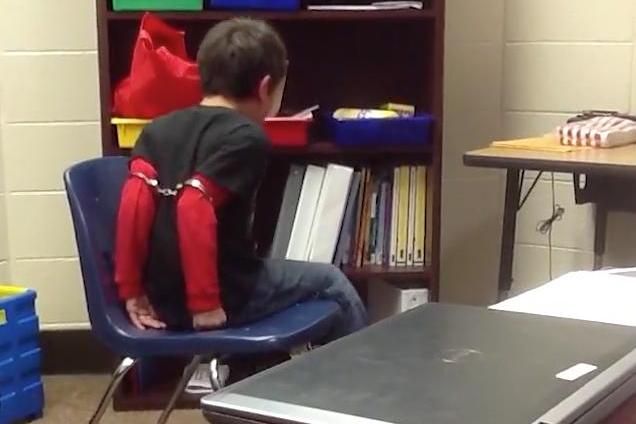
So this bit of news has been making the rounds the past couple of days among autism and other special-needs parents. It seems that in two unrelated incidents, a police resource officer in a Kentucky grade school put an eight-year-old boy and a nine-year-old girl in handcuffs in order to restrain them—cuffing them around their biceps because their small hands would slip through the cuffs. Both students have ADHD, and the girl also had a history of some kind of trauma.

The school was aware of the children’s diagnoses, as was the police officer who cuffed them. Both students had been removed from their classrooms because of disruptive behavior, and when the principal was unable to contain the situations, the officer took over, employing the handcuffs. (Note: watch the video at the top of the article at your own risk. It’s very disturbing.)

According to the report, the girl was especially upset by the situation, to the point of needing psychiatric treatment in a hospital. Understandably, both sets of parents are suing the officer involved.

This is a very sad story, especially in a time when attention has already been focused on police officers abusing their power and mistreating people who live on the margins. These incidents may not rise to the level of Freddie Gray or Michael Brown, but they come pretty darned close.

I don’t want to say much about the incidents—I don’t like stating the obvious or dwelling on people’s stupidity. But I do want to look at the article that described the situation. Actually, not the article (although it does have a couple of really embarrassing typos), but the utterly irresponsible headline that was assigned to it:

Lawsuit: Officer handcuffed mentally disabled kids as punishment.

Disabled? Mentally? What does that even mean? The report only talks about ADHD and some unspecified trauma. It’s not as if the kids had been lobotomized or anything. There’s nothing in the report that indicated the students were “disabled” in the sense that most people understand that term.

It doesn’t take a genius to see how this terminology places a kind of perception filter over the whole story.

“Oh, the kids must have been truly and deeply disturbed.”

“I can understand why the principal let the officer shackle the children.”

“These are mentally disabled kids—it’s not as if they were ‘normal’ kids. I guess it’s okay.”

It may not seem like a huge deal—just a matter of poor wording. But in this time when the Americans with Disabilities Act is celebrating its twenty-fifth anniversary, we don’t need to be going backwards. Remember, it was the ADA that ushered in the era of person-centered language. So we talk about a man with schizophrenia rather than calling him a schizophrenic. We talk about a woman who can’t walk instead of calling her a cripple. And we talk about a child with ADHD rather than calling him mentally disabled. Or at the very worst, we call him a child with a disability.

It shouldn’t be rocket science at this point in our history, and yet here we are. We’re still using hurtful, discriminatory words. Words that justify abuse, fear, and marginalization.

ADHD Hall of Fame.

But that’s not all. Terms like “mentally disabled” give the impression that the kids are slow learners or are academic underachievers. It puts them in a category of “less than,” when there is absolutely no evidence in the article that this is the case. For all we know, these kids could be total freaking geniuses who happen to have ADHD. It’s not uncommon, after all for this combination to occur.

Here, for instance, is a list of some well-known, very successful people who also have ADHD:

  • Virgin Airlines CEO Richard Branson
  • Quarterback Terry Bradshaw
  • Musician Justin Timberlake
  • Pulitzer Prize Winning Journalist Katherine Ellison
  • Comedian Whoopi Goldberg
  • Actress Michelle Rodriguez

Would you call any of them “mentally disabled”?

Words from the Unwise.

It’s possible that the editor who created this headline thought the article would get more views if he or she used a provocative title. Or maybe the editor was trying to allude to the recent police brutality stories. But it was a very poor choice of words. It’s deeply offensive, and it did a huge disservice, both to the story and more important, to the kids.

But hey, I guess we’re making some progress. At least the headline didn’t call the kids retarded.

Who’s Leading Who?

So today is Father’s Day. In honor of the day, I thought I’d dust off a post from a few years ago, update it a bit, and repost it. (That, and I’m too busy being a dad today to write something new.) So here goes:

Who’s Leading Who?

In one of the lesser-known resurrection accounts in the Bible, Jesus tells Peter: “When you were younger, you used to dress yourself and go where you wanted; but when you grow old, you will stretch out your hands, and someone else will dress you and lead you where you do not want to go.” The passage goes on to explain that Jesus said this to signify “by what kind of death he [Peter] would glorify God” (John 21:18-19).

This passage has always had special resonance for me, to the point of being a kind of interpretive key to almost all of the major events in my life. It sounds kind of grim, doesn’t it? All this talk about being led where you don’t want to go and dying—even if that death glorifies God. But that hasn’t really been my experience. Rather, I’ve found a surprise or two along the way as I’ve seen these words unfold in my life.

One major surprise came when I realized who it was who would end up leading me along unexpected paths: my own kids! Now I’m sure that many parents can relate. None of us really knows what to expect when we hold our first child. We can never fully appreciate how much our lives will change now that we have welcomed this new person into our lives. How much more when you are blessed with six children! And how much, much more when it turns out that all six children are on the autism spectrum!

Unexpected Paths.

I named an earlier post “A Little Child Shall Lead Them,” and I meant it as something more than a clever play on words. I can testify that my kids—all six of them—have led me in ways I never expected.

  • They have led me to the waiting rooms of psychologists and psychiatrists and speech and occupational therapists as I have sought to understand their challenges and help them make sense of them as well.
  • They have led me to school conference rooms, where I have advocated for them and labored mightily to convince unimaginative, one-size-fits-all educators to give them a fair shake.
  • They have led me to my knees in prayer—not desperate prayers for their healing, but impassioned entreaties that God will grant them a future full of hope, a future where their gifts are welcomed and where they can make a difference for other people.
  • They have led me down rocky paths as I have helped them work through sleepless nights; relationship challenges; full-scale tantrums; days-long depressive episodes; and anxious, hours-long perseverations.

Death and Freedom.

Now, Jesus told Peter this stuff as a way of hinting at the kind of death that awaited him. And that has proven true for me as well, in a more figurative way. No, I’m not writing from beyond the grave! But my kids have definitely led me to experience other kinds of “deaths”—

  • The death of my dream for a Brady Bunch kind of life. It was a pretty self-centered, self-indulgent dream anyway, and I’m glad it’s gone. Now I don’t have to worry about how clean or dirty the house is. Or about when my kids are going to record their first pop single.
  • The death of any rigidity or legalism I may have brought to my ideas of parenting. I have learned to become much more flexible and creative in my parenting. “So what if she wants to wear all black clothing to church?” “You want to stay in your bed to avoid the noise of the dinner table? Knock yourself out! Just make sure you eat afterward—and clean up your plate.”
  • The death of a few close friendships due to some people’s lack of willingness to “get” our family’s dynamic. This was especially hard at first, but I realized that it’s in times of difficulty that you learn what your friends are really made of. That’s when you have to decide who is really worth your time.
  • The death of a romanticized take on the spiritual life. There are no simple answers. There are no guaranteed formulas. And yes it’s true; sometimes God does give you more than you can handle. That’s why he gave us each other. It’s also why he created wine.

It’s ironic, but each of these deaths has made me feel a little more alive and free. Little by little, my kids have led me to a place of surrender. Not defeat. Not resignation. But acceptance. I have learned so much about myself; about human nature, both the bad and the good; and about God that I feel like I’m a very different person now compared to who I was when our first one was born. And that leads to the final part of this passage.

An Unforeseen Glory.

According to the story, Jesus was pointing to the way Peter’s death would glorify God. Well, I’m not about to think that I give God all that much glory. Not unless he is glorified in huge messes! But I do think that the deaths I listed above have helped me to see God’s glory in new, unexpected ways.

  • I see his light shining through my nine-year-old’s unassailable innocence, both when he’s in full melt down mode and when he’s completely aflutter with the joy of something as helping Katie cook dinner.
  • I see him shedding a tear when my fifteen-year-old gets himself tangled up inside and needs to be talked down from a ledge of self-condemnation.
  • I feel his arms around me every time I dive into yet another parent-teacher conference or begin yet another bitter disputation with the insurance company.
  • I see his covenant commitment every time I come home and watch Katie coaching the kids in homework, making dinner, and trying to help the six-year-old overcome his loud, insistent perseverations all at the same time.

So yeah, there’s a lot of good stuff that comes from these little, unlooked-for deaths. Leave it to religion to be so delightfully paradoxical!

This Is My Body.

 For those of you who don’t know, I’m a Catholic, so this last one comes from my faith tradition. More than anything else, I see God in the bread at Mass as he says, “This is my body.” But I don’t just see and believe. I’ve also found the audacity to pray in return: “Hey! Over here! This is your body, too—this precious family you have given me. We’re part of you, and we all belong to you. So don’t pass us over or forget about us. You made my kids this way, so you’re stuck with us.”

Then I go one step further and tell him, “And here is my body, my life. It’s nowhere near the image of you that it’s supposed to be. It’s still too much shadow and not enough light. Still, I offer it to you. Go ahead and keep leading me, even if it’s where I don’t want to go. With all of these little deaths, you have found so many ways to empty me. And I guess that’s fine. But now I need you to fill me and raise me up so that I can give myself—body and blood, soul and humanity—back to my children.”

And the Lord reaches out his hand to grasp mine, and responds: “Amen.”

Happy Father’s Day, everyone!

There’s No One Like You

Glaceon

This morning, I was greeted by an e-mail written by my fourteen-year-old daughter. I liked it so much that I decided—with her permission, of course—to post it below. Take a quick look, and you’ll see why I’m so proud of her—and all my kids!

Have you ever felt worthless, like you don’t belong in this world and the world would be a better place without you? Well I have felt that way sometimes. I have what’s known as Aspergers Syndrome, another form of autism. I’ve always felt left out, like I’m not good enough, even though I know that’s not true.

I used to go to a private school in Florida for kids just like me until my family moved to Maryland. Now I go to a public school with a lot of kids who aren’t like me. Not only that, but I’m now with a group of friends who are all atheists, and I’m the only religious person in that group, so I really feel like I stick out. And that can make me feel bad about myself again.

I’m not saying that my disorder is a bad thing; no, it makes me special. I have the right to live no matter how bad I feel sometimes. Aspergers is just one of my many special qualities and you can’t take that away from me! I will live the rest of my life with this disorder, but as of now, me being a teenage girl, I’m young and insecure, I’m on a wire balancing my dreams, hoping ends will meet their means, but I feel alone, uninspired.

I might like things that others don’t, for example Pokemon, Anime, Creepypasta, and FNaF. I do sometimes feel worthless and left out. Sometimes I wonder why I’m even alive. But am I going to give up? NO! I will stick with myself. I will surpass all of my fears, difficulties, insecurities, and faults! Even when I go into high school next year, I will walk through those doors with confidence, and if I don’t then shame on me!

I need to look at the positive side of life. My past might haunt me, and my brothers might make fun of me, but I am a YouTuber, a DeviantArtist, an honor roll student, and a good friend. I would help anyone I know through problems that they are having, and if I can’t, then I would tell them that everything is okay and help them back up.

I might be very different from everyone else, but just know one thing. If you feel worthless, look inside of yourself and see how much you matter to God. So please look at life in a good way and try to ignore the faults of humanity. Have confidence, be yourself, and if anyone tells you otherwise, ignore them and follow your own path! You are you, and there is no one like you!

Hope. Faith. Love.

Groovy Love

For those who don’t know, I’m a Catholic, and I take my faith kind of seriously. I also like to laugh at how quirky Catholicism can be at times. Among all the Christian denominations, we have got to be the most precise bunch. It’s likely because of our ties to the Roman Empire. Compared to the Greeks, who tended to be more philosophical and flexible, the ancient Romans were legal-minded sticklers for precision. How else did they manage to conquer the world?

Off the top of my head, I can think of two ways that our Roman roots show up. First, there’s our almost innate desire to define doctrines to the umpteenth decimal point: mortal versus venial sin, degrees of cooperation with evil, specific requirements for fasting, for receiving communion, and all that. Then there are the numbers. So many numbers. Just look at the sevens for an example: seven deadly sins, seven corporal works of mercy, seven spiritual works of mercy, seven sacraments the Seven Founders of the Order of Servites. Then there are the threes: Father, Son, and Spirit; poverty, chastity, and obedience; Scripture, Tradition, and the Magisterium. And, of course: faith, hope, and love.

It’s this last trilogy that struck me today. I recalled how St. Paul talks about faith, hope, and love being the only three gifts of God that last, and how “the greatest of these is love” (1 Corinthians 13:13). And it got me to thinking about how these three virtues are the most important things we need as parents—and doubly so as parents of special-needs children. Forget Doctor Spock. Forget Doctor Phil. Even forget Doctor Who. All those self-help books at Barnes & Noble? Rubbish. All those listicles about parenting on Buzzfeed? Worthless. If you have faith, hope, and love, you’ll do just fine.

And because I’m Catholic, I will now tell you the right order in which you need them. *Clears throat*

Hope.

Every parent begins with this one. A child is born. He is beautiful, innocent, full of promise and potential. We look on this tiny person that is the result of our love, and we are gobsmacked. We have such high hopes for this little baby. Not necessarily that he’ll be an astronaut or a top chef or a CEO—although that would be great. We hope that he’ll grow and flourish and find happiness and love. That she’ll find her own special someone with whom she can make a family of her own. We dream of school plays and soccer tournaments and Christmas trees and family trips. We dream of (and dread) the driving lessons, the first date, the prom, and graduation day. Holding this little blessing in our arms, we can’t help but dream of the future.

Then the child grows up, and we see things that challenge our hope. Perhaps speech is delayed. Maybe he takes far too long to learn how to walk or use the potty. Maybe she doesn’t know how to mingle with her classmates in preschool. Maybe he always cries at the doorbell or any sudden noise. Something’s not quite right, and we worry about the future. Then the word “autism” enters our vocabulary, and we feel hope draining away. What about the prom? What about graduation? What about finding love? Is it all possible?

That’s when we look to . . .

Faith.

It’s faith that keeps our hope alive. Faith in our child’s innate goodness. Faith that he really does want to do well and to succeed. Faith in the team of care providers that we stumblingly assemble to give him every chance at a full and rewarding life—whatever that means. Faith in a God who would never abandon a child of his.

That faith sees us through the melt downs, the tantrums, the tone-deaf schools, and the unthinking or unaware neighbors. It lifts us up when our kid begins to go south, whether because of regression or oppositional behavior or depression or anxiety. It sustains us through the long, wearying days and helps us sleep at night. When hope begins to fade, faith tells us that despite what we are seeing now, better days are ahead. It gives us assurance that what we hope for will come to pass (Hebrews 11:1). It may not look like what we expected, but it will come. And so we press on, fueled by faith, toward that vision that we have hoped for.

But what happens when even faith wavers? What if the child we have worked with, prayed for, fought for, and even clashed with, simply is not making progress? Maybe he can’t overcome the next hurdle, or maybe he just doesn’t want to. Whatever the case, what do you do when hope has dissipated and you can’t place your faith in any of the resources you once relied on?

You still have . . .

Love.

And in the end, you know that’s all you really needed. Your dreams may not be fulfilled. Your doctors and therapists may be at an impasse. Your prayers don’t seem to be working. Nothing is going right, and you don’t know if anything good is on the horizon.

It doesn’t matter. He’s your son. She’s your daughter. And you can’t help but love. Even when you want to throw up your hands in despair, you know that this is your child, and that knowledge brings you back to sanity. It softens your heart, if only just enough to let you take the next step forward.

No matter what happens, love wins out. It may take years, but it will win. Because a child who knows he is loved, no matter what, will always have a glimmer in his heart, and that glimmer will offer some protection, some encouragement, some guidance in the dark days. Just as God looked at us and couldn’t help but love us, even when we felt lost and hopeless, we can’t help but feel love when we look at our children.

So even if he never learns to use the toilet, even if she never speaks a word, even if he ends up living all alone or in your basement, there’s always love. Good old, stubborn love. Because it’s the one thing—the only thing—that will matter in the end.

It’s All About Us

Video

I’m so proud of my oldest daughter. All by herself, without telling us, she produced this video for a project in her Aspergers-only school. She doesn’t often tell us what she’s thinking—not uncommon for any 13-year-old girl and even more prevalent with girls on the spectrum—so I was blown away when I saw this.