Words from the Unwise

Lawsuit-Officer-handcuffed-elementary-school-students-with-ADHD

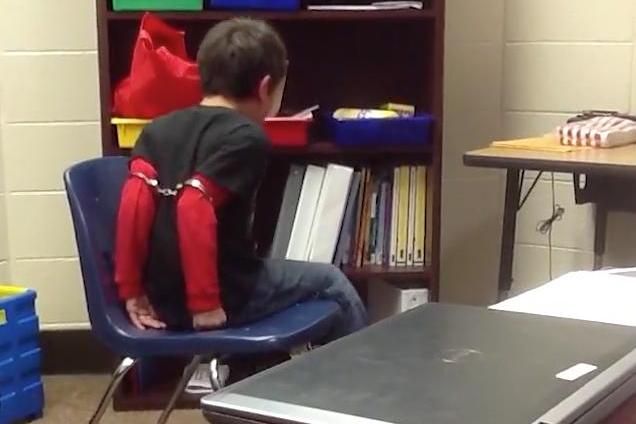
So this bit of news has been making the rounds the past couple of days among autism and other special-needs parents. It seems that in two unrelated incidents, a police resource officer in a Kentucky grade school put an eight-year-old boy and a nine-year-old girl in handcuffs in order to restrain them—cuffing them around their biceps because their small hands would slip through the cuffs. Both students have ADHD, and the girl also had a history of some kind of trauma.

The school was aware of the children’s diagnoses, as was the police officer who cuffed them. Both students had been removed from their classrooms because of disruptive behavior, and when the principal was unable to contain the situations, the officer took over, employing the handcuffs. (Note: watch the video at the top of the article at your own risk. It’s very disturbing.)

According to the report, the girl was especially upset by the situation, to the point of needing psychiatric treatment in a hospital. Understandably, both sets of parents are suing the officer involved.

This is a very sad story, especially in a time when attention has already been focused on police officers abusing their power and mistreating people who live on the margins. These incidents may not rise to the level of Freddie Gray or Michael Brown, but they come pretty darned close.

I don’t want to say much about the incidents—I don’t like stating the obvious or dwelling on people’s stupidity. But I do want to look at the article that described the situation. Actually, not the article (although it does have a couple of really embarrassing typos), but the utterly irresponsible headline that was assigned to it:

Lawsuit: Officer handcuffed mentally disabled kids as punishment.

Disabled? Mentally? What does that even mean? The report only talks about ADHD and some unspecified trauma. It’s not as if the kids had been lobotomized or anything. There’s nothing in the report that indicated the students were “disabled” in the sense that most people understand that term.

It doesn’t take a genius to see how this terminology places a kind of perception filter over the whole story.

“Oh, the kids must have been truly and deeply disturbed.”

“I can understand why the principal let the officer shackle the children.”

“These are mentally disabled kids—it’s not as if they were ‘normal’ kids. I guess it’s okay.”

It may not seem like a huge deal—just a matter of poor wording. But in this time when the Americans with Disabilities Act is celebrating its twenty-fifth anniversary, we don’t need to be going backwards. Remember, it was the ADA that ushered in the era of person-centered language. So we talk about a man with schizophrenia rather than calling him a schizophrenic. We talk about a woman who can’t walk instead of calling her a cripple. And we talk about a child with ADHD rather than calling him mentally disabled. Or at the very worst, we call him a child with a disability.

It shouldn’t be rocket science at this point in our history, and yet here we are. We’re still using hurtful, discriminatory words. Words that justify abuse, fear, and marginalization.

ADHD Hall of Fame.

But that’s not all. Terms like “mentally disabled” give the impression that the kids are slow learners or are academic underachievers. It puts them in a category of “less than,” when there is absolutely no evidence in the article that this is the case. For all we know, these kids could be total freaking geniuses who happen to have ADHD. It’s not uncommon, after all for this combination to occur.

Here, for instance, is a list of some well-known, very successful people who also have ADHD:

  • Virgin Airlines CEO Richard Branson
  • Quarterback Terry Bradshaw
  • Musician Justin Timberlake
  • Pulitzer Prize Winning Journalist Katherine Ellison
  • Comedian Whoopi Goldberg
  • Actress Michelle Rodriguez

Would you call any of them “mentally disabled”?

Words from the Unwise.

It’s possible that the editor who created this headline thought the article would get more views if he or she used a provocative title. Or maybe the editor was trying to allude to the recent police brutality stories. But it was a very poor choice of words. It’s deeply offensive, and it did a huge disservice, both to the story and more important, to the kids.

But hey, I guess we’re making some progress. At least the headline didn’t call the kids retarded.

There’s No One Like You

Glaceon

This morning, I was greeted by an e-mail written by my fourteen-year-old daughter. I liked it so much that I decided—with her permission, of course—to post it below. Take a quick look, and you’ll see why I’m so proud of her—and all my kids!

Have you ever felt worthless, like you don’t belong in this world and the world would be a better place without you? Well I have felt that way sometimes. I have what’s known as Aspergers Syndrome, another form of autism. I’ve always felt left out, like I’m not good enough, even though I know that’s not true.

I used to go to a private school in Florida for kids just like me until my family moved to Maryland. Now I go to a public school with a lot of kids who aren’t like me. Not only that, but I’m now with a group of friends who are all atheists, and I’m the only religious person in that group, so I really feel like I stick out. And that can make me feel bad about myself again.

I’m not saying that my disorder is a bad thing; no, it makes me special. I have the right to live no matter how bad I feel sometimes. Aspergers is just one of my many special qualities and you can’t take that away from me! I will live the rest of my life with this disorder, but as of now, me being a teenage girl, I’m young and insecure, I’m on a wire balancing my dreams, hoping ends will meet their means, but I feel alone, uninspired.

I might like things that others don’t, for example Pokemon, Anime, Creepypasta, and FNaF. I do sometimes feel worthless and left out. Sometimes I wonder why I’m even alive. But am I going to give up? NO! I will stick with myself. I will surpass all of my fears, difficulties, insecurities, and faults! Even when I go into high school next year, I will walk through those doors with confidence, and if I don’t then shame on me!

I need to look at the positive side of life. My past might haunt me, and my brothers might make fun of me, but I am a YouTuber, a DeviantArtist, an honor roll student, and a good friend. I would help anyone I know through problems that they are having, and if I can’t, then I would tell them that everything is okay and help them back up.

I might be very different from everyone else, but just know one thing. If you feel worthless, look inside of yourself and see how much you matter to God. So please look at life in a good way and try to ignore the faults of humanity. Have confidence, be yourself, and if anyone tells you otherwise, ignore them and follow your own path! You are you, and there is no one like you!

How I Learned to Love the Drugs

Kids' Meds

Here’s a snippet of a conversation I had yesterday evening with my little girl.

Her: Daddy, why does F take medicine?

Me: It helps him not feel so sad all the time.

Her: Okay, so why does L take medicine?

Me: It helps her focus in school and not be too worried.

Her: Well, what about C? What does his medicine do?

Me: It helps him keep calm in school and at home.

Her: And what about B? He takes medicine too.

Me: His medicine helps him not get too angry.

Her: So when will I start taking medicine?

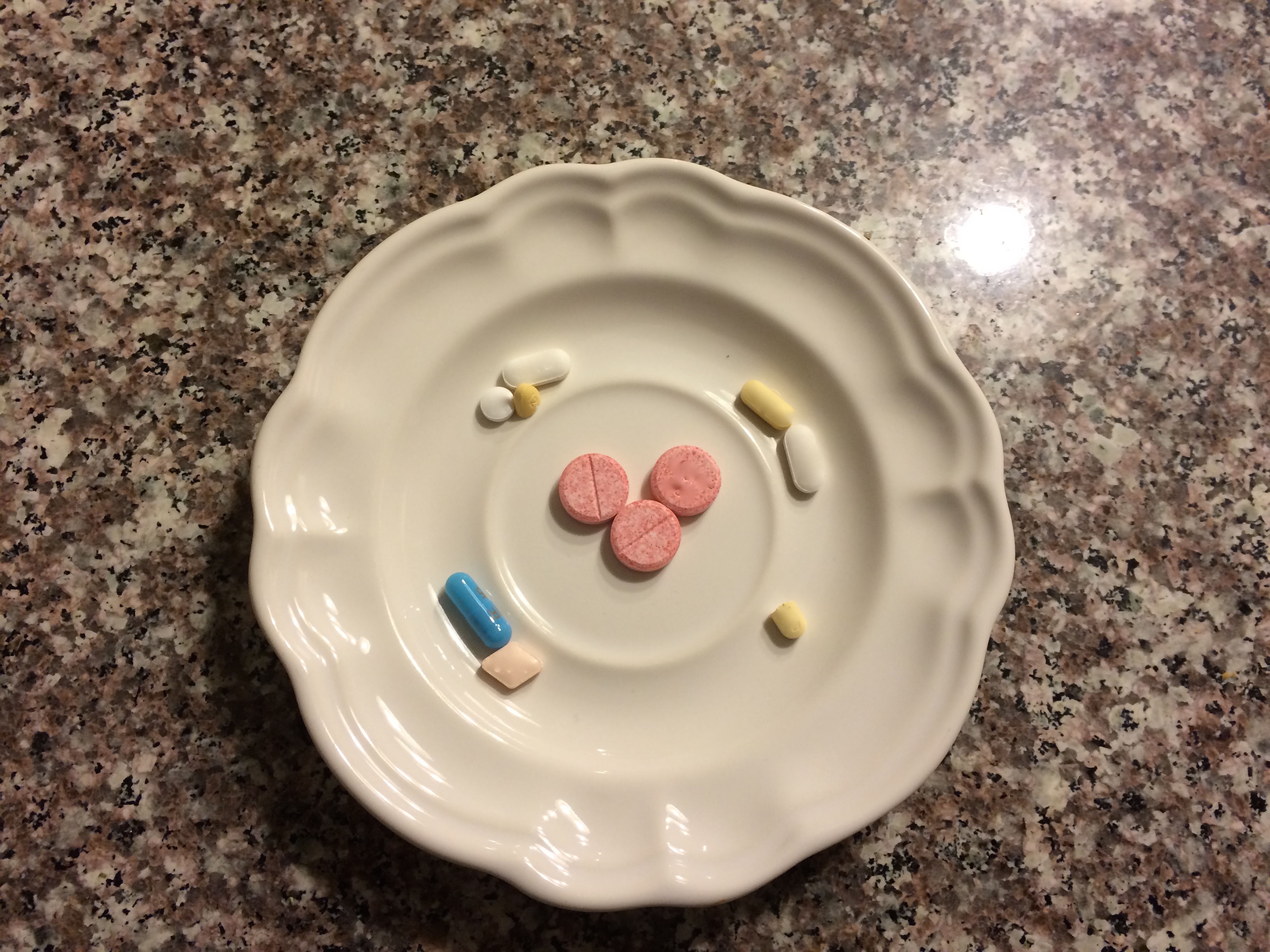
With an internal sigh, I brushed off her last question and changed the subject. I didn’t have the heart to tell her that we were going to start her on a drug trial in a couple of weeks—to help her deal with her anxiety. I figured she’d have plenty of time to think about it when the trial actually began. Nor did I tell her that her little brother was going to start his own trial around the same time. Again, the less said, the better.

So there it is. By the middle of May, all six of our children will be on some kind of psychotropic medication.

Surprised by Sympathy.

It’s interesting. I shared this little dialogue with a couple of autism parenting support groups I belong to on Facebook, and I was kind of surprised by some of the comments. Many posted the symbol for a virtual hug: (((you))), and a few said something like “It’s hard” or “So sad.” But my wife, Katie, had the best response: she laughed. It was, after all, a cute exchange, and it showed how innocent our girl is.

It never dawned on me that this conversation would elicit words of sympathy, but now that I see it through these commenters’ eyes, I think I get it. See, I’ve grown so used to our routine that it seems, well, routine to me. I don’t think of it as unusual, hard, or sad at all. In fact, it’s the thought of not medicating my children that fills me with fear and trembling—for my sake as much as for theirs!

An Evolution of Sorts.

It wasn’t always this way. Back in 2007, when our pediatrician first prescribed a medicated patch to help one of our girls with ADHD-like symptoms, I resisted mightily. I hated the idea of introducing mind-altering chemicals into her sweet little brain. It didn’t help that the doctor told us we’d likely need a prescription steroid to help control the skin irritation that often accompanied the patch. Great! A medicine to counteract the side effects of the original medicine. What could be better? Eventually, however, I gave in.

When the patch didn’t work, we began a three-year odyssey of various other trials (under the direction of two different pediatricians and two different psychiatrists) to help her not only with ADHD but her growing anxiety. One made her giddy and made her gain a lot of weight. Another gave her terrifying nightmares. A third got her so agitated that she ended up biting me on the shoulder in the middle of Mass one Sunday. There were other failures as well, but I can’t recall them now.

It wasn’t until we began working with our third psychiatrist that we found the right combination. Her anxiety diminished considerably. She lost the extra weight. Her grades began to soar. And her demeanor at home, while still needing some help, became much more manageable. The tide was turning, and I was happy—happy enough to let three of our other kids begin their own medicine trials. Thanks be to God, there was a lot less initial drama with them and generally positive results.

Six for Six.

So now our two youngest ones are on the verge of getting prescriptions. Their therapist tells us that she can do only so much with them as they are right now. The little guy is too hyperactive and the little girl is too nervous for any talk therapy to have a lasting effect. “If we can just take the edge off,” she told us, “we might be able to make some headway. But as it is, the cascade of emotions is too strong for them to work through.”

It was a bitter pill to swallow at first, this thought that all our kids need psychiatric medicines. Not only does it get expensive, but it emphasizes their otherness and the challenges they face. Still, it didn’t take me long to adjust. I’ve been down this road a few times already! Plus, the sheer everyday nature of the routine helps a lot. Maybe that’s why my little girl can be so nonchalant about it. She has seen her siblings take medicine twice a day for as long as she can remember. It’s just a part of who we are and how we live.

Embrace the Mess.

That’s probably the way it should be. For everyone. You work and work and work until you find what works for you. You let go of the “picture perfect” life you had envisioned for yourself and your family, and you embrace the beautiful, horrible, glorious, maddening, sanctifying mess that God has given you. And as you do, you find that he’s embracing you as well.

He’s probably laughing, too.

The Domino Effect

IMG_1729 See that? That’s my Little Guy being as silly (and ADHD) as ever. Not a dinner goes by without him doing something completely and engagingly out of the ordinary. From running around the kitchen table twenty times to dancing in place on the bench to ceaselessly tapping his spoon on the table, he can’t sit still to save his life—and it bothers his older siblings immensely. You know, the ones who are particularly sensitive to noises, extra activity, and anything out of the ordinary. One or another of them will end up shouting at him at every dinner, but he just keeps on keeping on, happily expending his energy.

That’s the fun of having multiple children on the autism spectrum. Some are ultra-sensitive to their surroundings while others are completely oblivious. That usually leaves Katie and me with the unenviable task of trying to mediate between the two factions. It’s not always easy, as the two most averse to noise and other sensory excitement also tend to be the most emotional ones. So they respond with a level of anger and frustration that far outstrips the gravity of the situation—that is, the gravity that we perceive. For them, their younger brother’s acrobatics are thoughtless, careless assaults on their frayed nerves. But for him, being hyperactive is his default position.

And so begins the Domino Effect. Child Number Six’s hyperactivity sets off Child Number Four’s aversion to the unexpected, then Child Number Four begins yelling at Child Number Six, which sets off Child Number One’s aversion to noise, which causes Child Number Two to cover her ears and yell louder, which causes Parental Unit Number One to try to calm down Child Number Six, which only causes Child Number Six to increase his jumping, which . . . well, you get the idea.

A Wild Rumpus.

I wish there were some way to solve this, but for the moment I’m baffled. We could, I suppose, have dinner in shifts, with two kids at the table at a time. But that can eat up a lot of time. Plus, how will they ever learn if we don’t help them work through this stuff? So we’re left trying our best to keep the little jumping bean from pushing too many buttons while also trying to help the older ones practice self-calming and emotional regulation.

Of course, some days are better than others. There are those times when the Little Guy is more subdued, or the older ones are more forgiving. But then there are the times when all Katie and I can do is raise our wine glasses to each other and smile wearily as the wild rumpus unfolds.

And then there are the worst days: when we unthinkingly rush into the fray and end up fanning the flames instead of extinguishing them. That never ends well. We’re getting better at checking ourselves, but there are times when you just can’t help it—or when safety concerns demand a forceful intervention.

Welcome to the Vortex.

This, I think, is one of the hardest things for ASD parents—keeping calm in the midst of a swirling vortex of emotional outbursts. We love our kids so much that we hate to see them upset. But the one causing the upset is another one of our kids, whom we love just as much and who we know has a hard time sitting still. So we’re torn. Plus, as parents, we want to see our kids get along, or at least be civil to each other. That’s kind of hard when they all see each other as threats to their well-being.

So we try the best we can, dreaming of that magical day when all eight of us will remain at the same dinner table for longer than our average of five minutes. Seriously. It’s not uncommon for them to run out of the kitchen not long after dinner has started. Either they’re giddily chasing each other or they’re desperately trying to get away from the noise or they’re taking advantage of the chaos to sneak back to their video games.

Collateral Blessings.

As challenging and dispiriting as this can be, the Domino Effect does have one positive side effect. After the peeling-off, there’s usually one kid still hanging out at the table, and it’s quite common for a conversation to develop. It’s not much, and it’s not long, but it’s real contact. And in a big family like ours, those moments are important.

It never ceases to surprise me the kinds of topics that come up in these impromptu encounters. From our oldest girl’s questions about two girls in her class who seem a little too affectionate with each other (this is 8th grade) to our nine-year-old telling us about the math teacher who yells at his students, we learn a lot, and we can share a little. Sometimes we laugh together, other times we offer advice, and other times we commiserate. But we always try to listen.

As I said, it’s not a lot. But it’s something, and it’s precious. Even our most sensitive kids are able to hang around for a short time—even if there’s full-on chaos in the next room. When they know they have both their parents’ attention, the other stuff recedes into the background. They know we’re listening. They know we’re on their side. They know we love them. And love always wins.

So keep on jumping and stretching and dancing, Little Guy. You have no idea how much good you’re doing!

A Wibbly-Wobbly Ball of . . . Stuff

Wibbly-Wobbly Ball

Before we start, take a look at this very short clip from Doctor Who, in which The Doctor explains the true nature of time. Trust me, it does relate.

That was pretty good, wasn’t it? Now for the explanation.

In a recent blog post, ASD guru and Aspergers role model John Elder Robison tackled the use of terms high-functioning and low-functioning when it comes to describing people with autism. Here’s what he said:

Much has been written about calling people high functioning or low functioning. With all respect to you and your situation, I don’t do it anymore and I suggest you don’t either.

It’s not accurate, and it’s degrading. . . . Suggesting that “you’re a real high functioning autistic” feels to me a lot like “you talk pretty good for a retard.” People say the former to me all the time today, and they said the latter to me quite a bit 50 years ago. I didn’t like it then and I don’t like it now.

Robison then goes on to talk about how dividing people up based on their “functioning” status misses the point of how autism works:

We now know that our functional level changes with time and other factors. As bright and capable as someone like me can seem, I can have meltdowns during which I become essentially nonfunctional and have no more usable intellectual capability that someone with an IQ of 70. It’s true that is not a lasting condition for me, but it happens, and when it does I would just as soon not be stigmatized for it.

As I said in my last post, my kids are showing me that autism can shift and swirl over time. Not for nothing is it called a developmental difference. It’s a matter of how and when a person develops social, cognitive, and communication skills. Some people develop more slowly or more unevenly than others. Some have persistent, nagging glitches in their development that affect them throughout their lives, while others overcome some challenges as they mature—only to find new challenges crop up. For many, it’s a mixture of both permanent and emerging attributes. So it’s awfully simplistic to reduce such a complex thing as autism to a question of high or low functional skills.

Forget the Spectrum.

But I want to go one step further. I want to suggest that along with abandoning the high- versus low-functioning distinction, we should scrap the image of a spectrum altogether. When we use this term, we evoke a kind of linear gradation, with some people lower down, or farther back, on the scale than others. But one problem with this approach is that people are assigned their place on that spectrum according to different criteria. Is it IQ? Is it verbal communication? Is it eye contact? Social skills?

Someone with limited verbal skills may well have an off-the-chart IQ. Or someone who can appear gregarious and outgoing in public may be masking significant social struggles, only to melt down in private. Where would you place each of these people on the spectrum? How would you decide? And most important, what purpose does it serve?

The Autism Ball.

Rather than talking about a spectrum, I’d like to suggest we talk about a sphere—a big ball of wibbly-wobbly, autism . . . stuff. There’s no low or high end. There’s no up or down or forwards or backwards. You just happen to be somewhere on that sphere, and your fellow autistics are somewhere else on it. No one is farther along than anyone else. No one is of greater value than another because he or she is “higher functioning.”

This is why I like the Doctor Who clip. It paints the picture of time, or in this case autism, as something that isn’t static but full of life and energy. And that makes it unpredictable: wild and mysterious, wonderful and dangerous.

So let’s imagine a ball that contains all the possible symptoms and manifestations of autism, all wibbling-wobbling around. Things like hand flapping, mind blindness, rigid thinking, sensitivity to loud noises, toe-walking, perseveration, narrow focus of interest. Imagine that ball also containing the comorbid conditions connected to autism: OCD, depression, ADHD, ODD, etc. Finally, imagine that this ball contains the positive traits of autism: laser focus, attention to detail, unflinching objectivity, a quirky imagination, a strong sense of justice, and an innate innocence.

Now, imagine your own ASD profile as a line running through the ball in one end and out the other end. As that line travels through the ball, it intersects with the various ways your autism manifests itself—not all of the traits, just the ones particular to you. No two lines are in exactly the same place, and no line is in a better position than another. They’re just there, marking out their own individual quirks and challenges, strengths and gifts.

High? Or Low?

All of this theorizing has a point. In an earlier post, I described how misleading the term “mild autism” can be. I gave some examples from my own kids of how difficult things can be for them, even though they would be considered high-functioning. As Robison said, people with high-functioning autism still have autism, and it still affects them profoundly.

We recently went through a rough patch with one of our kids, in which we saw just how much he keeps things hidden inside of himself, especially his awareness of how different he is and how hard it is for him to feel like he fits in. But on the outside, he presents as a clever, quick-witted, amiable boy. So while he seems very high-functioning, a lot of “low-functioning” stuff is going on underneath the surface: depression that can keep him in bed for two days straight, lack of empathy, misunderstanding of other people’s emotions, learning glitches, and an inordinate need for physical stimulation. He can navigate the outside world, but only for a time. Then he shells up when he’s home or alone. Where would you place him on the spectrum? Is he low-functioning or high-functioning?

Then there’s another one of my boys. You need only five minutes with him to “see” the autism: his odd gait, his lack of eye contact, his unusual speech patterns, his stimming, and his tendency to disappear within himself for a time. But hidden behind all of these quirks and tics is a very intelligent, sensitive child with keen insights into his own behavior and the people around him. Where does he fit on the spectrum? In the higher-functioning part of the line? Or the lower? Why?

Get on the Ball!

Mind you, most of this is irrelevant to me. I just look at them as my kids, with all of their strengths and weaknesses, their beauty and awesomeness, and work with each of them based on who they are. But it does make a difference in the universe outside of our home. It makes a difference when I attend IEP meetings or when I have to explain some unusual behavior to a friend or neighbor. It also makes a huge difference in the way society treats people with autism. If you’re a Bill Gates kind of autistic, you are given as many opportunities as you want. But if you’re nonverbal or if you’ve got some other trait that people might call low-functioning, you’ve got fewer chances to show just how awesome you are and what you can accomplish. And that’s sad, because you risk accepting a bleaker narrative about yourself and your potential than if you were given the opportunity to shine.

If we can get away from defining people based on their so-called levels of functionality, we can get closer to seeing each person as a precious individual with his or her own unique set of talents. We will stop assigning each person a value based on what he or she “contributes” to society. Each person is a gift, and you don’t assign a value to a gift based on its usefulness. You treasure it for what it is: a token of love from the One who gave it to you.

So get off the line and get on the wibbly-wobbly ball!