Have Yourself an Aspie Little Christmas

Welcome to the Most Wonderful Time of the Year! For the next month or so, front porches will be festooned with twinkling lights. Santa Claus will hold court at the local mall. Candles will glow at the table. Carols will resound at the spinet. And families will gather for feasts that will make all the Whos down in Whoville green with envy.

It’s that last one—the family gathering—that has me a little nervous this year. For the past twelve years, Katie and I were living in Florida while the bulk of our siblings were living in Maryland. But this summer, we moved back up North. Now, more than 32 relatives live within a one-hour radius of our home. Some are as close as the next neighborhood over.

Believe me, I love being back home. I’m so glad my brothers and sisters, as well as most of my in-laws, are nearby. They’re all good people, and we get along really well. But it’s been years since we’ve been part of a major family gathering, and a lot has happened in those intervening years. Mainly, we had a lot of kids who just happen to be on the high-functioning end of the autism spectrum.

If you know anything about autism, you know that people on the spectrum can have a hard time with sensory overload. Noises and crowds can make them shut down or act out. Changes in routine are unsettling. The smells, tastes, and textures of a holiday meal can be overwhelming. Even when they’re surrounded by people they know and love, they’re still surrounded. And that doesn’t always feel good.

All of this got me thinking about how different our family can be—and how different we may appear to people who come to visit. Mind you, most of our relatives are familiar with our dynamic, but there are a few outliers. Not to mention, new friends may end up dropping by. So, with no malice or prejudgment intended, I decided to come up with a few random guidelines for visitors to our home over the holidays.

A Field Guide to the Zanchettin Holiday Home.

  • Please remember that the Hallmark Channel is a mendacious purveyor of myth. No one’s dining room looks like that, and certainly not ours. We’re too busy running to therapy sessions and prepping for IEP meetings to dust every other day. Or every other month. Or ever.
  • No, the mini-trampoline belongs in the hallway, where we can keep an eye on it. And on its users.
  • If you find yourself trapped in a heavily one-sided conversation with one of the kids, remember that nonverbal clues don’t work. Use your words. Find some hook that you can use to change the subject. Unless, of course, you enjoy lengthy discourses about the relative merits of water type Pokémon versus grass types in the Kanto Region.
  • Please try not to make any references to Frozen. Not even oblique references. Don’t even say, “Let it go” in casual conversation.
  • Yeah, he spins around like that sometimes. Or hops. Or planks. He’ll be fine.
  • Don’t be offended if one or more of the kids disappears without notice. It isn’t you; it’s her. She’s probably getting overwhelmed and looking for a quiet place to unwind. Just shrug your shoulders and move on to another child. We’ve got six of them, so there should be plenty to go around.
  • Yes, that probably is the 75th time you’ve heard the theme song for the video game “Five Nights at Freddy’s.” It makes him happy, so we’ve learned to block it out.
  • Don’t be surprised if, when you ask one of the kids what extracurricular activity he’s involved in, he replies, “Therapy.” He’s being honest.
  • Yes, he often sits upside down like that, with his head near the floor and his feet in the air. Or athwart both arms of the chair. Or draped over the back of the sofa. And yes, he’s very comfortable doing it.
  • Yes, I know he’s taking a bath right before dinner. That’s his safe place when things get too noisy. He’ll be out in about an hour.
  • All compliments about our parenting will be graciously accepted by the management. All advice will be graciously ignored.
  • Why yes, I’d love another glass of wine. How did you know?
It’s All About Us

Video

I’m so proud of my oldest daughter. All by herself, without telling us, she produced this video for a project in her Aspergers-only school. She doesn’t often tell us what she’s thinking—not uncommon for any 13-year-old girl and even more prevalent with girls on the spectrum—so I was blown away when I saw this.

Five Years with Autism

Five years.

Sixty months.

Two hundred and sixty weeks.

One thousand, two hundred and eighty-six days.

That’s how long we’ve been living with autism. Actually, scratch that. We’ve been living with it for fourteen years, but we didn’t know what it was until five years ago. We were a little slow on the uptake.

Five years is a kind of a milestone, isn’t it? So naturally, I did a bit of looking back at both the highlights and the lowlights to see how far we’ve come and to think a little bit about the future. Here’s what I came up with.

From Fear to Acceptance.

First, the diagnoses themselves. From the first one, when our lives began to change, to the last one, which was more or less a given, I can see somewhat of a progression.

• With the first diagnosis, in March of 2009, there was fear. Would he ever talk? Would he ever be independent? Would he wander off one day and get hit by a car? Would he spend the rest of his life alone?

• Then came the second diagnosis, in May of 2009. This time, there was a combination of relief and anger. Relief because we finally had a name for her quirkiness and emotionality. Anger at her pediatrician, who had told us it was only a matter of bad parenting.

• Then came the third diagnosis in September of 2010. This time, there was mostly guilt. Guilt because of all the lost years. Guilt because this was our oldest, so he had to bear the most years of our misunderstanding him. The signs were there early on, but I didn’t want to see them.

• With the fourth one, in March of 2011, there was a sense of validation. I had called it early on this time. This little fellow spent almost an entire year insisting that he wear nothing but red shirts and shorts. He would also get so absorbed in building Legos that he would forget to go to the bathroom.

• Then came the fifth in early 2012. This time, there was laughter. I had seen so much with the first four that nothing was a shocker. Besides, by this time, my attention had turned to working with the kids’ schools. Frankly, I had bigger fish to fry than to react to something I was beginning to think was inevitable.

• I’m sure I felt something when the last diagnosis came during the summer of 2013. I just can’t remember what it was. Nonchalant acceptance, maybe? More or less, I took it in stride. Nothing could shock me anymore. It just gave us more insight into this sweet little girl.

Not Just Labels.

But besides the accumulation of labels, there are some other milestones. During this time, I have:

• Attended more than 30 IEP meetings at three different schools.

• Spent nearly $50,000 in autism-related medical and psychological treatments, schools, medicines, and therapies for my kids.

• Lobbied our state representatives for increased funding for our local autism center—and won.

• Taken more than 15 stress-relieving day trips to Disney World.

• Seen the dissolution of two friendships—one close, the other not so much—because of misunderstandings or judgments about our family.

• Seen two other friendships slip into casual acquaintances. Not because of any malice but because our paths rarely cross any more. (Let’s face it. I rarely cross paths with anyone these days!)

• Met other autism parents online, in whom I have found encouragement, humor, common experiences, and wisdom.

• Fallen more deeply in love with my wife, whose commitment to our kids never ceases to inspire me.

• Made peace with God over the whole situation. Ironically, I bear fewer external markers of my faith than I have in decades (e.g., commitment to a Bible study, membership in a small faith community, parish involvement), but I feel more strongly connected to the Lord and my faith than ever before.

Accepting a Constant Presence.

So yeah, it’s been a wild ride. There have been wonderful triumphs, like the day our four-and-a-half-year-old finally got potty trained. And there have been crushing blows, like the day one of our kids, in a full-scale melt down, grabbed a kitchen knife and threatened to cut himself. There have been strings of days when we’ve wondered if it could ever get any worse. And there have been times when everyone seemed to be firing on all cylinders and we could breathe easier.

But through the ups and the downs, autism has been a constant presence. I know I said a few years ago that not everything is about autism, but I don’t think that’s true any more. Autism is an integral part of who my kids are, and that means it shows up in just about every aspect of their personalities. They’re not being autistic only when they’re melting down or misinterpreting social situations. They’re just as autistic when they’re happy and making excellent progress. They do everything a little bit different, and that’s part of what makes them so unique.

I guess this means that I no longer look at autism as a scaly, ravenous monster ready to devour my children. There are days, mind you, when it seems like that’s happening. But there are many more days when it feels more like an awkward, galumphing puppy that you have to keep an eye on—you don’t want it peeing on your floor or chewing your furniture!

So have I come to a point of acceptance? Yes and no.

Accepting my kids and their unique neurologies? Absolutely.

Accepting the fact of their diagnoses? Pretty much, although there are times that I lose sight of it.

Accepting that this is how they’re going to be forever? No. I’m not trying to fix them, but I am trying to teach them how to be as successful as possible in a world that can seem so bizarre, alien, and even frightening.

What’s around the Corner?

And that’s where the future comes in. As I stand at the five-year mark, I can be proud of what we’ve accomplished, even as I peer nervously around the corner to see what’s still waiting for us. I know every year will have its own challenges and triumphs. I also know better than to assume that the worst is behind us. No one can say that with any degree of confidence. But I can say that the past five years have changed and shaped me in ways I never expected. They have shattered old misconceptions and built up new, stronger convictions. They have revealed a shallowness in my heart and taught me how to love more selflessly. And they have taught me never to put limits on what I—or Katie or any of my kids—can do.

There are many more obstacles to overcome, many more challenges to face down, many more threats to neutralize. There’s so much more we haven’t experienced yet, but I think we’ll be able to handle it.

Just as we’ve done for five years.

No Love from the Lollipop Guild

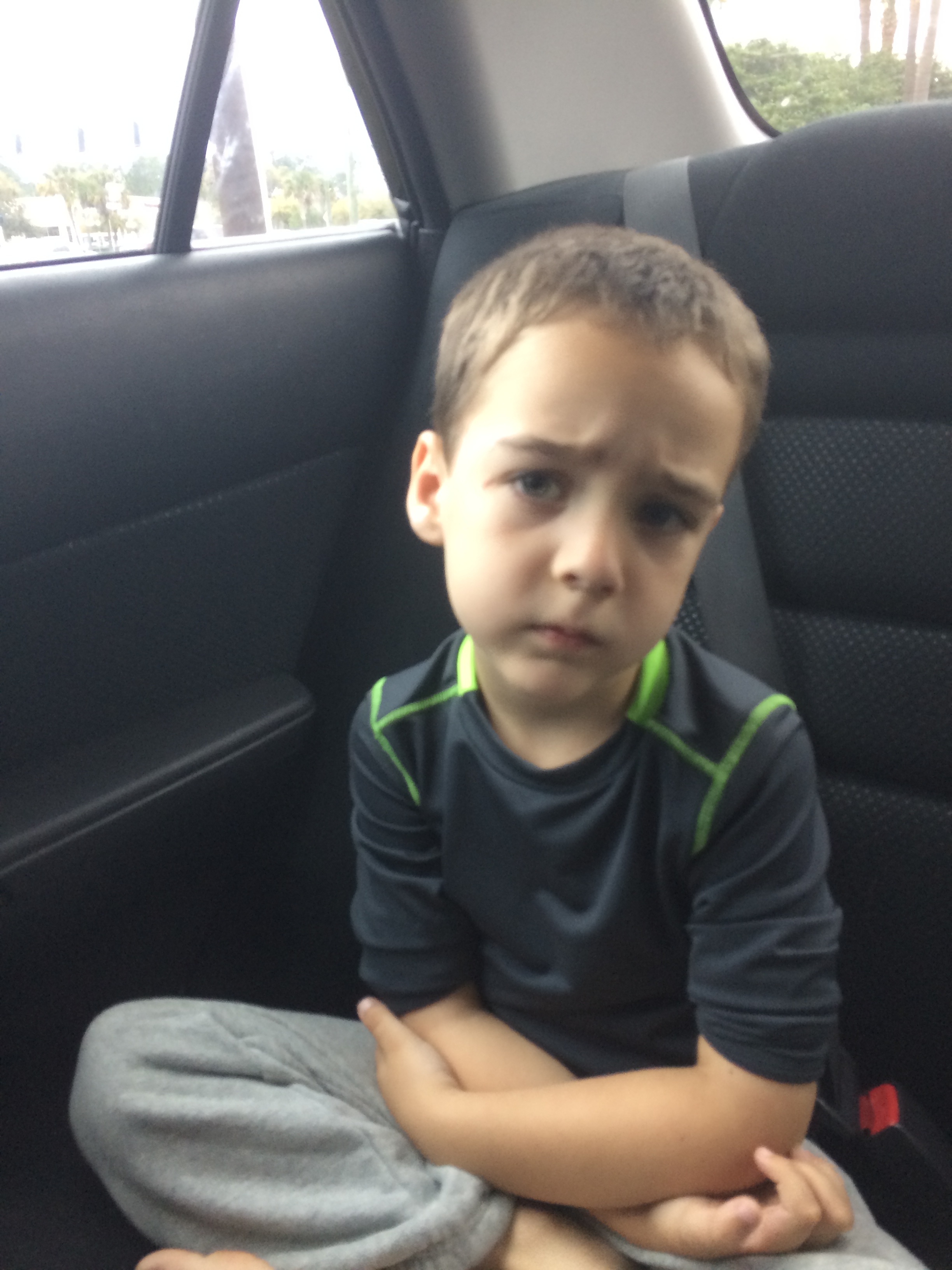
IMG_1279

Someone’s unhappy. No lollipops at the bank, because Daddy used the ATM tonight. Mommy always uses the drive-up window, and the Little Guy always gets a lollipop. But it was after hours, and the window was closed. The poor guy sitting in the back seat of my car just couldn’t comprehend a world in which The Bank does not equal Lollipop. No matter how many times I explained it to him, it just didn’t load. He knew his routine, and there was no room for variation. The autistic brain thrives on structure and predictability. Unanticipated change is a dangerous thing—especially when that change means no lollipops!

A Stuck Brain.

“Are we going to get a lollipop?”

“Not tonight, Little Guy. I have to go to the ATM.”

“Aren’t you going to the bank?”

“Yes, the ATM is a machine at the bank.”

“Doesn’t the machine give lollipops?”

“No, it doesn’t. If you want a lollipop, you have to go to the window. But that’s closed now.”

“But we going to the bank, and we always get lollipops at the bank.”

“Yes, but we can’t get one tonight.”

“But Mommy always gets lollipops at the bank.”

“That’s because she uses the window. But the window is closed, so we can’t get one.”

“No lollipop? This is so wrong!”

“I’m sorry, Little Guy, but we can’t get one.”

“But aren’t we going to the bank? We always get lollipops at the bank.”

I tried. I really did. I tried changing the subject. But he kept circling back to the lollipop. I tried to turn it into a game, tickling him and telling him that we had a yummy dinner waiting for us at home. Nope. I even took him to the drive-up window so that he could see that no one was there. No dice. No matter what I did, he became more and more anxious.

Plan B.

So I did what any sane man would do. I took him to the drive-through window at pharmacy across the street. They give out lollipops too.

“Hi, I think you have a prescription waiting for me? The name is Z-a-n-c-h-e-t-t-i-n. Nothing? Oh well, I guess my wife already picked it up. Oh, by the way, can you give my boy here a lollipop?” [I’m so clever.]

“Sorry, sir. We’re all out of lollipops.”

$#!† Now I was really in trouble. He started to cry. Big, crocodile tears.

Plan C—Please?

As we headed home, I tried a different distraction. I promised him a couple of mini Reese’s Peanut Butter Cups after dinner. But his language glitch was in high gear. First he thought I was promising him a cup of chocolate.

“No, chocolate and peanut butter. Together.”

“But I don’t like peanut butter. Only Nutella.”

“No, Little Guy. It’s a Reese’s Cup. You remember them, don’t you?”

“Is it chocolate ice cream?”

“No, chocolate and peanut butter. Together. You know—Reese’s cups!”

“Do you have them here?”

“No, they’re at home, waiting for us.”

“Instead of dinner?”

“No, after dinner.”

<Sniff> “Okay” <Sniff> “And a lollipop, right?”

The Comforts of Home.

By this time, we had pulled into the garage. He got out of the car, headed into the kitchen, and ate dinner with the rest of the family. A little disconsolate, but nothing too dramatic. Come dessert time, he had completely forgotten about the Reese’s cups. He was back home, back in his routine, and all was right with the world.

The little stinker!

Not So Fast!

2014 seemed like it was going to be a good year. Our two oldest were enrolled in a private school dedicated to kids on the high-functioning end of the autism spectrum, and they were actually enjoying it. We were, too. Who wouldn’t? There is very little homework, and the teachers are both knowledgeable about ASD and approachable.

Our next two oldest kids were making good strides in the public school, including a very responsive IEP team for our fourth child. And the two youngest were skating along beautifully, showing the world just how much they could learn.

We had taken a relatively incident-free overnight trip to Disney World in January, and in February we took a longer trip to visit my father in Tampa—again, with no real problem. During that trip, we took a side visit to Sarasota that blew me away. The primary purpose was to visit my mother’s grave, but we turned it into an all-day thing, throwing in a lunch at a restaurant downtown. That entailed walking through a crowded arts fair. But again, with no incident. What’s more, at the restaurant, two people told us how beautiful our family was and how well-behaved our children were. I couldn’t have been more proud!

Things were going so well, in fact, that I caught myself wondering whether I was making a mountain out of a molehill with all this autism stuff. Was I just being too dramatic? Was I letting my fears color the way I looked at my kids? Maybe I was turning my anxieties into self-fulfilling prophecies.

Oh, Well . . .

That was a few weeks ago. Since then, we’ve had to deal with . . .

• A huge melt down from one of our private-school kids over a Doctor Seuss celebration the school had been planning. This trivial event brought back embarrassing memories from a similar one seven years prior. “I can’t go to school,” she wailed. “Don’t you remember how I had a migraine in kindergarten during Doctor Seuss Day, and I threw up? I don’t want that to happen again!” It took two hours of helping her work through it before we could get her to school. Ant that was just the beginning. For the entire week afterward, she became so anxious that she began throwing up every day.

• Completely irrational anxiety from our oldest about his upcoming confirmation—all because of a cognitive glitch that left him petrified of our local bishop. Seriously, the guy’s a kindly Cuban gentleman who lives next to the cathedral in St. Augustine. But my boy was convinced that the bishop was going to interrogate him in front of the whole congregation and condemn him to hell for his sins!

• Increasingly angry, sometimes violent, outbursts from our eight-year-old every evening. Once he’s surrounded by the whole family at the dinner table, he becomes jumpy and irritable. Too much stimulus that he can’t control. Too many voices talking. Too many flavors and textures on his plate.

• Our ten-year-old whiz kid fighting tooth and nail instead of doing the bang-up job he was capable of on his STEM project. The melt downs bordered on the epic because Minecraft had to win out.

• Our six-year-old girl collapsing into an emotional heap every time we corrected her for the slightest mishap.

• Our five-year-old boy suddenly becoming unable to sit still for love or money. Unless he’s playing Fruit Ninja on my iPad or watching YouTube videos of Angry Birds on the computer.

No Laurel-Resting.

So yeah, it’s been a trying couple of weeks that left me wondering what the hell happened. Everything was going so well, and then all of a sudden it wasn’t.

All this has shown me something, and I hope I don’t forget it.

Good days come, and you get a break every now and then. Maybe even a longish one lasting a couple of months. But God help you if you ever let down your guard. If you don’t keep working with your kids, if you don’t take advantage of every opportunity to move them forward another step or two, you risk losing more ground than you thought you had gained.

I knew it, but I relearned it: ASD is permanent. It’s also a tricky S.O.B. Just when you think you’ve got it figured out, just when you think your kids have it licked, it comes out of left field and says, “Not so fast, Cowboy!” This is especially true when your kids are high-functioning. They get good at masking what’s going on inside them, until they can’t take anymore. And if you’re not careful, you play along with them.

The Trap of Wishcraft.

It also showed me the power of the imagination. In a sense, I was in denial because there were no immediate crises to deal with. Things were relatively smooth, and I let wishful thinking take over. Rather than pay attention to the signs that some of the kids were beginning to unhinge, I slacked off and enjoyed the rest. And yes, there were signs. Katie saw them and tried to alert me to them. But I didn’t want to look. Instead, I conjured a fantasyland in my mind and tried to make the outside world conform to it.

I don’t think I’m the only parent who does this, by the way. Everyone takes a mental vacation every now and then. But in the case of special-needs parents, the stakes are usually much higher.

So we slid down the mountain a bit. It happens. But that’s okay. I’m back on the watch tower now.