Have Yourself an Aspie Little Christmas

Welcome to the Most Wonderful Time of the Year! For the next month or so, front porches will be festooned with twinkling lights. Santa Claus will hold court at the local mall. Candles will glow at the table. Carols will resound at the spinet. And families will gather for feasts that will make all the Whos down in Whoville green with envy.

It’s that last one—the family gathering—that has me a little nervous this year. For the past twelve years, Katie and I were living in Florida while the bulk of our siblings were living in Maryland. But this summer, we moved back up North. Now, more than 32 relatives live within a one-hour radius of our home. Some are as close as the next neighborhood over.

Believe me, I love being back home. I’m so glad my brothers and sisters, as well as most of my in-laws, are nearby. They’re all good people, and we get along really well. But it’s been years since we’ve been part of a major family gathering, and a lot has happened in those intervening years. Mainly, we had a lot of kids who just happen to be on the high-functioning end of the autism spectrum.

If you know anything about autism, you know that people on the spectrum can have a hard time with sensory overload. Noises and crowds can make them shut down or act out. Changes in routine are unsettling. The smells, tastes, and textures of a holiday meal can be overwhelming. Even when they’re surrounded by people they know and love, they’re still surrounded. And that doesn’t always feel good.

All of this got me thinking about how different our family can be—and how different we may appear to people who come to visit. Mind you, most of our relatives are familiar with our dynamic, but there are a few outliers. Not to mention, new friends may end up dropping by. So, with no malice or prejudgment intended, I decided to come up with a few random guidelines for visitors to our home over the holidays.

A Field Guide to the Zanchettin Holiday Home.

  • Please remember that the Hallmark Channel is a mendacious purveyor of myth. No one’s dining room looks like that, and certainly not ours. We’re too busy running to therapy sessions and prepping for IEP meetings to dust every other day. Or every other month. Or ever.
  • No, the mini-trampoline belongs in the hallway, where we can keep an eye on it. And on its users.
  • If you find yourself trapped in a heavily one-sided conversation with one of the kids, remember that nonverbal clues don’t work. Use your words. Find some hook that you can use to change the subject. Unless, of course, you enjoy lengthy discourses about the relative merits of water type Pokémon versus grass types in the Kanto Region.
  • Please try not to make any references to Frozen. Not even oblique references. Don’t even say, “Let it go” in casual conversation.
  • Yeah, he spins around like that sometimes. Or hops. Or planks. He’ll be fine.
  • Don’t be offended if one or more of the kids disappears without notice. It isn’t you; it’s her. She’s probably getting overwhelmed and looking for a quiet place to unwind. Just shrug your shoulders and move on to another child. We’ve got six of them, so there should be plenty to go around.
  • Yes, that probably is the 75th time you’ve heard the theme song for the video game “Five Nights at Freddy’s.” It makes him happy, so we’ve learned to block it out.
  • Don’t be surprised if, when you ask one of the kids what extracurricular activity he’s involved in, he replies, “Therapy.” He’s being honest.
  • Yes, he often sits upside down like that, with his head near the floor and his feet in the air. Or athwart both arms of the chair. Or draped over the back of the sofa. And yes, he’s very comfortable doing it.
  • Yes, I know he’s taking a bath right before dinner. That’s his safe place when things get too noisy. He’ll be out in about an hour.
  • All compliments about our parenting will be graciously accepted by the management. All advice will be graciously ignored.
  • Why yes, I’d love another glass of wine. How did you know?

Dispelling the Cloud, Removing the Chip

Oriole

So I was out of town a couple of weeks ago at a meeting of the Catholic Biblical Association. It’s an annual gathering of biblical scholars that I attend as an “associate” member—someone who isn’t really a scholar but who works with the Bible on a regular basis and who would benefit from hearing research reports from the full members. One of the things I enjoy about this gathering is the collegial atmosphere. For the most part, everyone is treated equally: the great, the near-great, and the just plain silly. You are not looked down upon if you don’t have a PhD; you are welcomed just as much as the most celebrated, published scholar.

At the conference, I had the pleasure of sharing dinner with an old friend whom I hadn’t seen in a few years. Like the others, he is a respected scholar and researcher, but he is also a born teacher who brings a pastoral approach to his studies. Plus, he’s from Canada, so he has niceness encoded into his DNA. The last time we met, I had told him a little about our fourth child, whose high-functioning autism we were just learning about. This was our first diagnosis. We didn’t know about the others until later on. So it was only natural for him to ask me this time how our boy was doing and how the rest of the family was adjusting to his uniqueness.

That’s when the discomfort began. Should I tell him that all six of our kids are on the spectrum? Do I have the emotional energy to give a minor tutorial in the ins and outs, the mysteries and challenges of ASD? I’ve been down this road before with a lot of other people, and I was getting tired of it.

I debated changing the subject, but I respected this fellow too much to stay shallow. So I dove in, with a lump in my throat.

An Impromptu Community.

As it turns out, I didn’t have to worry. My friend, along with a couple of others at our table, listened carefully and asked insightful questions. They showed genuine concern for our kids. They shared their own experiences and understandings of autism. We ended up talking together about how God is and is not at work in challenging situations like mine. So what began as a general “How’s it going” conversation grew into a shared reflection on mercy, grace, compassion, justice, and perseverance. It was as if we had formed an impromptu community of faith.

Mind you, I did feel somewhat uncomfortable being the center of attention for so long. I was afraid that the conversation would decline to the kind of pity and mock-sympathy that I detest. But another part of me thoroughly enjoyed the conversation. There was something distinct about it. Everyone there was immersed in Scripture and its teachings, so our discussion had a strong faith dimension to it. Of course, not every Scripture scholar is a saint, but it was clear that these people had taken Jesus’ words to heart and were striving to live in the love of God. That’s no small thing.

The Cloud and the Chip.

Rather than feeling drained, as I usually do after “raising autism awareness,” I left the conversation feeling energized and encouraged. And that got me thinking. You see, I’m not used to having such genial discussions about my kids—and especially, not with people who don’t know me well. I have spent so much of my time the past few years advocating for them in a cash-strapped school system and among neighbors who (with a few exceptions) didn’t have patience for anything outside the status quo. So I wasn’t expecting such a kind reception of my story.

Add to that the fact that I didn’t have that many friends in Florida. Katie and I spent so much time with our kids, and that made it hard to meet new people. Plus, we lost a couple of friends due to our kids’ challenges, and these losses left me defensive, guarded, and cynical. I didn’t want to get to know anyone else. “Why bother?” I’d think. “It’ll only turn out bad.” I didn’t realize it until after having left Florida, but I had spent the better part of four years walking around with a cloud over my head and a chip on my shoulder.

A New Beginning?

That seems to be changing now. A couple of months ago, we moved back to Maryland, where Katie and I both are from. It’s something we had been wanting to do for quite a while, but never had the chance. We knew that Maryland schools were better, and most of our family is there. So when the opportunity finally arose for me to be transferred back to my company’s home office, we grabbed it—and we’re really glad we did. The school year hasn’t started yet, but all of our preliminary meetings have been extremely encouraging. Accommodations we could only dream of in Florida were offered to us without our even having to ask for them. Programs are in place here that we had never heard of down South—programs to help ASD kids not only survive but thrive.

What’s more, and I don’t exactly know why, there seem to be a lot more families with ASD in our new hometown. Maybe it’s because of the higher population density. Maybe it’s because there are more doctors here who are trained to spot the signs of autism. Or maybe the parents are just better informed. Whatever the reason, that increase in numbers brings an increase in awareness and acceptance. So we’re feeling like we fit in here better than we did down there. It doesn’t feel as lonely.

And then there’s family. All of my siblings are within an hour’s drive, and most of Katie’s siblings are even closer. Plus, Katie’s parents are just a ten-minute walk away. So there’s a lot more support where we are now, and our kids are surrounded by more than twenty cousins ranging from age three to twenty-six.

All these factors have helped me relax a little bit. With increased awareness and acceptance, our kids have a better shot. With family around, we have ready-made friends and social situations. With a more accommodating school district, we hope to have fewer fights and less tension. A few days ago, I wrote that our family’s future is beginning to look brighter. Maybe I’m just fooling myself. Maybe we’re in a bit of a lull right now, a respite between crises. Or maybe with this fresh new start Katie and I are able to see our situation and our kids in a different light. Whatever the case, I’m enjoying it—almost as much as I enjoyed my conversation with those biblical scholars who reflected a God who loves and cares for his people.

It’s All About Us

Video

I’m so proud of my oldest daughter. All by herself, without telling us, she produced this video for a project in her Aspergers-only school. She doesn’t often tell us what she’s thinking—not uncommon for any 13-year-old girl and even more prevalent with girls on the spectrum—so I was blown away when I saw this.

Five Years with Autism

Five years.

Sixty months.

Two hundred and sixty weeks.

One thousand, two hundred and eighty-six days.

That’s how long we’ve been living with autism. Actually, scratch that. We’ve been living with it for fourteen years, but we didn’t know what it was until five years ago. We were a little slow on the uptake.

Five years is a kind of a milestone, isn’t it? So naturally, I did a bit of looking back at both the highlights and the lowlights to see how far we’ve come and to think a little bit about the future. Here’s what I came up with.

From Fear to Acceptance.

First, the diagnoses themselves. From the first one, when our lives began to change, to the last one, which was more or less a given, I can see somewhat of a progression.

• With the first diagnosis, in March of 2009, there was fear. Would he ever talk? Would he ever be independent? Would he wander off one day and get hit by a car? Would he spend the rest of his life alone?

• Then came the second diagnosis, in May of 2009. This time, there was a combination of relief and anger. Relief because we finally had a name for her quirkiness and emotionality. Anger at her pediatrician, who had told us it was only a matter of bad parenting.

• Then came the third diagnosis in September of 2010. This time, there was mostly guilt. Guilt because of all the lost years. Guilt because this was our oldest, so he had to bear the most years of our misunderstanding him. The signs were there early on, but I didn’t want to see them.

• With the fourth one, in March of 2011, there was a sense of validation. I had called it early on this time. This little fellow spent almost an entire year insisting that he wear nothing but red shirts and shorts. He would also get so absorbed in building Legos that he would forget to go to the bathroom.

• Then came the fifth in early 2012. This time, there was laughter. I had seen so much with the first four that nothing was a shocker. Besides, by this time, my attention had turned to working with the kids’ schools. Frankly, I had bigger fish to fry than to react to something I was beginning to think was inevitable.

• I’m sure I felt something when the last diagnosis came during the summer of 2013. I just can’t remember what it was. Nonchalant acceptance, maybe? More or less, I took it in stride. Nothing could shock me anymore. It just gave us more insight into this sweet little girl.

Not Just Labels.

But besides the accumulation of labels, there are some other milestones. During this time, I have:

• Attended more than 30 IEP meetings at three different schools.

• Spent nearly $50,000 in autism-related medical and psychological treatments, schools, medicines, and therapies for my kids.

• Lobbied our state representatives for increased funding for our local autism center—and won.

• Taken more than 15 stress-relieving day trips to Disney World.

• Seen the dissolution of two friendships—one close, the other not so much—because of misunderstandings or judgments about our family.

• Seen two other friendships slip into casual acquaintances. Not because of any malice but because our paths rarely cross any more. (Let’s face it. I rarely cross paths with anyone these days!)

• Met other autism parents online, in whom I have found encouragement, humor, common experiences, and wisdom.

• Fallen more deeply in love with my wife, whose commitment to our kids never ceases to inspire me.

• Made peace with God over the whole situation. Ironically, I bear fewer external markers of my faith than I have in decades (e.g., commitment to a Bible study, membership in a small faith community, parish involvement), but I feel more strongly connected to the Lord and my faith than ever before.

Accepting a Constant Presence.

So yeah, it’s been a wild ride. There have been wonderful triumphs, like the day our four-and-a-half-year-old finally got potty trained. And there have been crushing blows, like the day one of our kids, in a full-scale melt down, grabbed a kitchen knife and threatened to cut himself. There have been strings of days when we’ve wondered if it could ever get any worse. And there have been times when everyone seemed to be firing on all cylinders and we could breathe easier.

But through the ups and the downs, autism has been a constant presence. I know I said a few years ago that not everything is about autism, but I don’t think that’s true any more. Autism is an integral part of who my kids are, and that means it shows up in just about every aspect of their personalities. They’re not being autistic only when they’re melting down or misinterpreting social situations. They’re just as autistic when they’re happy and making excellent progress. They do everything a little bit different, and that’s part of what makes them so unique.

I guess this means that I no longer look at autism as a scaly, ravenous monster ready to devour my children. There are days, mind you, when it seems like that’s happening. But there are many more days when it feels more like an awkward, galumphing puppy that you have to keep an eye on—you don’t want it peeing on your floor or chewing your furniture!

So have I come to a point of acceptance? Yes and no.

Accepting my kids and their unique neurologies? Absolutely.

Accepting the fact of their diagnoses? Pretty much, although there are times that I lose sight of it.

Accepting that this is how they’re going to be forever? No. I’m not trying to fix them, but I am trying to teach them how to be as successful as possible in a world that can seem so bizarre, alien, and even frightening.

What’s around the Corner?

And that’s where the future comes in. As I stand at the five-year mark, I can be proud of what we’ve accomplished, even as I peer nervously around the corner to see what’s still waiting for us. I know every year will have its own challenges and triumphs. I also know better than to assume that the worst is behind us. No one can say that with any degree of confidence. But I can say that the past five years have changed and shaped me in ways I never expected. They have shattered old misconceptions and built up new, stronger convictions. They have revealed a shallowness in my heart and taught me how to love more selflessly. And they have taught me never to put limits on what I—or Katie or any of my kids—can do.

There are many more obstacles to overcome, many more challenges to face down, many more threats to neutralize. There’s so much more we haven’t experienced yet, but I think we’ll be able to handle it.

Just as we’ve done for five years.

No Love from the Lollipop Guild

IMG_1279

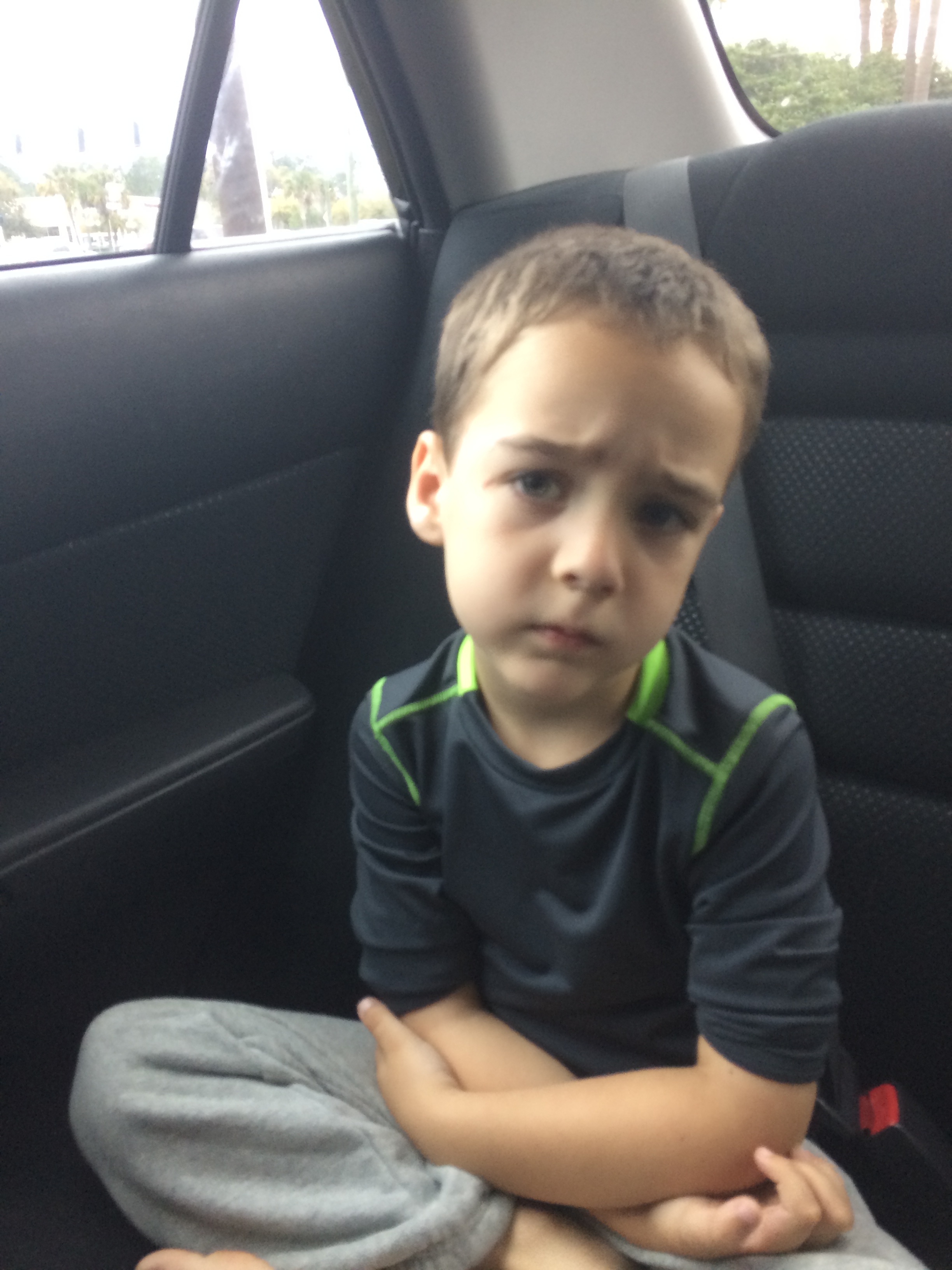
Someone’s unhappy. No lollipops at the bank, because Daddy used the ATM tonight. Mommy always uses the drive-up window, and the Little Guy always gets a lollipop. But it was after hours, and the window was closed. The poor guy sitting in the back seat of my car just couldn’t comprehend a world in which The Bank does not equal Lollipop. No matter how many times I explained it to him, it just didn’t load. He knew his routine, and there was no room for variation. The autistic brain thrives on structure and predictability. Unanticipated change is a dangerous thing—especially when that change means no lollipops!

A Stuck Brain.

“Are we going to get a lollipop?”

“Not tonight, Little Guy. I have to go to the ATM.”

“Aren’t you going to the bank?”

“Yes, the ATM is a machine at the bank.”

“Doesn’t the machine give lollipops?”

“No, it doesn’t. If you want a lollipop, you have to go to the window. But that’s closed now.”

“But we going to the bank, and we always get lollipops at the bank.”

“Yes, but we can’t get one tonight.”

“But Mommy always gets lollipops at the bank.”

“That’s because she uses the window. But the window is closed, so we can’t get one.”

“No lollipop? This is so wrong!”

“I’m sorry, Little Guy, but we can’t get one.”

“But aren’t we going to the bank? We always get lollipops at the bank.”

I tried. I really did. I tried changing the subject. But he kept circling back to the lollipop. I tried to turn it into a game, tickling him and telling him that we had a yummy dinner waiting for us at home. Nope. I even took him to the drive-up window so that he could see that no one was there. No dice. No matter what I did, he became more and more anxious.

Plan B.

So I did what any sane man would do. I took him to the drive-through window at pharmacy across the street. They give out lollipops too.

“Hi, I think you have a prescription waiting for me? The name is Z-a-n-c-h-e-t-t-i-n. Nothing? Oh well, I guess my wife already picked it up. Oh, by the way, can you give my boy here a lollipop?” [I’m so clever.]

“Sorry, sir. We’re all out of lollipops.”

$#!† Now I was really in trouble. He started to cry. Big, crocodile tears.

Plan C—Please?

As we headed home, I tried a different distraction. I promised him a couple of mini Reese’s Peanut Butter Cups after dinner. But his language glitch was in high gear. First he thought I was promising him a cup of chocolate.

“No, chocolate and peanut butter. Together.”

“But I don’t like peanut butter. Only Nutella.”

“No, Little Guy. It’s a Reese’s Cup. You remember them, don’t you?”

“Is it chocolate ice cream?”

“No, chocolate and peanut butter. Together. You know—Reese’s cups!”

“Do you have them here?”

“No, they’re at home, waiting for us.”

“Instead of dinner?”

“No, after dinner.”

<Sniff> “Okay” <Sniff> “And a lollipop, right?”

The Comforts of Home.

By this time, we had pulled into the garage. He got out of the car, headed into the kitchen, and ate dinner with the rest of the family. A little disconsolate, but nothing too dramatic. Come dessert time, he had completely forgotten about the Reese’s cups. He was back home, back in his routine, and all was right with the world.

The little stinker!