Not So Fast!

2014 seemed like it was going to be a good year. Our two oldest were enrolled in a private school dedicated to kids on the high-functioning end of the autism spectrum, and they were actually enjoying it. We were, too. Who wouldn’t? There is very little homework, and the teachers are both knowledgeable about ASD and approachable.

Our next two oldest kids were making good strides in the public school, including a very responsive IEP team for our fourth child. And the two youngest were skating along beautifully, showing the world just how much they could learn.

We had taken a relatively incident-free overnight trip to Disney World in January, and in February we took a longer trip to visit my father in Tampa—again, with no real problem. During that trip, we took a side visit to Sarasota that blew me away. The primary purpose was to visit my mother’s grave, but we turned it into an all-day thing, throwing in a lunch at a restaurant downtown. That entailed walking through a crowded arts fair. But again, with no incident. What’s more, at the restaurant, two people told us how beautiful our family was and how well-behaved our children were. I couldn’t have been more proud!

Things were going so well, in fact, that I caught myself wondering whether I was making a mountain out of a molehill with all this autism stuff. Was I just being too dramatic? Was I letting my fears color the way I looked at my kids? Maybe I was turning my anxieties into self-fulfilling prophecies.

Oh, Well . . .

That was a few weeks ago. Since then, we’ve had to deal with . . .

• A huge melt down from one of our private-school kids over a Doctor Seuss celebration the school had been planning. This trivial event brought back embarrassing memories from a similar one seven years prior. “I can’t go to school,” she wailed. “Don’t you remember how I had a migraine in kindergarten during Doctor Seuss Day, and I threw up? I don’t want that to happen again!” It took two hours of helping her work through it before we could get her to school. Ant that was just the beginning. For the entire week afterward, she became so anxious that she began throwing up every day.

• Completely irrational anxiety from our oldest about his upcoming confirmation—all because of a cognitive glitch that left him petrified of our local bishop. Seriously, the guy’s a kindly Cuban gentleman who lives next to the cathedral in St. Augustine. But my boy was convinced that the bishop was going to interrogate him in front of the whole congregation and condemn him to hell for his sins!

• Increasingly angry, sometimes violent, outbursts from our eight-year-old every evening. Once he’s surrounded by the whole family at the dinner table, he becomes jumpy and irritable. Too much stimulus that he can’t control. Too many voices talking. Too many flavors and textures on his plate.

• Our ten-year-old whiz kid fighting tooth and nail instead of doing the bang-up job he was capable of on his STEM project. The melt downs bordered on the epic because Minecraft had to win out.

• Our six-year-old girl collapsing into an emotional heap every time we corrected her for the slightest mishap.

• Our five-year-old boy suddenly becoming unable to sit still for love or money. Unless he’s playing Fruit Ninja on my iPad or watching YouTube videos of Angry Birds on the computer.

No Laurel-Resting.

So yeah, it’s been a trying couple of weeks that left me wondering what the hell happened. Everything was going so well, and then all of a sudden it wasn’t.

All this has shown me something, and I hope I don’t forget it.

Good days come, and you get a break every now and then. Maybe even a longish one lasting a couple of months. But God help you if you ever let down your guard. If you don’t keep working with your kids, if you don’t take advantage of every opportunity to move them forward another step or two, you risk losing more ground than you thought you had gained.

I knew it, but I relearned it: ASD is permanent. It’s also a tricky S.O.B. Just when you think you’ve got it figured out, just when you think your kids have it licked, it comes out of left field and says, “Not so fast, Cowboy!” This is especially true when your kids are high-functioning. They get good at masking what’s going on inside them, until they can’t take anymore. And if you’re not careful, you play along with them.

The Trap of Wishcraft.

It also showed me the power of the imagination. In a sense, I was in denial because there were no immediate crises to deal with. Things were relatively smooth, and I let wishful thinking take over. Rather than pay attention to the signs that some of the kids were beginning to unhinge, I slacked off and enjoyed the rest. And yes, there were signs. Katie saw them and tried to alert me to them. But I didn’t want to look. Instead, I conjured a fantasyland in my mind and tried to make the outside world conform to it.

I don’t think I’m the only parent who does this, by the way. Everyone takes a mental vacation every now and then. But in the case of special-needs parents, the stakes are usually much higher.

So we slid down the mountain a bit. It happens. But that’s okay. I’m back on the watch tower now.
Dude, That’s So Intense

iPad Boy

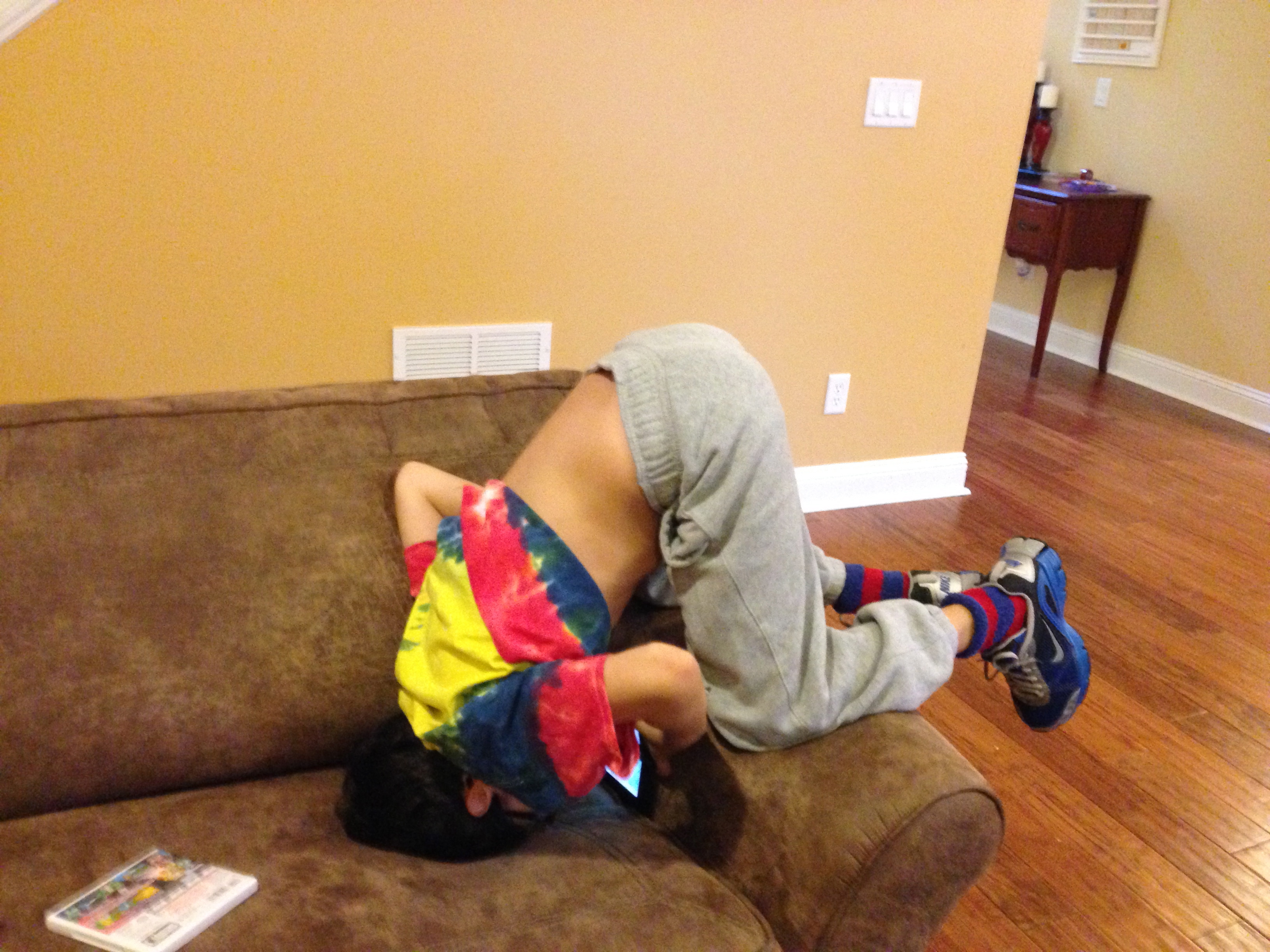
Isn’t this a cool picture? That’s our eight-year-old boy playing Fruit Ninja on the iPad. This is quite a common sight in our home. It’s just one of many contortions this kid does. He’ll fold himself backwards over the back of the sofa. Or he’ll have his legs crossed, yoga-style, and suspended in the air while he rests on his shoulders. Or he’ll curl himself up in a ball, with one leg sticking out at a highly improbable angle. Or a combination of many different poses. He’s never in the same position for more than a couple of minutes.

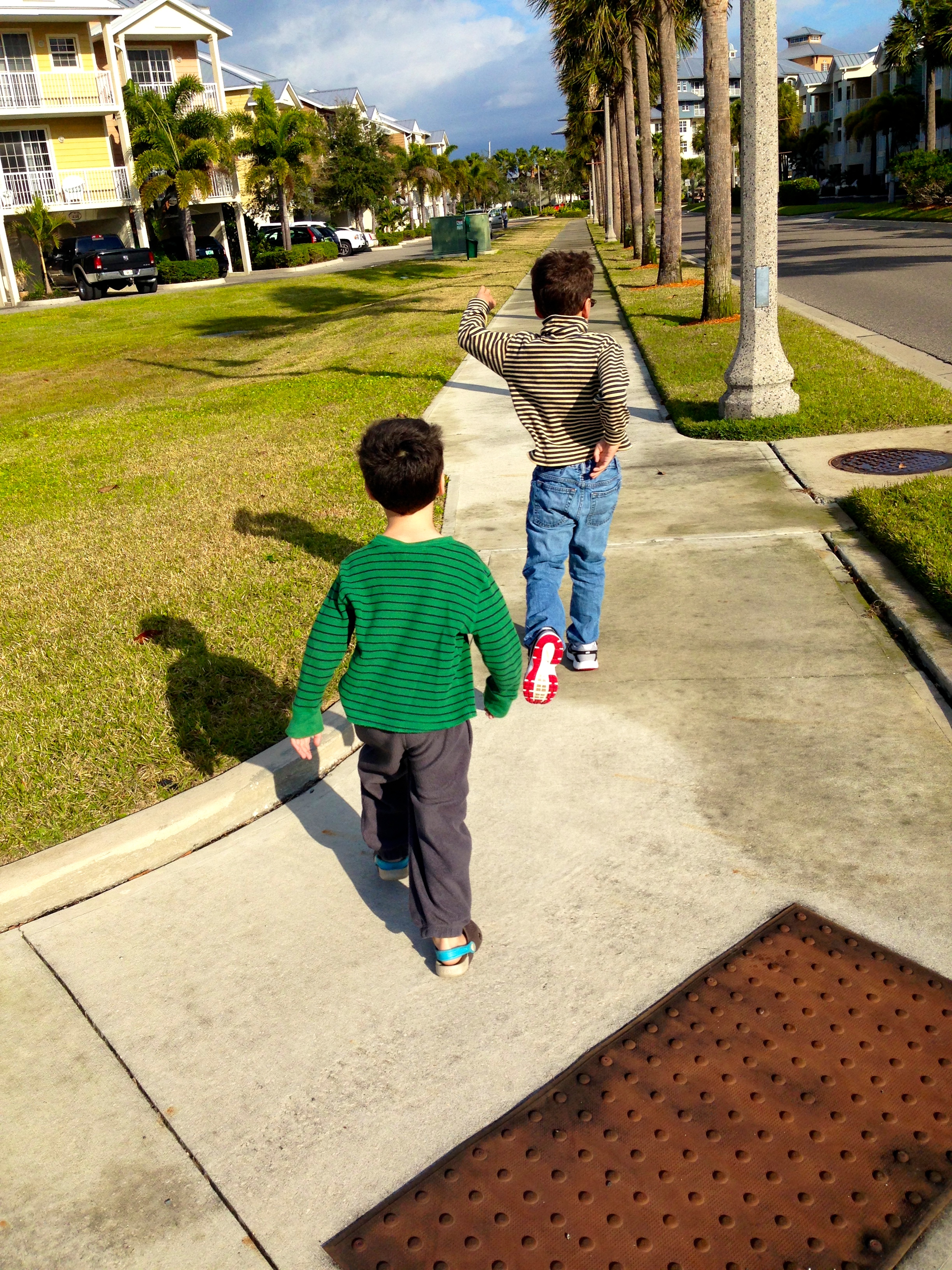
When he’s not twisted up, he’s like a perpetual motion machine—hopping, dancing, mock-battling, wrestling with his reluctant little sister. Dinner is always difficult for him. He’s usually the first one out of his seat (within three to five minutes), running around or hopping up and down. Even taking a walk can be an exercise (sic) in unique movement.

A Fun Walk

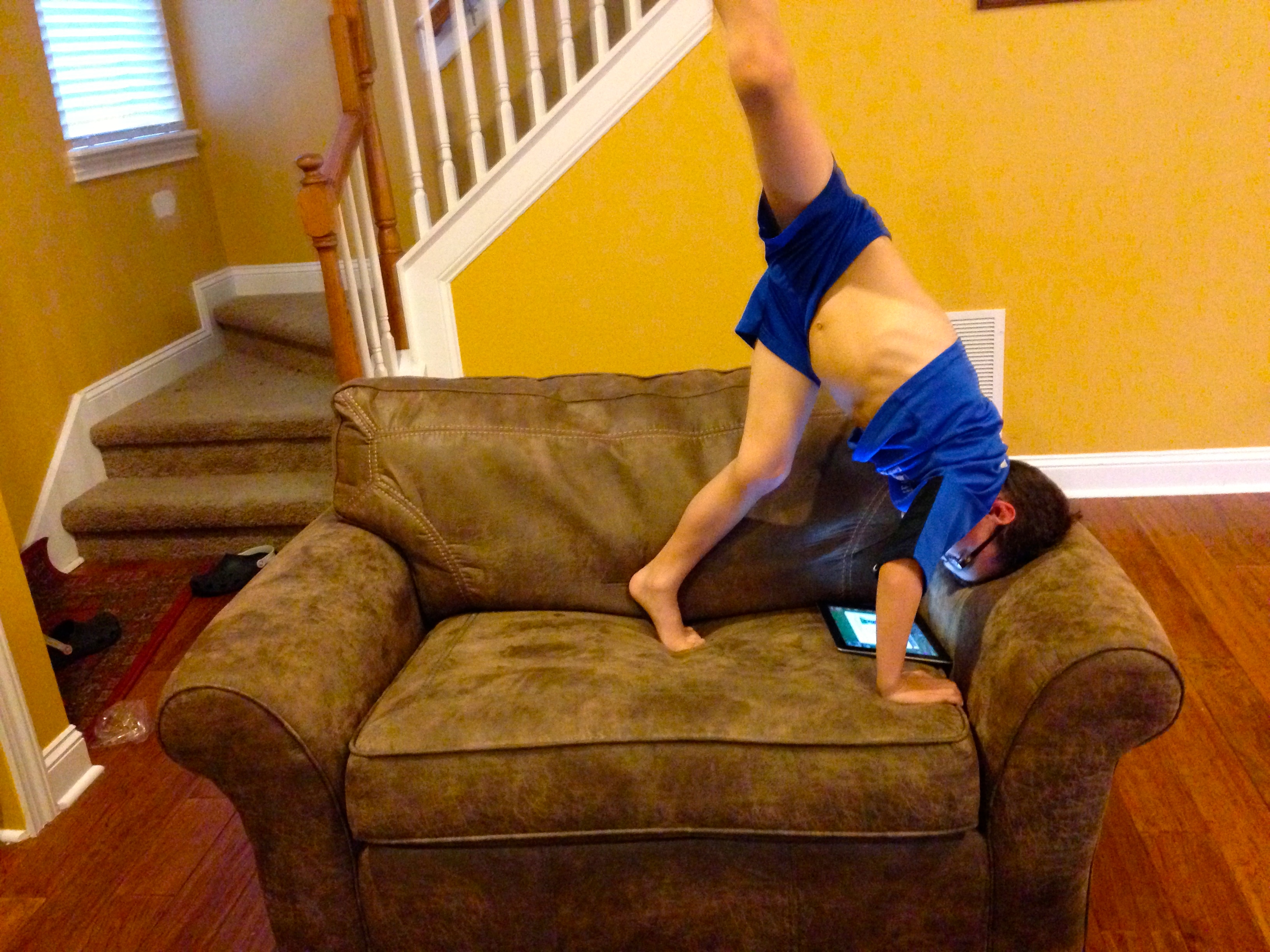
He’s not the only one, either. His next-oldest brother is very much the same way:

Upside Down Buddy

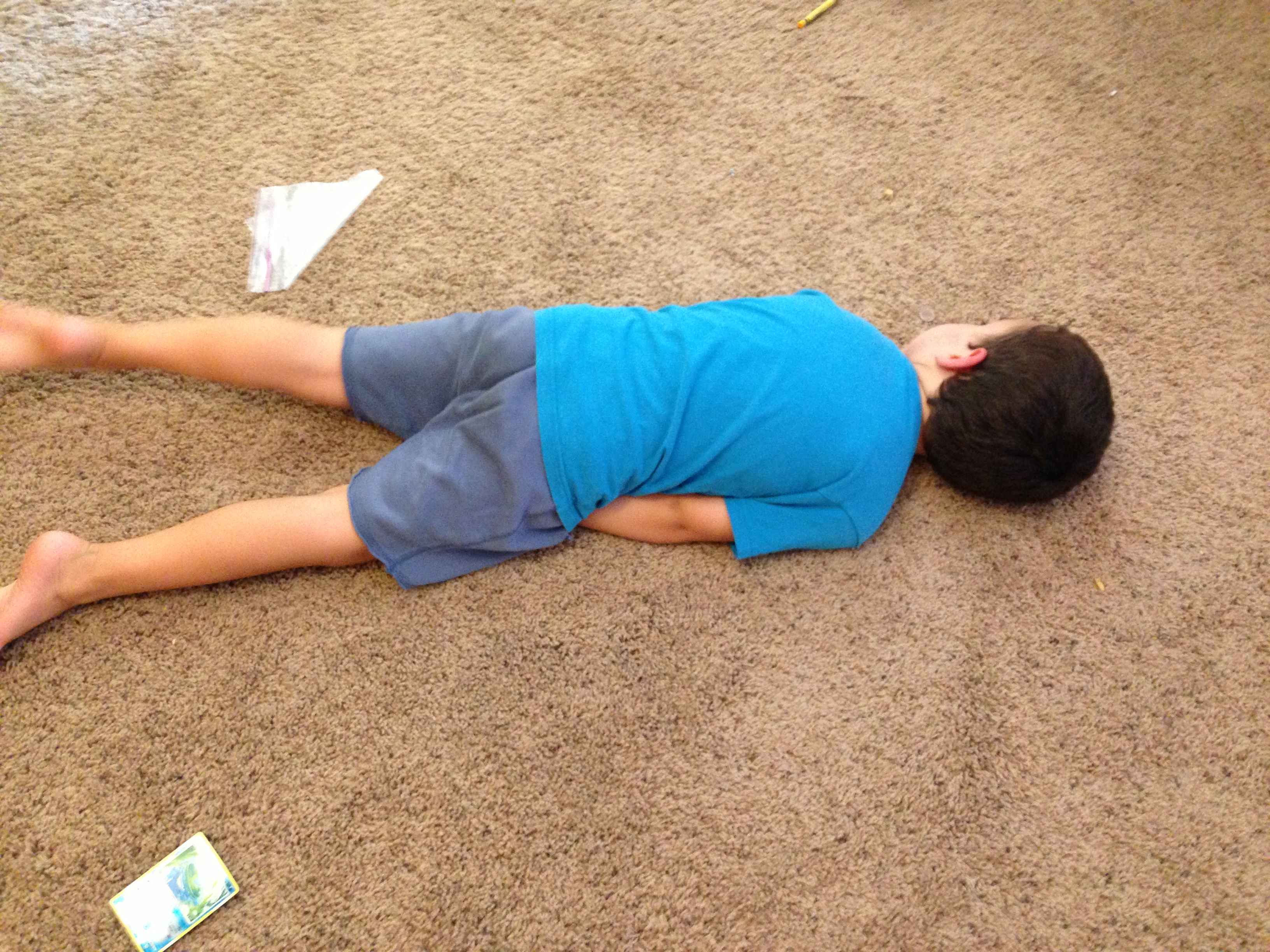
Now, this is a marked contrast to his younger brother who will, at odd times, simply plank.

Plank BoyKatie and I think he does this as a coping mechanism when he gets overwhelmed. He just shuts down for a few minutes, presses his internal reset button, and then he’s back at it again. He’s just as hyperactive as his brothers, but he has a different way of dealing with overstimulation.

Funny enough, though, if you put any of these kids in front of a computer on Minecraft, they can sit still, absorbed, for hours. They may be at odd angles again, but they’re still.

Isaac Newton Explains.

So what’s going on?

Katie and I think it’s related to something called Intense World Theory. Pioneered by a pair of neuroscientists in Switzerland, Intense World Theory posits that people with autism are hyper-aware of everything going on around them and within them. ASD folks feel everything so intensely—both physical and emotional—that their attempts to compensate need to be just as intense. It’s like an autistic version of Newton’s Third Law of Motion: For every action, there has to be an equal and opposite reaction.

So our armchair contortionists are merely reacting bodily to the busyness around them and in their minds. Their world is so intense and so full that they react to it in a similarly intense, involved way. Or it’s so intense that they need to shut it out at times, as our little one does, so that they can press their internal Reset button.

This also explains their ability to become so absorbed in the world of video games. It can be very loud and frenetic, but it is also limited and contained. Just a small screen (okay, small-ish) that they can turn on or off. And as noisy as it is, it’s also pretty predictable. So there’s an element of safety and comfort there. Of course, engaging in the virtual world doesn’t really help them get out their pent up energy. It only helps them suppress the need for it and, therefore, suppress their need to (over)react to it.

It’s Just Too Much!

All this can be kind of cute, but there’s another, more troubling, side to it.

Take my oldest son, for instance. He likes to go to Teen Gamers, a monthly gathering of middle- and high-school students hosted by the local library. It’s a place where kids can hang out, play video games, and have pizza, all under adult supervision. I don’t mind that it’s all about video games. Considering his social anxiety, it’s a golden opportunity for him to expand his social circle.

But as much as he enjoys himself there, as soon as he comes home, he hurries up to his bedroom and spends the next couple of hours in virtual seclusion. The same can happen after a long day at school or after we all go somewhere as a family. In fact, after just about any situation where he is out of his comfort zone, the boy high tails it to his room, turns off the lights, and burrows under the covers with his 3DS or his iPod Touch. The outside world is too much for him to handle, and he needs time to decompress.

Something similar happens with my older daughter, although with her, the reaction isn’t always delayed. She is just as likely to melt down right in the middle of a store or restaurant as she is to wait until we get home. That’s why we’ve come to expect her to spend a considerable amount of time in the bathroom at church on Sundays.

That’s how intense the world can be for these two. It can actually hurt to be engaged in it for too long.

Silly? Stubborn? Sullen?

I like this explanation a lot. It helps me see that my kids are not being antisocial—at least not on purpose. It also gives me some more insight into the way their brains are wired. And most important, it helps me adjust my plans and expectations.

I know, for instance, not to expect them to be able to handle a marathon day at Disney World. I should be happy to get three hours out of them—and that’s with one or two breaks so they can regroup. It also helps me understand what school is like for them. They spend six hours trying to maintain an ordered exterior while everything around them (and within them) feels like it’s set on overdrive. Of course they’re going to need some serious decompression when they come home—whether that means time on the trampoline or some mini-hibernation. There’s no way we should expect them to do anything productive like homework right away. And on days when there’s a lot of homework, we know we need to break it up into smaller chunks—or tell their teachers that they’ll finish it the next day.

Now, I know that they can’t expect this to go on forever. They’re going to have to find other ways to cope when things get too rough. There aren’t too many workplaces that have yoga mats or dimly-lit quiet rooms for decompression. And God help you if you take too many breaks! So we are trying to teach them how to increase their tolerance and find other, less obvious, ways to deal with all that frustration and overstimulation. It’s all part of living with ASD. They’re not being silly or stubborn or sullen. They’re just trying to survive.

Words I Wish I Never Heard: Perseveration

Poodle (our favorite nickname for our six-year-old girl) has tumbling class every Friday at 5:00. She is a very flexible, high-energy little sprite, and she loves the chance to jump, roll, run, and play with other kids her age. The place where she goes is an easy fifteen-minute drive from our home, and she’s been there a number of times. Still, the following sequence of events happens just about every Friday afternoon.

4:15 p.m.

Poodle: Mommy, I have to get changed for tumbling. I don’t want to be late.

Katie: We’ve got lots of time, Poodle. I’m in the middle of something. I’ll help you in a few minutes.

Poodle: No, Mom. I don’t want to be late. You have to help me now.

Katie: Hang on just a couple more minutes. We won’t be late. I promise.

Poodle (her voice quavering a bit): Okay. I just don’t want to be late.

4:20 p.m.

Katie: Okay, Poodle, let’s get you dressed. Get your leotard from your room and bring it down here.

Poodle: I can’t do that! The boys will see me.

Katie: No they won’t. We’ll go in my bedroom and close the door.

Poodle: Are you sure? I don’t want the boys to see me naked.

Katie: I promise I’ll close the door. I’ll even lock it if you want.

Poodle: Ohhhh, Mommy, I don’t know. I don’t want the boys to see me naked.

Katie: I promise they won’t. Now get down here so we can get you changed.

Poodle (nervously): Okay. I don’t want the boys to see me naked. You’re sure we won’t be late?

Katie: I promise.

4:25 p.m.

Katie: Go get your Crocs so we can get going.

Poodle: I don’t know where they are. Let’s just go. I don’t want to be late.

Katie: It’s okay, Poodle. We have lots of time. Go and find your Crocs.

Poodle: No, Mommy. I don’t want to be late. I can’t be late. They won’t like me if I’m late. Let’s go!

Katie: I don’t want you going outside without any shoes. It’s raining, and it’s chilly. Find your Crocs, and we’ll get going.

Poodle: Please, Mommy! I don’t want to be late!

Katie: Tumbling is only 15 minutes away, and we have more than 35 minutes to get there. We’ll be fine.

Poodle: No, Mommy, no. We need to go now. I don’t want to be late!

Katie: Fine! Get in the car. I guess I can carry you into the tumbling studio.

Poodle: Okay. I don’t want to be late.

4:30 p.m.

Poodle (wringing her hands): Mom? How long before we get there? I don’t want to be late.

Katie: Fifteen minutes.

Poodle: Is that enough time?

Katie: Yes, it is. We’ll get there with fifteen minutes to spare.

Poodle: Are you sure? I don’t want to be late.

Katie: Yes, I’m sure. Look how far we’ve gone already. We’ll be there with lots of time.

Poodle (suspiciously): Okay, if you say so.

4:33 p.m.

Poodle: Are we getting close? I don’t want to be late.

Katie: Yes, we’re getting close.

Poodle: Will we be there on time?

Katie: We’ll be early.

Poodle (twisting a lock of her hair): Are you sure? I don’t want to be late.

Katie: Yes, I’m sure.

4:40 p.m.

Poodle: When does tumbling start?

Katie: In twenty minutes.

Poodle: Will we be there in time? I don’t want to be late.

Katie: I told you already, we’ll be early. We’re almost there.

Poodle: We’re not going to be late, are we?

Katie: No, we’ll be early.

4:44 p.m.

Poodle: Are we going to be on time? I can’t be late. They don’t like it when I’m late.

Katie: Look up there. See that traffic light? The studio is just beyond that light. We’ll be there as soon as the light turns green.

Poodle: No we won’t. We’re going to be late.

Katie: Don’t worry, Poodle. When the light turns green, we’ll be there.

Poodle: You’re going to go as soon as the light turns green?

Katie: Yes, I will. Then we’ll be at tumbling.

Poodle: Ohhhh, how much time do we have now? Are we going to be late?

Katie: We have fifteen minutes. All we have to do is cross this intersection. Then we’ll be there.

Poodle: Are you sure? I don’t want to be late.

Katie: Yes, I’m sure, Poodle. We’ll be there in less than a minute.

4:46 p.m. [The light turns green.]

Poodle: How much time now, Mommy?

Katie: Fourteen minutes.

Poodle: Are we going to get there in time?

Katie: Yes, we’re pulling into the parking lot right now.

Poodle: We won’t be late?

Katie: No, we have lots of time.

4:47 p.m. [Katie carries her, shoeless, into the studio.]

Poodle: We’re not late, are we?

Katie: No, we’re not.

Poodle: That was close, wasn’t it?

Katie: I guess so.

Poodle: Okay. Are you sure Daddy is going to be on time to pick me up?

Katie: <sigh> Yes, I’m sure.

Hey! Dads Rock Too!

I had a good chuckle when I came across this blog post today. Called, “20 Reasons Moms of Kids with Special Needs Rock,” it has such gems as “Because we have bad days and breakdowns and bawl-fests, and then we pick ourselves up and keep right on going,” and “Because we never stop pushing for our kids.”

Lists like these are fun to read because while they do give some insights, they mostly include items that we can relate to—items that most parents of “typical” kids have often no clue about. But it struck me that dads need the occasional shout-out as well. After all, they have their part to play as well. At least they should be playing their part! So without too much tought, all in good fun, and in no particular order, I would like to propose to you . . .

Image

20 Reasons Why Dads of Kids with Special Needs Rock

1. Because we are sticking with it, day in and day out, when many dads give up or skip out. No wimps here!

2. Because we listen to our wives’ worries, fears, and frustrations patiently without trying to “fix” everything.

3. Because we take on our share of the load in everything, including the laundry and the diapers and the dishes.

4. Because we fight for our kids at every IEP meeting, never backing down or giving in.

5. Because many of us work 40-plus hours a week and don’t bat an eye when we come home to absolute chaos. We just dive right in and get to work.

6. Because we guard date night jealously, even zealously.

7. Because we have memorized the alphabet soup of our kids’ diagnoses—and we understand what they mean

8. Because we know that marriage is not about gourmet meals, nightly sex, and an immaculate house.

9. Because we have no problem staring down the gawkers at the mall and in the park.

10. Because we know what “fun” means to our kids, and we aren’t too proud to share it with them. Even if it means wearing silly hats or rolling around on the floor.

11. Because we know how to “gently” restrain a flailing, screaming, melting-down child.

12. Because we don’t complain when the money earmarked for our favorite hobby has to go to insurance or a new therapist instead.

13. Because we don’t care if the other “dudes” our age seem to be having more fun.

14. Because we never say, “That’s her problem, not mine.”

15. Because we have learned how to suck it up and not gripe and complain. Especially not to our wives. Most of the time.

16. Because we can spot the difference between a spoiled-brat tantrum and a genuine melt down at twenty paces. And we know how to respond accordingly.

17. Because we don’t mind when our wives fall asleep on the sofa at 8:30 in the evening.

18. Because special-ed teachers tremble when we enter the room.

19. Because we have learned how to see goodness, beauty, and progress in every tough situation.

20. Because we never, ever, ever give up.

Blues Radio

web-maxell-blown-away-guyYesterday was an easy Saturday, when I had the luxury of running a few errands on my own. Normally, I enjoy these rare events when I can get out and knock a few things off my to-do list. But today was different. I just couldn’t slow down my racing mind as I drove around town. Like a car radio that was stuck in “Seek” mode, I kept changing stations from one worry to another.

<click> To thoughts about one of my daughters, whose perseverations and OCD-like anxiety have increased dramatically the past few months. On the short, ten-minute drive to her tumbling class last week, she asked Katie over and over and over again, “Are we going to be late? I can’t be late. Please hurry up, Mom, I don’t want to be late. My friends won’t like me if I’m late.” (Katie left ten minutes early to stave off these worries—but to no avail.)

<click> To thoughts about another son, who can’t control himself when a cascade of negative emotions comes over him. The slightest word of correction will send him into a rage, as will the smallest disappointment or denial of a preferred activity. I have worked and worked with him, trying to teach him “cooling thoughts” and self-calming activities, but none of it helped. Now we have to turn to medication to help regulate his emotions.

<click> To thoughts about how to convince a glacier’s-paced school system to give my son the help he needs in social and pragmatic language skills. He’s a whiz at simple mathematics and spelling, but he doesn’t always get nonverbal cues, and he can have a hard time expressing himself clearly. The inferential thinking involved in reading comprehension and word problems is a challenge for him, but his teachers are reluctant to do more, since his other skills are buoying up his grades. “He’s not failing, so what’s the problem?”

<click> To thoughts about the son who can spend hours at a time in his room watching his favorite YouTube personalities talk about video games. His self-isolation is giving him a short temper with his siblings and keeping him from the few friends he has. But it’s like pulling teeth to get him to interact.

<click> To thoughts about finances and all the visits to therapists, psychiatrists, counselors, and doctors for everyone. And then there’s the private, Aspergers-only school our two oldest ones attend—and which at least one more will likely end up in.

<click> To thoughts about our daughter the hoarder and what it’s going to take to get her to part with some of the things she has collected—or at least organize her bedroom so that we can see the carpet. And to thoughts about what makes her so anxious that she feels such a deep need for all these toys. For a recent overnight trip, she stuffed more than twenty of her plush Pokémon figures into a backpack just to keep them by her side. They never saw the light of day, but she refused to be parted from them. “They help keep me calm.”

Daddy’s Home!

By the time I had finished my run and was pulling into our neighborhood, I was feeling pretty depressed. So many unanswered questions. So many problems needing to be solved. So many signs pointing to the challenges my kids have yet to face. (Not to mention, my errands were a bust. No store I visited seemed to have anything I was looking for.)

This is what it can be like living with autism and Aspergers—especially in a world that reduces things and people down into their various components. You wind up seeing everything in terms of the goal, the challenge, the problem, the next “thing” that needs to be addressed. With so many kids on the spectrum, Katie and I have to juggle a variety of diagnoses and an even wider array of manifestations of them. So it’s easy to focus on the problems and miss out on the bigger picture.

It took me a while to come back down to earth and remember that my kids are more than the conglomeration of their problems. It helped a lot when, as I walked through the front door, our youngest popped up off the sofa and ran to me, his face beaming with delight. “Daddy! You came home! I missed you so much!” Then his brother, four years older, came down from his bedroom and shouted, “Yay! Daddy’s home!” and then began jumping up and down with great gusto and doing his signature spinning headstand on the sofa.

None of the challenges went away, of course. They are all very real and still demand my attention. But none of them can overshadow the innocence that these kids have. Even my oldest two, for all their adolescence, have a childlikeness about them that melts my heart. They all have their melt downs and tantrums, but they still have that wide-eyed wonder and openness that tells me there’s still loads of hope. It’s when they shut out the world—or shut me or Katie out—that I need to be concerned.

I suppose the fact that I see my kids in such a reductive way every now and then is, I suppose, to be expected. I’m just glad that today my kids helped me move beyond this partial vision so that I could see with my heart and not rely on my racing mind.

The next time I’m out on my own, I’ll listen to NPR.