Five Years with Autism

Five years.

Sixty months.

Two hundred and sixty weeks.

One thousand, two hundred and eighty-six days.

That’s how long we’ve been living with autism. Actually, scratch that. We’ve been living with it for fourteen years, but we didn’t know what it was until five years ago. We were a little slow on the uptake.

Five years is a kind of a milestone, isn’t it? So naturally, I did a bit of looking back at both the highlights and the lowlights to see how far we’ve come and to think a little bit about the future. Here’s what I came up with.

From Fear to Acceptance.

First, the diagnoses themselves. From the first one, when our lives began to change, to the last one, which was more or less a given, I can see somewhat of a progression.

• With the first diagnosis, in March of 2009, there was fear. Would he ever talk? Would he ever be independent? Would he wander off one day and get hit by a car? Would he spend the rest of his life alone?

• Then came the second diagnosis, in May of 2009. This time, there was a combination of relief and anger. Relief because we finally had a name for her quirkiness and emotionality. Anger at her pediatrician, who had told us it was only a matter of bad parenting.

• Then came the third diagnosis in September of 2010. This time, there was mostly guilt. Guilt because of all the lost years. Guilt because this was our oldest, so he had to bear the most years of our misunderstanding him. The signs were there early on, but I didn’t want to see them.

• With the fourth one, in March of 2011, there was a sense of validation. I had called it early on this time. This little fellow spent almost an entire year insisting that he wear nothing but red shirts and shorts. He would also get so absorbed in building Legos that he would forget to go to the bathroom.

• Then came the fifth in early 2012. This time, there was laughter. I had seen so much with the first four that nothing was a shocker. Besides, by this time, my attention had turned to working with the kids’ schools. Frankly, I had bigger fish to fry than to react to something I was beginning to think was inevitable.

• I’m sure I felt something when the last diagnosis came during the summer of 2013. I just can’t remember what it was. Nonchalant acceptance, maybe? More or less, I took it in stride. Nothing could shock me anymore. It just gave us more insight into this sweet little girl.

Not Just Labels.

But besides the accumulation of labels, there are some other milestones. During this time, I have:

• Attended more than 30 IEP meetings at three different schools.

• Spent nearly $50,000 in autism-related medical and psychological treatments, schools, medicines, and therapies for my kids.

• Lobbied our state representatives for increased funding for our local autism center—and won.

• Taken more than 15 stress-relieving day trips to Disney World.

• Seen the dissolution of two friendships—one close, the other not so much—because of misunderstandings or judgments about our family.

• Seen two other friendships slip into casual acquaintances. Not because of any malice but because our paths rarely cross any more. (Let’s face it. I rarely cross paths with anyone these days!)

• Met other autism parents online, in whom I have found encouragement, humor, common experiences, and wisdom.

• Fallen more deeply in love with my wife, whose commitment to our kids never ceases to inspire me.

• Made peace with God over the whole situation. Ironically, I bear fewer external markers of my faith than I have in decades (e.g., commitment to a Bible study, membership in a small faith community, parish involvement), but I feel more strongly connected to the Lord and my faith than ever before.

Accepting a Constant Presence.

So yeah, it’s been a wild ride. There have been wonderful triumphs, like the day our four-and-a-half-year-old finally got potty trained. And there have been crushing blows, like the day one of our kids, in a full-scale melt down, grabbed a kitchen knife and threatened to cut himself. There have been strings of days when we’ve wondered if it could ever get any worse. And there have been times when everyone seemed to be firing on all cylinders and we could breathe easier.

But through the ups and the downs, autism has been a constant presence. I know I said a few years ago that not everything is about autism, but I don’t think that’s true any more. Autism is an integral part of who my kids are, and that means it shows up in just about every aspect of their personalities. They’re not being autistic only when they’re melting down or misinterpreting social situations. They’re just as autistic when they’re happy and making excellent progress. They do everything a little bit different, and that’s part of what makes them so unique.

I guess this means that I no longer look at autism as a scaly, ravenous monster ready to devour my children. There are days, mind you, when it seems like that’s happening. But there are many more days when it feels more like an awkward, galumphing puppy that you have to keep an eye on—you don’t want it peeing on your floor or chewing your furniture!

So have I come to a point of acceptance? Yes and no.

Accepting my kids and their unique neurologies? Absolutely.

Accepting the fact of their diagnoses? Pretty much, although there are times that I lose sight of it.

Accepting that this is how they’re going to be forever? No. I’m not trying to fix them, but I am trying to teach them how to be as successful as possible in a world that can seem so bizarre, alien, and even frightening.

What’s around the Corner?

And that’s where the future comes in. As I stand at the five-year mark, I can be proud of what we’ve accomplished, even as I peer nervously around the corner to see what’s still waiting for us. I know every year will have its own challenges and triumphs. I also know better than to assume that the worst is behind us. No one can say that with any degree of confidence. But I can say that the past five years have changed and shaped me in ways I never expected. They have shattered old misconceptions and built up new, stronger convictions. They have revealed a shallowness in my heart and taught me how to love more selflessly. And they have taught me never to put limits on what I—or Katie or any of my kids—can do.

There are many more obstacles to overcome, many more challenges to face down, many more threats to neutralize. There’s so much more we haven’t experienced yet, but I think we’ll be able to handle it.

Just as we’ve done for five years.
Dude, That’s So Intense

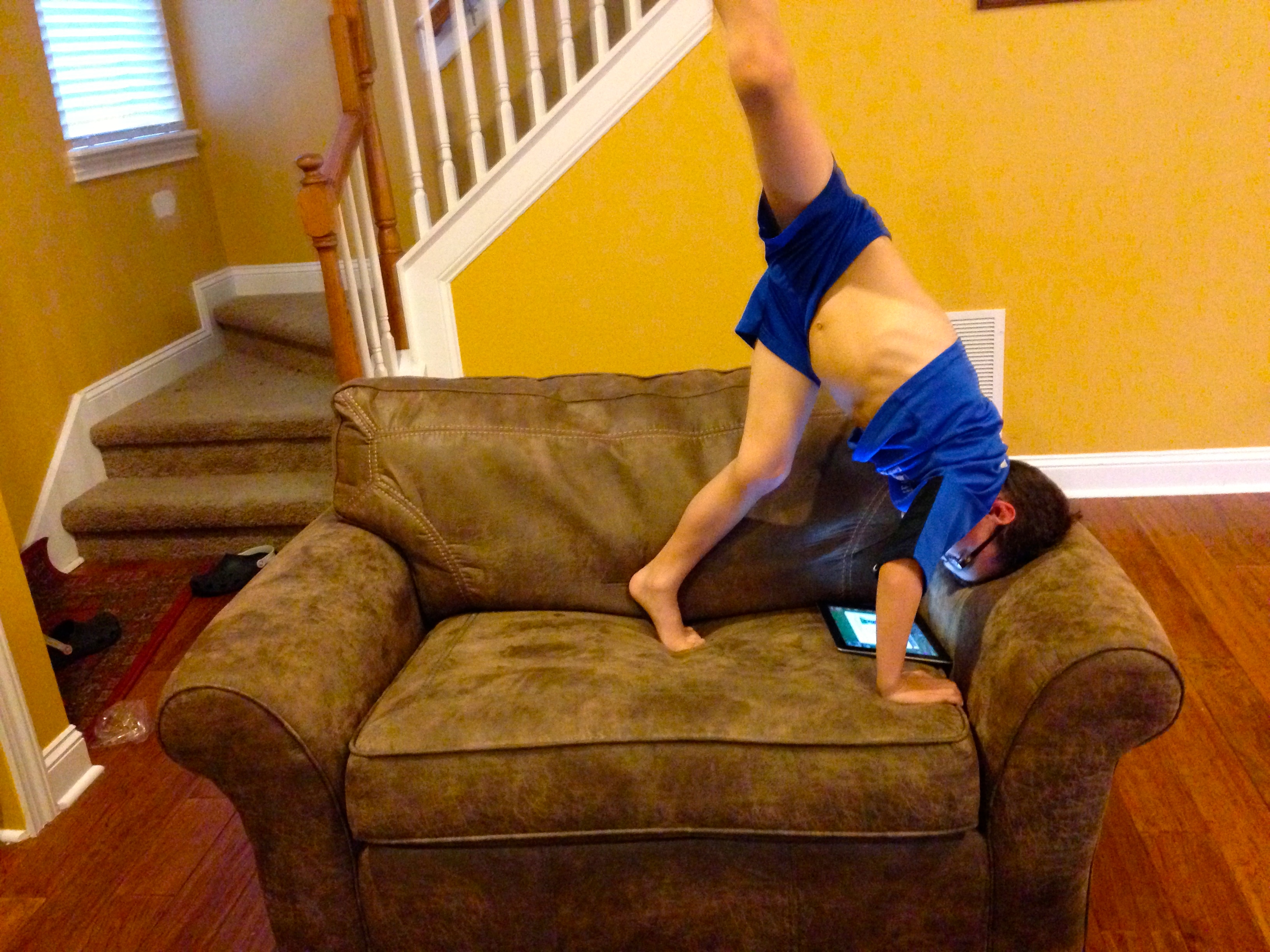
iPad Boy

Isn’t this a cool picture? That’s our eight-year-old boy playing Fruit Ninja on the iPad. This is quite a common sight in our home. It’s just one of many contortions this kid does. He’ll fold himself backwards over the back of the sofa. Or he’ll have his legs crossed, yoga-style, and suspended in the air while he rests on his shoulders. Or he’ll curl himself up in a ball, with one leg sticking out at a highly improbable angle. Or a combination of many different poses. He’s never in the same position for more than a couple of minutes.

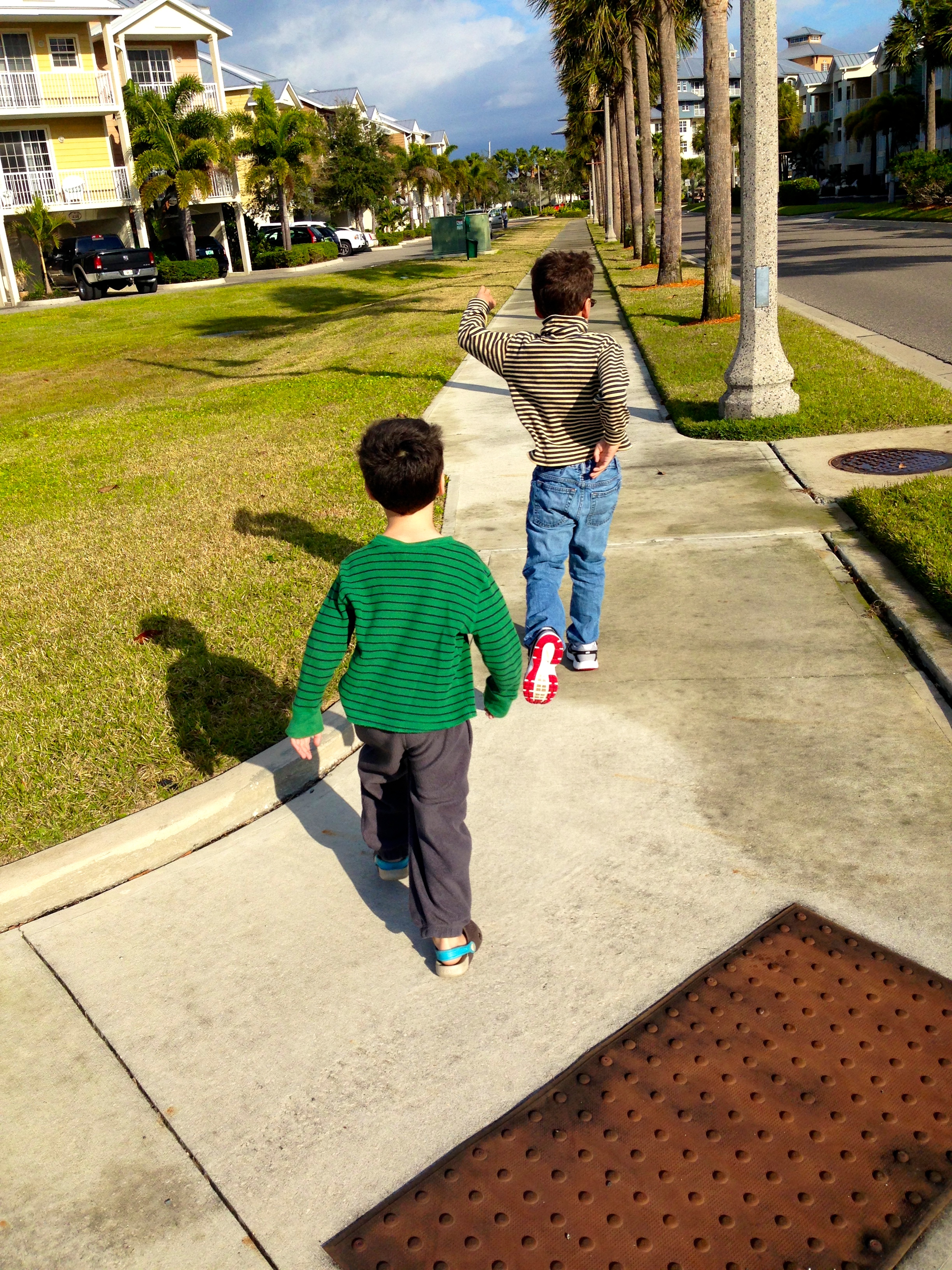
When he’s not twisted up, he’s like a perpetual motion machine—hopping, dancing, mock-battling, wrestling with his reluctant little sister. Dinner is always difficult for him. He’s usually the first one out of his seat (within three to five minutes), running around or hopping up and down. Even taking a walk can be an exercise (sic) in unique movement.

A Fun Walk

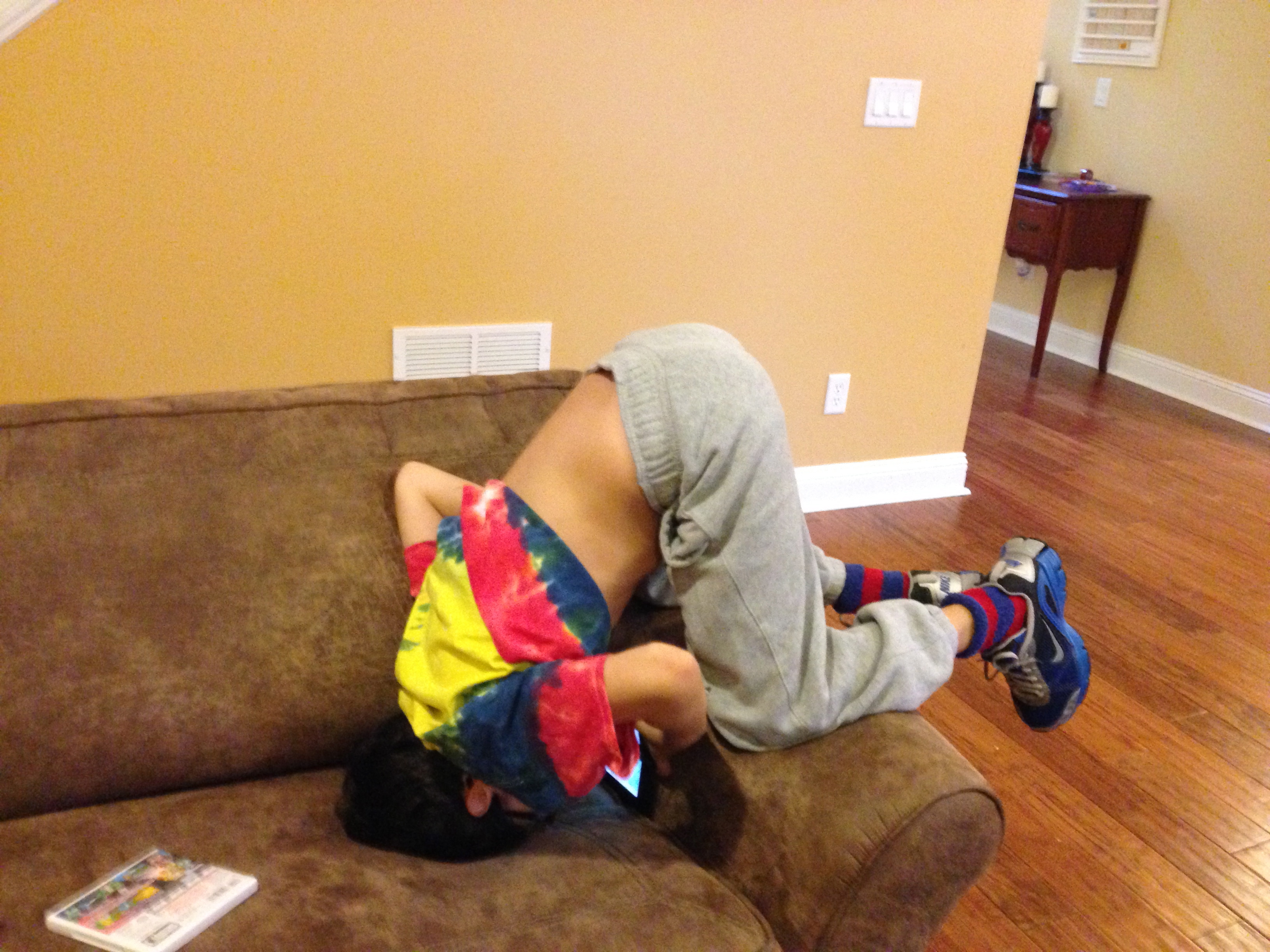
He’s not the only one, either. His next-oldest brother is very much the same way:

Upside Down Buddy

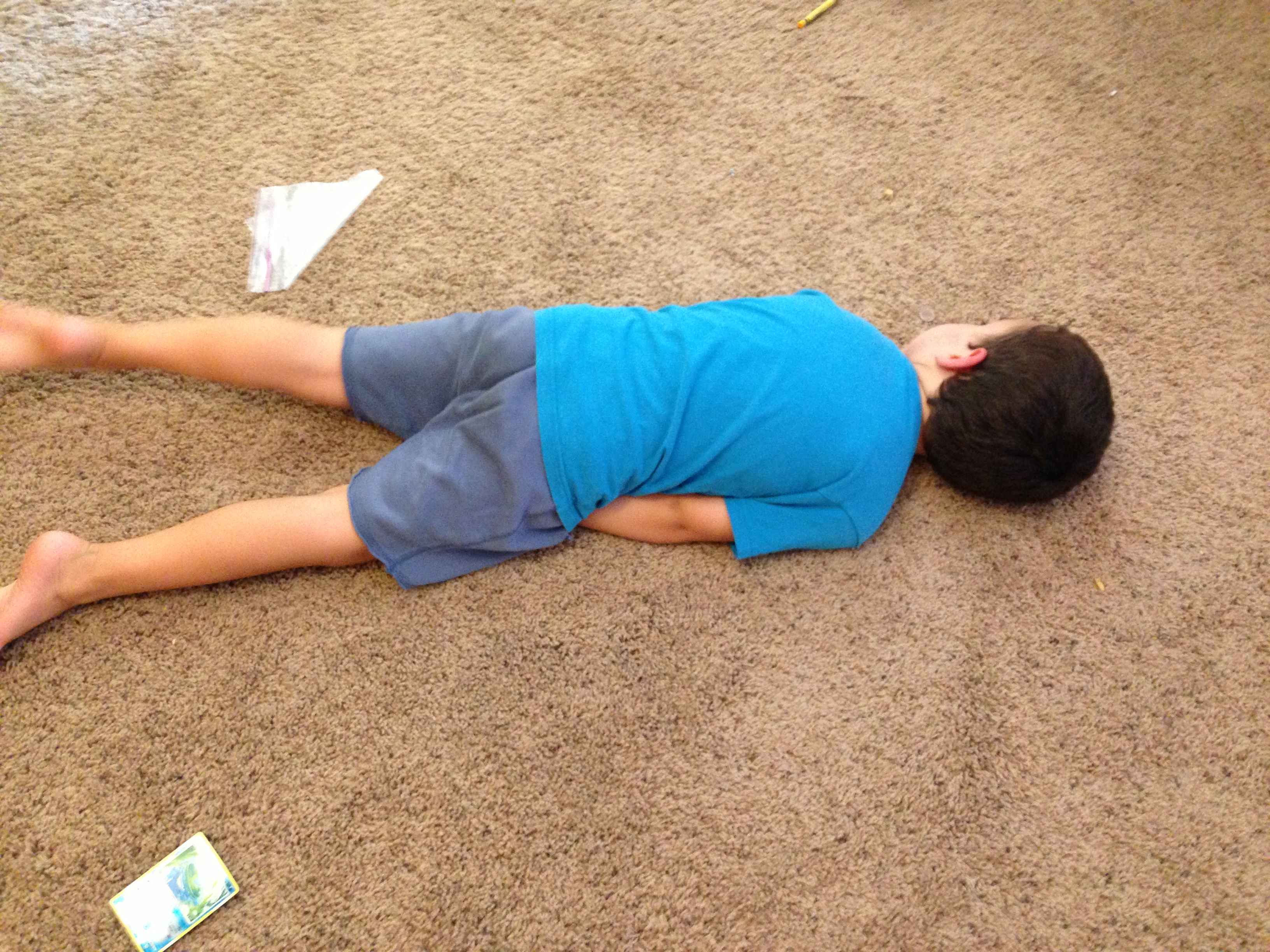
Now, this is a marked contrast to his younger brother who will, at odd times, simply plank.

Plank BoyKatie and I think he does this as a coping mechanism when he gets overwhelmed. He just shuts down for a few minutes, presses his internal reset button, and then he’s back at it again. He’s just as hyperactive as his brothers, but he has a different way of dealing with overstimulation.

Funny enough, though, if you put any of these kids in front of a computer on Minecraft, they can sit still, absorbed, for hours. They may be at odd angles again, but they’re still.

Isaac Newton Explains.

So what’s going on?

Katie and I think it’s related to something called Intense World Theory. Pioneered by a pair of neuroscientists in Switzerland, Intense World Theory posits that people with autism are hyper-aware of everything going on around them and within them. ASD folks feel everything so intensely—both physical and emotional—that their attempts to compensate need to be just as intense. It’s like an autistic version of Newton’s Third Law of Motion: For every action, there has to be an equal and opposite reaction.

So our armchair contortionists are merely reacting bodily to the busyness around them and in their minds. Their world is so intense and so full that they react to it in a similarly intense, involved way. Or it’s so intense that they need to shut it out at times, as our little one does, so that they can press their internal Reset button.

This also explains their ability to become so absorbed in the world of video games. It can be very loud and frenetic, but it is also limited and contained. Just a small screen (okay, small-ish) that they can turn on or off. And as noisy as it is, it’s also pretty predictable. So there’s an element of safety and comfort there. Of course, engaging in the virtual world doesn’t really help them get out their pent up energy. It only helps them suppress the need for it and, therefore, suppress their need to (over)react to it.

It’s Just Too Much!

All this can be kind of cute, but there’s another, more troubling, side to it.

Take my oldest son, for instance. He likes to go to Teen Gamers, a monthly gathering of middle- and high-school students hosted by the local library. It’s a place where kids can hang out, play video games, and have pizza, all under adult supervision. I don’t mind that it’s all about video games. Considering his social anxiety, it’s a golden opportunity for him to expand his social circle.

But as much as he enjoys himself there, as soon as he comes home, he hurries up to his bedroom and spends the next couple of hours in virtual seclusion. The same can happen after a long day at school or after we all go somewhere as a family. In fact, after just about any situation where he is out of his comfort zone, the boy high tails it to his room, turns off the lights, and burrows under the covers with his 3DS or his iPod Touch. The outside world is too much for him to handle, and he needs time to decompress.

Something similar happens with my older daughter, although with her, the reaction isn’t always delayed. She is just as likely to melt down right in the middle of a store or restaurant as she is to wait until we get home. That’s why we’ve come to expect her to spend a considerable amount of time in the bathroom at church on Sundays.

That’s how intense the world can be for these two. It can actually hurt to be engaged in it for too long.

Silly? Stubborn? Sullen?

I like this explanation a lot. It helps me see that my kids are not being antisocial—at least not on purpose. It also gives me some more insight into the way their brains are wired. And most important, it helps me adjust my plans and expectations.

I know, for instance, not to expect them to be able to handle a marathon day at Disney World. I should be happy to get three hours out of them—and that’s with one or two breaks so they can regroup. It also helps me understand what school is like for them. They spend six hours trying to maintain an ordered exterior while everything around them (and within them) feels like it’s set on overdrive. Of course they’re going to need some serious decompression when they come home—whether that means time on the trampoline or some mini-hibernation. There’s no way we should expect them to do anything productive like homework right away. And on days when there’s a lot of homework, we know we need to break it up into smaller chunks—or tell their teachers that they’ll finish it the next day.

Now, I know that they can’t expect this to go on forever. They’re going to have to find other ways to cope when things get too rough. There aren’t too many workplaces that have yoga mats or dimly-lit quiet rooms for decompression. And God help you if you take too many breaks! So we are trying to teach them how to increase their tolerance and find other, less obvious, ways to deal with all that frustration and overstimulation. It’s all part of living with ASD. They’re not being silly or stubborn or sullen. They’re just trying to survive.

Dissecting a Victory

So today was the big day. We had our eligibility meeting at the school to determine if our fourth child, a third-grader, qualified as being on the autism spectrum according to the school district’s definitions. And I’m happy to report that the IEP team (consisting of the school psychologist, the speech therapist, our son’s teacher, the assistant principal, our private psychologist, and Katie and me) all agreed that he met the district’s criteria for being identified as ASD.

A Good Day.

On one level, not much has changed as a result of this new designation. He is still receiving the same services he received under his previous designation as “Language Impaired.” We’ll revisit his Individualized Education Plan later in the school year to see if he needs more help than he’s currently receiving.

But having him identified as being on the autism spectrum is also a safeguard for the future. Should things go downhill for him in the social/emotional sphere, as it has done for our older daughter, school officials will know that part of it is because he has autism. And that will alter the way they intervene and how they will help him.

Should he run into further glitches in his auditory processing, his short-term memory, or his ability to adapt to new surroundings (like changing classes in middle school), it will be that much easier for accommodations to be put in place to help him.

And since kids on the autism spectrum tend to be literal thinkers, it will be easier for him to access special-ed helps as the curriculum begins to demand more inferential thinking and not just rote memory or quick calculations. He can learn these skills, but he’s probably going to need more help in making the jump from the literal to the figurative.

So this was a good day. It was a long time coming, too—the fruit of a couple of very tense preliminary meetings and hours and hours of preparation on our part. It came after we had to challenge the previous assistant principal’s thinly-veiled insinuations that we didn’t know what we were talking about and that she was the real expert in autism. It came after a couple of years of seeing his school-related melt downs increase in frequency and intensity. And it came on the heels of two similarly long-fought victories for his older brother and sister. That makes us three for three. Quite a lot to celebrate, don’t you think?

Walking a Rocky Road.

So why, as Katie and I left the meeting with our son’s new designation in hand, did I not hoot and holler in victory? Why was there a lump in my throat instead of a smile on my face?

Because my son still has autism. Because yet another official organization has recognized—and thus reminded me—that he has a disability that will impair him for the rest of his life.

Don’t get me wrong. I’m glad for what we did. It’s going to protect our boy through his entire educational career. It’s going to open the door to a set of services and accommodations that will help him learn how to live in this strange world filled with neurotypical people.

But I know that through that door lies a path of misconceptions and of challenges that I wish he would never have to face. A path where potential friends may not understand him and may even reject him.

A path where potential employers may not see the gifts he has to offer.

A path where the joys and comforts of a family of his own may be forever elusive.

It’s a rougher, rockier path than most of his peers will be walking. And that’s never a fun thing to think about.

A Sobering Reminder.

We got a stark illustration of this just a few hours after that all-important IEP meeting. Katie called me at work to let me know that our boy had had a rough day at school. Because he didn’t complete a homework assignment over the weekend (we thought he had), he received a 40% grade.

It wasn’t a huge assignment, and it wasn’t a big deal. But in his literal brain, it was a complete and total failure. He came off the bus with his fists clenched, his brow furrowed, and his jaw trembling in a heartbreaking mix of anger and shame. Katie tried to help him work through it, but the rest of the afternoon was a complete loss: melt downs over new homework, high-pitched tantrums at his “annoying” younger brother, and anxious, hyperactive “stimming” that was so intense that I was afraid he might hurt himself.

He did calm down eventually, and we got his homework done. In fact, once he got all his frustration and anxiety out, he sailed through most of the work. He’s a pretty smart kid, after all. He just needed to expend himself before he could get his brain back in gear.

So this is the challenge he will be facing—and Katie and me along with him: how to manage the down side of his autism so that all his gifts and talents can shine. Because he really is a sweet, innocent, affectionate, intelligent, perceptive fellow. He has so much to offer. There is so much he can accomplish. He has the potential to enrich the lives of countless people. He just needs more help than most in getting there. He may have some serious glitches, but he’s an awesome kid. I just want everyone else to be able to see that.

It’s our hope that today’s “victory” will help this happen.

Leo Zanchettin, Prosecuting Attorney

VinnyWell, it’s that time of the year again—the beginning of school and its attendant Rite of Introduction. That’s when you get to meet your kids’ teachers and size them up. Are they the type who live solely by the rules and standardized tests? Are they the kind who have high expectations for their students (a good thing), but don’t know how to help their exceptional students meet those expectations (a not so good thing)? Are they the kind who will look at you like you have two heads when you tell them that your child has an autism spectrum disorder? Will they be quick to respond to your e-mails and questions? Or will you have to pry it out of them?

It’s also the season for IEP meetings. Those wonderful exercises in diplomacy, tact, and tongue-biting. Those opportunities to do penance for your past sins and to try mightily to avoid any future sins.

A Successful Pre-Trial Hearing.

I’ve been thinking about IEP meetings a lot recently, because we have a big one coming up in a couple of weeks. It’s for our fourth child, who is entering third grade this year. Last February, we had a pretty tense gathering with his IEP team at school, when we requested that he be tested and formally recognized as being on the autism spectrum. After a ninety-minute “discussion” on the issue, Katie and I prevailed, and the process of testing him was put into motion.

To this day, I don’t know what turned the tables. For the first hour, I was sure we were going to be denied. But then out of nowhere, the assistant principal began passing out consent forms. Katie thinks it had something to do with the fact that I used the word “irresponsible” in describing the administration’s response to my son’s needs, but I’m still not convinced.

Anyway, the school took all the time it could in conducting the tests, so we couldn’t meet before the end of the school year to discuss the test results. So now we are gearing up for the very important get together, when the school will either agree with us and formally designate him as needing ASD services, or they will give some new variation on the standard line: “he seems fine to us.”

I’m not too worried this time. We’ve got enough evidence from the school’s own testing as well as diagnoses from our therapists to win the day. Granted, schools can be pretty clever when it comes to finding a way out of these things. But we’re getting familiar with the tactics and are learning how to counter them. This is, after all, the third time we’ve been down this road.

I Hate It.

But here’s the thing. I hate these meetings. And not primarily because I have to deal with a skeptical, reluctant team of educators and administrators. What I hate more is the fact that I have to convince them. I have to take them by the hand and walk them through our all the aspects of our son’s ASD.

I have to rehearse every “academically relevant” way in which his disorder manifests itself—including the melt downs over homework and the inability to read social cues and the sometimes tragic, sometimes comical things that come from this inability.

I have to become something of an NSA agent taping his conversations and culling through them to find the evidence of his uneven pragmatic language skills.

I have to pore over all of his testing data, highlighting every deficit so that I can show how it relates to his ASD and how it will affect his ability to move through the curriculum.

I have to give special emphasis to his challenges and deficits and defects (God, I hate that word). When a teacher says something like, “But he’s so cute and charming,” I get to agree, but I can’t dwell on his good qualities for too long. I have to get right back to his needs.

In other words, I have to build a case against my own son, sort of like the way a prosecuting attorney would build a case against a criminal. Because the school will hang on to any positive inkling about him and use it to deny him the services he needs.

That’s what I hate.

Because he’s such a good kid. He’s smart. He’s sensitive. He’s energetic. He’s loving and kind. He’s got the brightest light in his eyes and the liveliest spring to his step I’ve ever seen (yes, he’s a toe-walker). Here he is, my own flesh and blood, and I have the singular privilege of telling a group of low-level bureaucrats everything that’s “wrong” with him.

A Smile on My Face and a Pit in My Stomach.

What’s not to hate?

But we do it, as we’ve done for two of our other children. As we’ll likely have to do for two more. We do it because we want them to get the “free and appropriate public education” that is their right by law. We do it because we want them to be given a fair chance to learn and grow and develop and make a positive contribution in a world that can seem so alien to them. We do it because we love them too much to let them or their school think that just squeaking by is good enough.

So there I’ll be in a couple of weeks, patiently and carefully building a case against my own son. I’ll do it with a smile on my face and a pit in my stomach. And I’ll be praying the whole time that I not lose my cool. Because I want what any parent wants: the best for my kid.

A Whole Blue World

As many of you know, I reached my fundraising goal of $1,500.00 late last month. What a great feeling, both being able to raise so much and seeing the support that so many friends have given us. Every donation has been a moving testimony to Katie and me that we’re not alone in this journey.

But as inspiring as it has been to come this far, I believe we can go farther. I know there are still people out there who need just a little more encouragement—or a couple more reminders. There are still aunts and uncles, cousins and godparents, co-workers and neighbors, friends and even frenemies out there, just waiting for another invitation.

So here’s the new incentive. If I can get to the $2,000.00 level before the walk, I’ll dye my whole head blue. Yup—the entire cranium. All it takes is $500.00. That’s just $50.00 from 10 people. Or $100.00 from 5 people. Or $25.00 from 20 people. That’s not too hard to imagine, is it?

And if you do give, here’s how your donation will be put to work.

First, there’s Autism Speaks’ research program, which makes grants to pediatricians, geneticists, psychologists, neurologists, and other professionals delving into the causes and treatments of autism spectrum disorders. The program also includes the Autism Genetic Research Exchange (AGRE), which is building a comprehensive research database comprised of DNA, clinical, and medical information from families with two or more children on the autism spectrum. Needless to say, our family is a mother lode of information for them! We’ve been part of the AGRE project for the past three years, and it feels great knowing that we’re able to help.

There are also a number of online tool kits developed by Autism Speaks. The most popular is their 100 Day Kit, which was created for parents of newly-diagnosed children. Those first few months are often filled with anxiety and loads of questions, and this online tool offers expert guidance to help parents acclimate themselves to their new reality. Other tool kits give parents information concerning medication options, various behavioral treatments, and navigating challenging events like dental visits and potty training.

Next, there’s Autism Votes, the lobbying arm of Autism Speaks. The purpose of this group is to advocate for laws that will protect people on the spectrum. Some states still don’t require insurance companies to cover behavior therapy or speech and occupational therapies to people with an ASD diagnosis. Autism Votes is in these states, working to convince lawmakers that the upfront cost of these requirements is far less than the long-term costs of caring for people who never learned the skills they needed to help them function in the outside world. Autism Votes was also instrumental in getting the Combating Autism Reauthorization Act (CARA) through the House and Senate. This act secured nearly $700 million in federal dollars over three years for autism research, treatment, and services. It’s still not where it should be, but at least there’s movement.

See how much good you’ll be doing if you make a pledge? It’s not about making me dye my hair blue; it’s about helping to improve the lives of families touched by ASD. It’s about figuring out what causes this thing in the first place. It’s about making the world a more welcoming place for folks on the spectrum. So if you haven’t made a donation yet, go ahead. Push me over the $2,000.00 mark. You can help make a difference in so many lives. And if you’ve already donated, thank you so much. You’ve already made a huge difference!